Skip to content
powderbulkvideos.com
Menu

powderbulkvideos.com knowledge hub

Powder and Bulk Solids Industries

In brief

The machines repeat across industries. The rules around them do not.

Each industry page explains what governs design in that sector, which materials dominate, and where the usual solutions have to be adapted.

  • Food and pharma are governed by what can be cleaned and documented.
  • Cement, mining and energy are governed by wear, scale and weather.
  • Every sector with an organic or metal dust is governed by explosion protection.

Browse industries

18 published

Editorial illustration of enclosed metal powder handling equipment beside an additive manufacturing system

Industry

Additive Manufacturing Powders

AM powder handling has one job: return powder to the machine in a known state.

That means preserving feedstock identity, particle-size distribution, and cleanliness through every transfer, recovery, and reuse step — while controlling worker exposure and ignition hazards along the way.

Explore
Photorealistic industrial process installation representing Agriculture.

Industry

Agriculture

Agricultural bulk handling moves and stores grain, feed ingredients, seed and meal whose properties change with crop, harvest condition and storage history.

A sound system controls breakage, segregation, spoilage, dust, ignition sources and worker access to bins, and it treats seasonal material variation as part of the capacity basis.

Explore
Photorealistic industrial process installation representing Battery Production.

Industry

Battery Production

Battery production runs on tightly controlled powder operations, from receiving and dosing through mixing and coating preparation.

Material identity, particle properties, moisture, contamination, worker exposure and traceability all need active management.

Explore
Editorial illustration of wood chips and pellets moving through bulk handling equipment in a biomass processing plant

Industry

Biomass & Bioenergy Feedstock Processing

Biomass feedstock systems turn seasonal, low-density and variable material into a stable reactor feed.

That means managing moisture, degradation, dust and fire risk while accounting for the energy consumed by drying, size reduction and densification.

Explore
Photorealistic industrial process installation representing Building Materials.

Industry

Building Materials

Building materials production converts minerals, binders and additives through crushing, screening, drying, grinding, classification, blending, storage and packing.

Equipment selection must handle abrasion, moisture, dust, product grading and the high transfer rates typical of cement, aggregate, lime, clay and dry-mix plants.

Explore
Photorealistic industrial process installation representing Cement and Aggregates.

Industry

Cement and Aggregates

Cement and aggregate plants connect crushing, screening, storage, grinding, classification and dispatch into one dependent chain.

Reliable design starts with feed variability, required product grading, abrasion, moisture and dust — and with how each unit affects the next process step.

Explore
Closed big-bag discharge station charging a reactor in a chemical plant

Industry

Chemicals

Chemical plants move powders such as pigments, resins, catalysts, fillers and specialty additives through closed transfer, batching and blending systems.

Selection is governed by containment of hazardous materials, compatibility with aggressive products, combustible-dust safety under NFPA 652/OSHA enforcement and reproducible batch accuracy.

Explore
Generic editorial illustration of hygienic powder handling equipment in cosmetics manufacturing

Industry

Cosmetics

Cosmetics powder handling has to deliver the correct ingredient and dose without cross-contamination, dust exposure or loss of batch traceability.

Cleaning and changeover must stay compatible with the finished-product safety system.

Explore
Generic editorial illustration of bulk-material handling equipment at an energy and power facility

Industry

Energy & Power

Power generation bulk solids systems must deliver fuel and sorbents at a controlled rate and remove ash and residues reliably as load changes.

That means keeping control of dust, hot material, fire risk and every emissions-related interface across the full operating range.

Explore
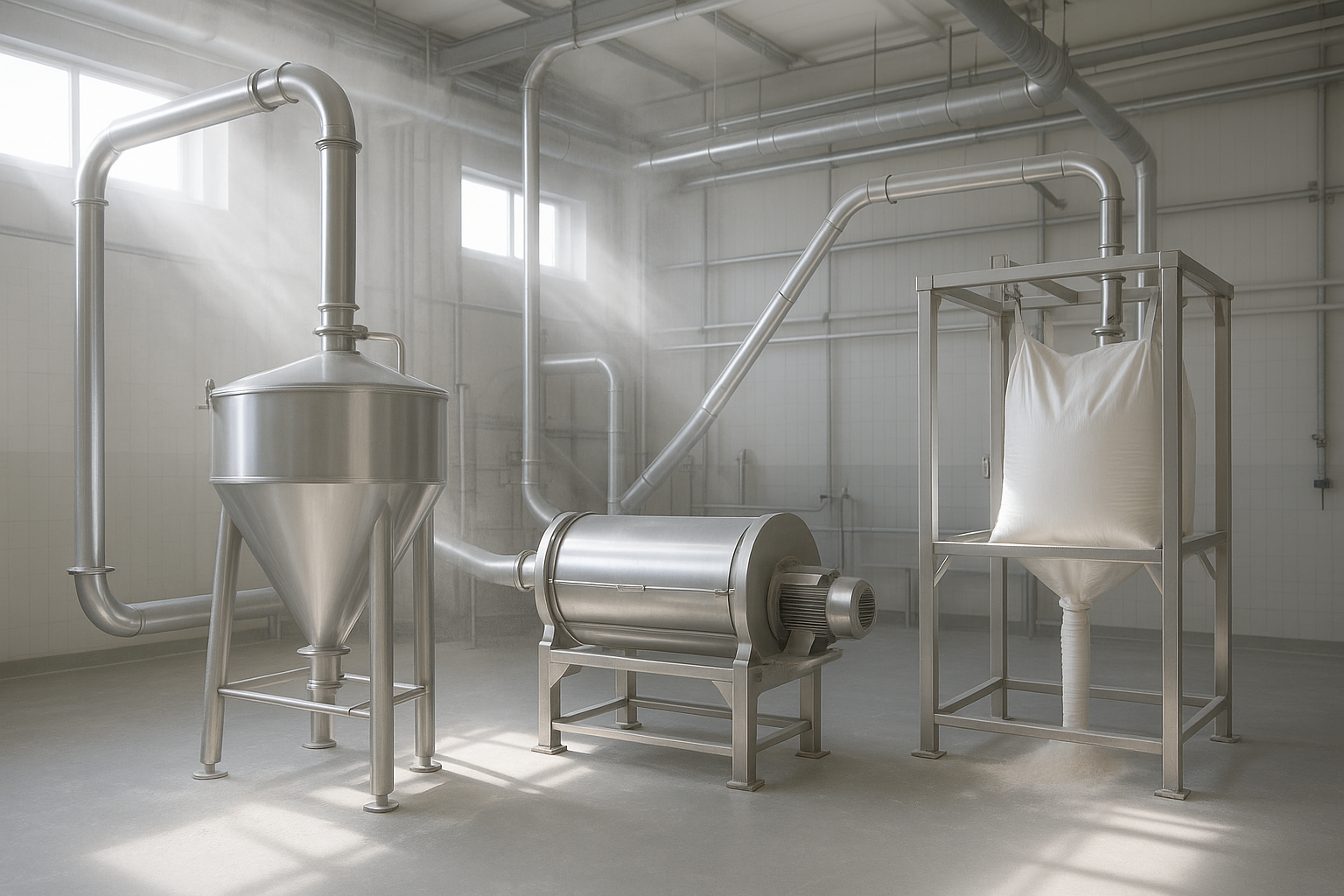
Stainless steel powder handling line with sifter and bulk bag unloader in a food plant

Industry

Food & Beverage

Food and beverage plants handle powders such as flour, sugar, starch, dairy powders and functional ingredients through closed, cleanable transfer systems.

Equipment selection is driven by hygienic design, allergen and cross-contact control, combustible dust safety and verifiable cleaning — not by throughput alone.

Explore
Generic editorial illustration of mineral batching and bulk-material handling equipment in glass manufacturing

Industry

Glass Manufacturing

Glass batch handling has to deliver silica sand, soda ash, limestone, cullet, and minor ingredients to the furnace in the intended proportions.

That means weighing accurately, mixing well, and then protecting the blend from segregation, dust release, and contamination on its way to the charger.

Explore
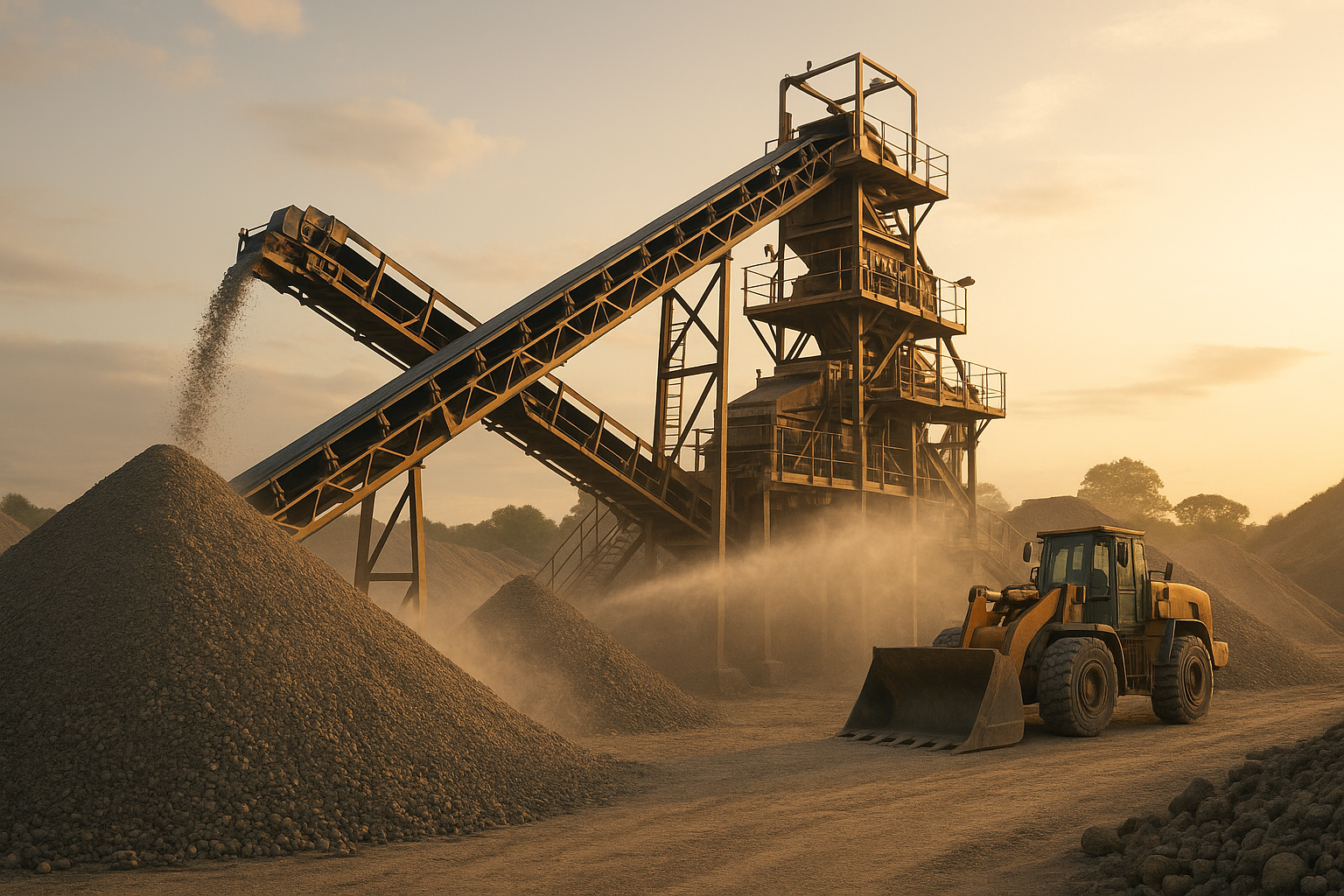
Belt conveyor and screening tower with ore stockpiles at a mineral processing site

Industry

Mining & Mineral

Mining and mineral processing reduces run-of-mine ore to sized, concentrated products through crushing, screening, grinding, classification and materials handling at large scale.

Equipment selection is dominated by abrasion resistance, availability under continuous duty, dust control and the safe storage and reclaim of coarse and fine bulk materials.

Explore
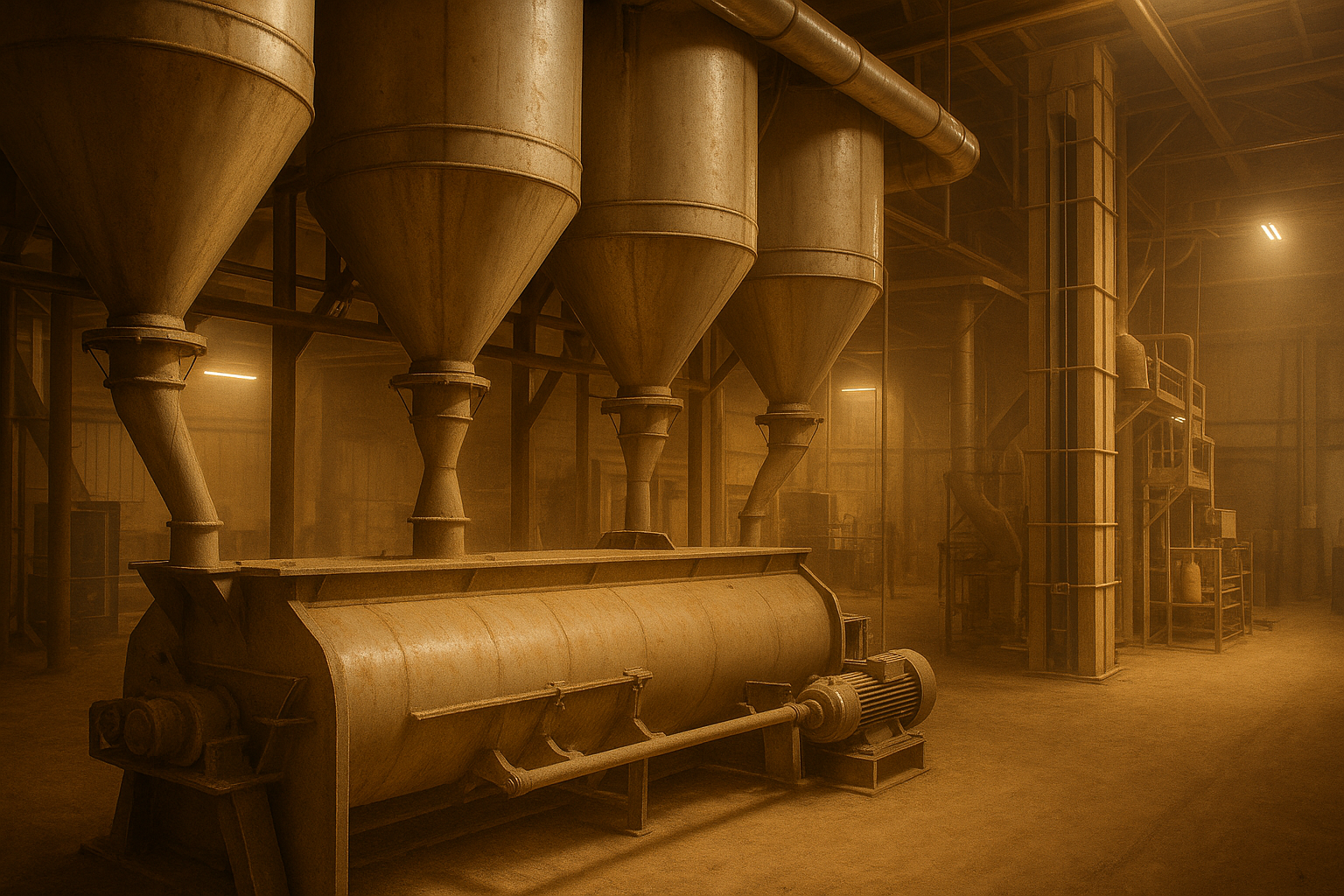
Batching hoppers and paddle mixer inside an animal feed mill

Industry

Pet Food

Pet food and animal feed plants convert grains, meals, vitamins and minerals into uniform, safe rations through grinding, batching, mixing and thermal processing.

Handling systems are selected for accurate micro-ingredient dosing, cross-contamination control between species and recipes, combustible dust safety and FSMA-grade traceability.

Explore
Generic editorial illustration of enclosed bulk-solids handling equipment in a petrochemical facility

Industry

Petrochemicals

Petrochemical bulk-solids systems receive, store, convey and dose resins, additives and catalysts connected to hazardous chemical processes.

The core duties are preserving grade identity, controlling dust, electrostatic ignition and contamination, and treating every solids interface as part of the process-safety boundary.

Explore
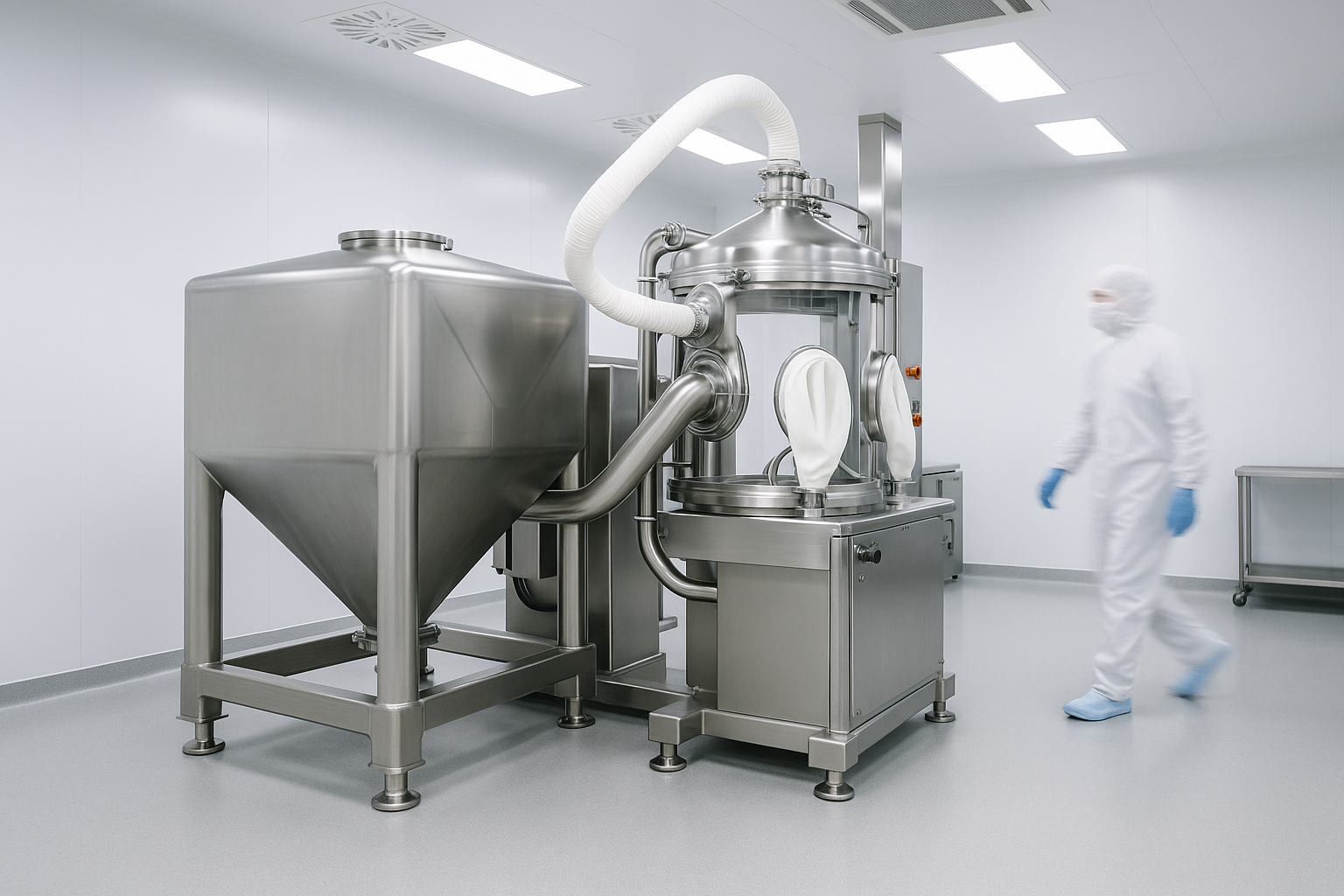
Contained IBC blending and powder transfer station in a pharmaceutical cleanroom

Industry

Pharmaceuticals

Pharmaceutical solid-dose production transfers APIs and excipients through closed, GMP-compliant systems that protect the product, the operator and the environment.

Selection is driven by containment performance for potent compounds, validated cleaning, blend uniformity and full batch documentation under FDA cGMP and EU GMP.

Explore
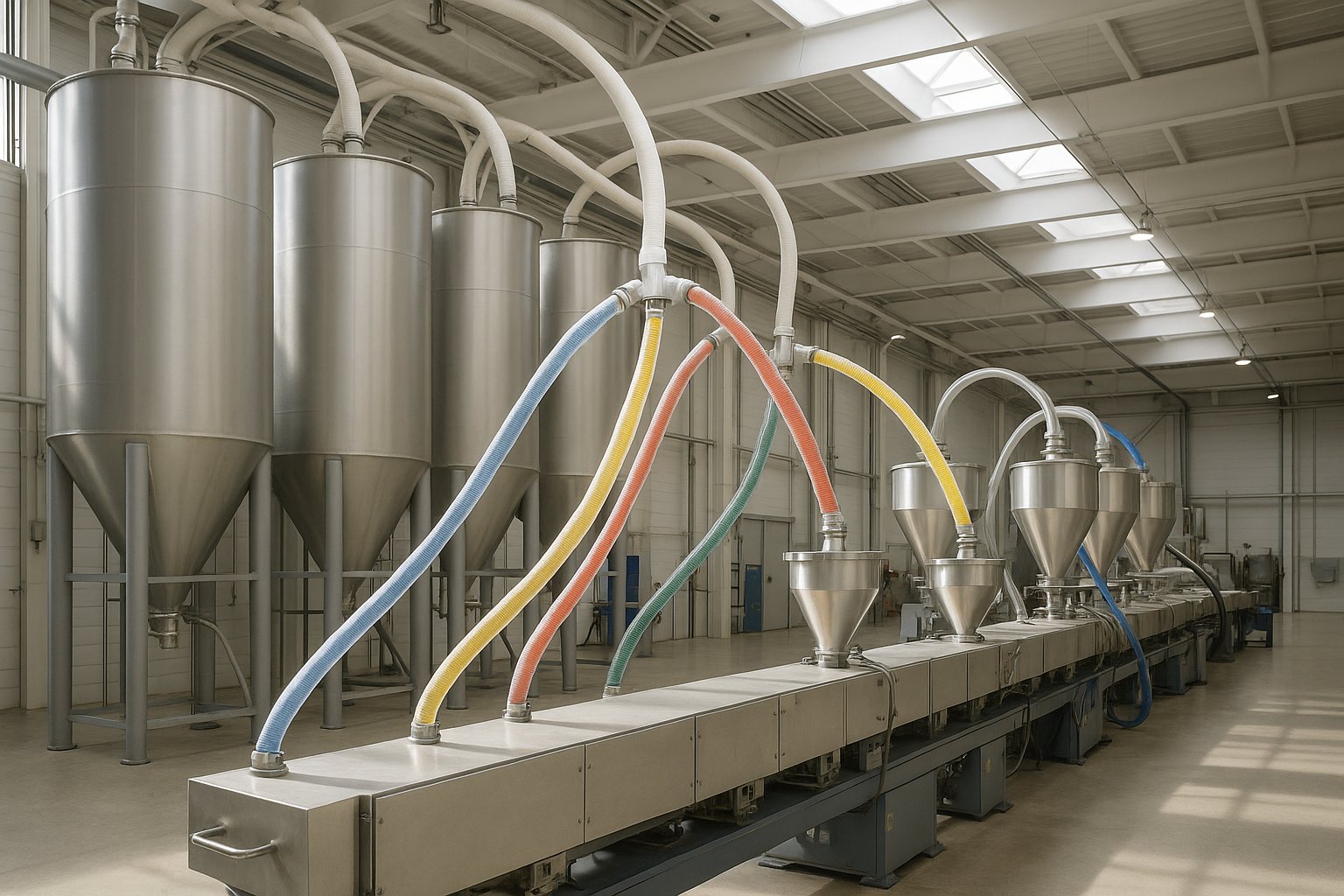
Resin silos and pneumatic conveying lines feeding extruder hoppers in a plastics plant

Industry

Plastics

Plastics processing moves polymer pellets, regrind, powders and additives from silos and bulk bags to dryers, blenders and processing machines.

System selection balances gentle conveying that limits dust and streamers, moisture control for hygroscopic resins, accurate additive dosing and contamination-free material changes.

Explore
Generic editorial illustration of fibrous and powder additive handling equipment in a pulp and paper mill

Industry

Pulp & Paper

Pulp and paper mills handle wood chips, bark, recovered fiber, starch, fillers, lime and ash — streams too different for one generic silo or conveyor specification.

Fibrous materials interlock and arch, while mineral additives bring dust, wear and moisture problems, so each stream needs its own measured design basis.

Explore
Editorial illustration of conveying, sorting and size-reduction equipment in a recycling and waste processing plant

Industry

Recycling

Recycling and waste-processing systems turn variable incoming material into defined, marketable fractions.

The hard part is doing it while controlling contaminants, fires, dust and equipment damage — and while changes in the feed stream keep pushing product quality off target.

Explore

About industries

Why the industry changes the answer

Bulk bag discharge is one job. In a dairy it is a hygiene problem, in a cement works a wear problem, in a pharmaceutical plant a containment problem.

The frame is identical, the bag is identical, and the specification is not. These pages describe what each sector adds to the base design.

What governs where

Food and beverage

Cleaning drives the geometry. Surfaces have to be reachable, joints have to be inspectable, and the time available for a changeover is part of the design, not an operational detail.

Allergen segregation decides whether a line can be shared at all. Conveying air becomes an ingredient: its moisture, filtration and oil content belong in the specification.

Pharmaceuticals

Containment and evidence. The question is not only whether the transfer works but whether the exposure can be demonstrated and the cleaning validated.

This is why vacuum dominates over pressure: a vacuum line that leaks draws air in instead of pushing powder out. The containment-critical components are the receiver filter and the discharge valve, and they are specified with measured performance rather than a description.

Chemicals and petrochemicals

Variety and hazard. One plant may handle a free-flowing granule and a corrosive, hygroscopic powder in the same week, with area classification and material compatibility deciding the equipment.

Cement, building materials and aggregates

Wear and scale. Fine abrasive mineral destroys bends, valve seats and screw flights, and the velocity chosen on day one is the wear bill for the next decade.

Moisture is a process variable rather than a nuisance: hydraulic binders react with it, so dried conveying air is a requirement, not a comfort.

Mining and minerals

Outdoor conditions, long distances, large tonnages, and respirable crystalline silica wherever the rock contains quartz. Dust suppression at transfer points is part of the process design, not an addition.

Plastics

Gentle transfer and contamination control. Pellets create streamers and angel hair when they are conveyed too fast against a wall, and a single contaminated batch can stop a compounding line for a shift.

Agriculture, feed and grain

Dust and ignition sources in combination with large volumes and seasonal peaks. Grain handling has its own regulatory history, written after dust explosions in elevators, and the design reflects it.

Energy, biomass and battery production

Two ends of a spectrum. Fuel handling is about large volumes, abrasion, weather and self-heating. Battery material production is about contamination control and containment, with toxic and reactive powders in small quantities and high value.

What stays the same everywhere

Three things do not change with the sector.

  • Material properties govern. The flow function, the abrasiveness and the dust behaviour do not know which industry they are in.
  • The interfaces decide the result. Most installation problems live between two machines, not inside one.
  • Protection follows the dust, not the brochure. If a dust is explosible, the sector does not change that, only the paperwork around it.

How to use an industry page

Start here when you know the plant but not yet the equipment. Each page names the dominant materials, the usual equipment chain, the constraints that are specific to the sector and the regulatory context that shapes them.

From there, the links lead into the applications that make up a line and the technologies that build them.

The regulatory context in short

Each sector carries a framework that shapes the design long before a supplier is chosen. The pages name the specific requirements; the pattern is the same everywhere.

  • Food: hazard analysis and preventive controls, cleaning validation, allergen management, material compatibility for food contact.
  • Pharmaceuticals: good manufacturing practice, qualification of equipment and methods, containment bands set by occupational exposure limits.
  • Combustible dust: hazard assessment, housekeeping, ignition source control, venting, isolation and inspection, wherever an explosible dust exists.
  • Mining and minerals: exposure limits for respirable crystalline silica, which decide capture and suppression at every transfer point.
  • Emissions: particulate limits that decide filter type and monitoring on anything vented to atmosphere.

What changes when a sector adopts another sector's method

The most useful transfers between industries are usually methods, not machines.

Battery material production took containment from pharmaceuticals, because it handles toxic powders in small quantities. Food plants took sampling discipline from pharmaceuticals when allergen control became enforceable. Cement terminals took dust suppression from mining.

When a sector page mentions an approach that is standard elsewhere, that is deliberate: the equipment already exists and the first installation is rarely the development project it is assumed to be.

Where sectors get each other wrong

Two assumptions travel badly between industries, and both are expensive.

The first is that a hygienic design is automatically a contained design. It is not. Hygiene protects the product from the plant; containment protects people from the product. A beautifully cleanable open transfer can expose an operator to a potent compound.

The second is that a design which works in a dry climate works anywhere. Hygroscopic materials behave according to the humidity in the building, and a line commissioned in February can behave differently in August.

Scale changes the problem, not only the size

A plant handling two hundred kilograms a day and one handling two hundred tonnes an hour do not use the same solution scaled up.

  • At small scale, manual handling and containment dominate, and the question is exposure and cleaning.
  • At medium scale, the question becomes automation, dust capture and keeping tolerance across a batch.
  • At large scale, it becomes wear, continuous operation, storage and the weather.

Each industry page says where on that range the sector usually sits, because it determines which of the available answers are worth considering at all.

Frequently asked questions

Does equipment have to be different in each industry?
Often it is the same machine with a different specification: material of construction, surface finish, sealing concept, cleaning access and documentation. Occasionally the industry rules out a type entirely, such as pressure conveying where containment is required.
Which industries are governed by explosion protection?
Any sector that handles an explosible dust, which includes food, feed, grain, plastics, pharmaceuticals, wood, metal powders and many chemicals. The protection concept follows the measured dust properties, not the sector name.
Where do hygiene and containment differ?
Hygiene protects the product from the plant and the environment. Containment protects people and the environment from the product. They often use similar closed designs for opposite reasons, and a design built for one does not automatically satisfy the other.

Partner with powderbulkvideos.com

Put your technical expertise in front of engineers who are already researching.

Build a connected company, video and technology presence with clearly labelled partner visibility and measurable placement performance.