
Industry
Pharmaceuticals
Answer in brief
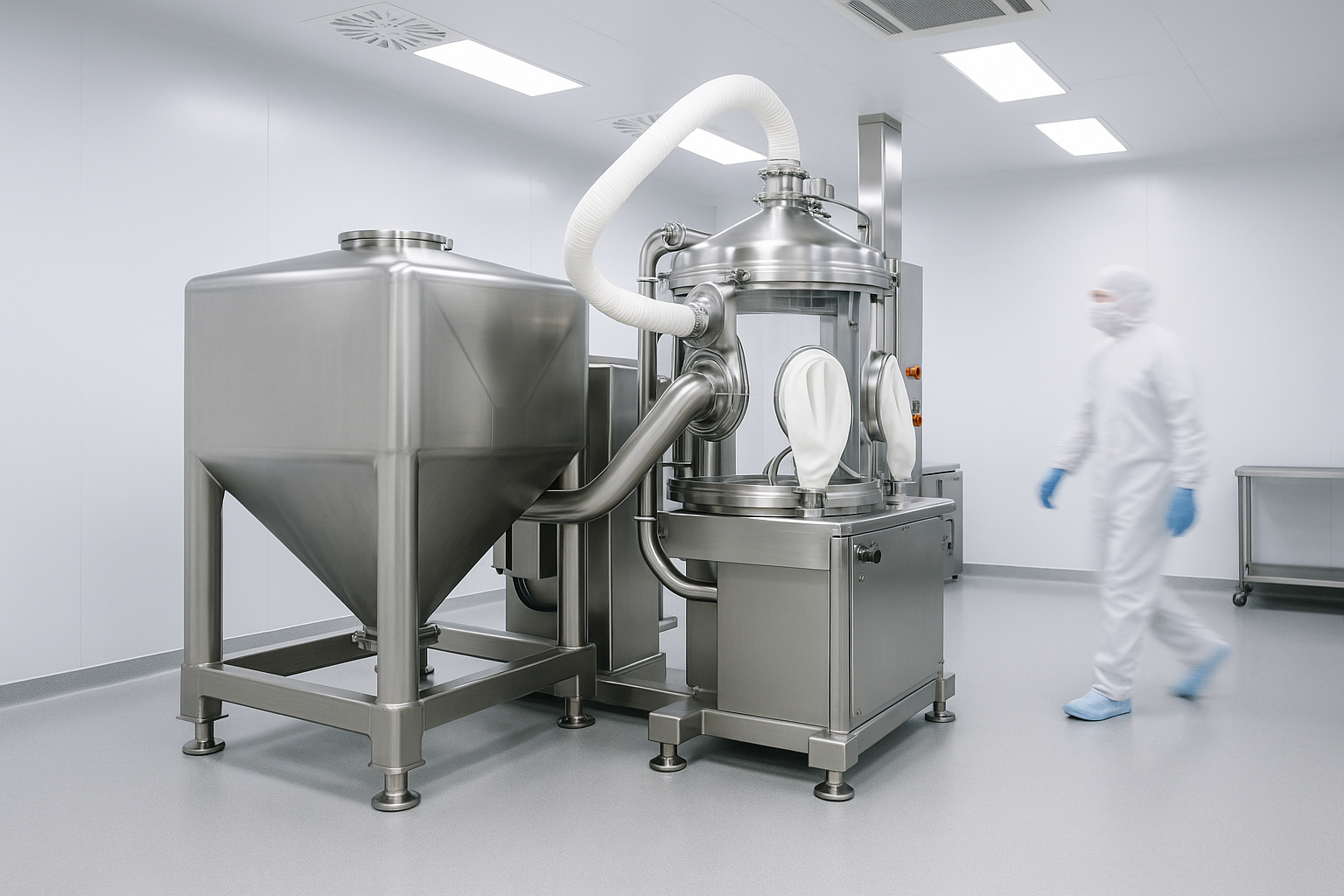
Pharmaceutical solid-dose production transfers APIs and excipients through closed, GMP-compliant systems that protect the product, the operator and the environment. Selection is driven by containment performance for potent compounds, validated cleaning, blend uniformity and full batch documentation under FDA cGMP and EU GMP.
Reviewed August 13, 2026 · Updated October 11, 2026
Sponsored visibility
Featured Pharmaceuticals videos
Paid placements are clearly marked and remain separate from the editorial related-video selection.
Process challenges
Material challenges
Hygiene requirements
Safety requirements
Regulatory context
Partner with powderbulkvideos.com
Put a relevant technical solution in this decision path.
Connect your company and video evidence with clearly labelled visibility where engineers evaluate this material, application, industry or product.
Related content
Continue exploring
Move from this page to the companies, videos and technical topics that add useful context.
Companies


Videos

Gericke AG
Double Shaft Mixer GMS 5000 ECD Multiflux
Gericke presents the GMS 5000 Multiflux double-shaft mixer in a powder-mixing and hygienic-design context.
Total reach: 40,852

Gericke AG
Gericke: GFS Formulation Skid and Tablet Press
This video presents the Gericke Formulation Skid (GFS) combined with a tablet press, showing how pharmaceutical formulations move from blending through downstream processing in one controlled, scalable setup. The system runs semi-continuously or fully continuously and targets development, scale-up, and technology transfer.
Total reach: 3,741

Gericke AG
Gericke: GUC-F Feeding and Dosing Controller
This video presents the Gericke GUC-F Feeding and Dosing Controller, a multi-channel control system designed for precise feeding, dosing, and weighing tasks in powder and bulk solids processing. The controller supports demanding process requirements across a wide range of industries where accuracy, reproducibility, and process transparency matter.
Total reach: 3,532

Hecht Technologie GmbH
HECHT Technologie: Pfizer HighCon Factory
HECHT documents a high-containment powder-handling project at Pfizer, showing contained transfer interfaces and the surrounding production context for pharmaceutical powder handling.
Total reach: 25,420

Hecht Technologie GmbH
HECHT: Containment Sampling Stick – Closed Sampling up to OEB 5
HECHT presents the handling sequence for its CPS disposable containment sampling system.
Total reach: 27,043

HS Umformtechnik GmbH
HS Umformtechnik Company Video
HS Umformtechnik presents large-radius pipe bends, pipe couplings and branch pipes for pneumatic conveying systems.
Total reach: 6,271

Gericke AG
Nibbler and Deagglomerator Gericke GNB
Gericke's video explains the operating and cleaning concept of the GNB coarse grinder and deagglomerator: a low-speed paddle-and-screen arrangement works lumps down to size, and the unit opens for inspection. Particle size, capacity, heat input and wear still require representative material testing.
Total reach: 3,156

REMBE® GmbH Safety+Control
REMBE®: Authorized Servicepartner
REMBE® presents its Authorized Partner Program: certified on-site service partners for pressure relief, trained in seminars on rupture disc types, application limits, signaling and safe assembly.
Total reach: 6,028