
Independent industry shortlist for Mixers & Blenders
Top Mixing and Blending Systems for Bulk Powders
Answer in brief
Gericke, Hosokawa Solids Solutions, and Dec Group lead this shortlist of mixing and blending systems for powders, granules, and pastes.
Gericke covers double-shaft batch mixing with up to 16 cycles per hour in 40 to 4,000 liter batches and continuous mixing from 1 kg/h to 100 t/h. Hosokawa offers conical screw, ribbon screw, conical paddle, and high-shear mixers from laboratory size to 100,000 liters.
Dec Group's PTS Batchmixer blends in a closed vessel without moving parts and is CIP/SIP cleanable.
The right machine depends on matching a convective, diffusive, or shear-dominated mixing principle to your material and the tolerance the downstream process demands.
By Editorial Team · Published August 29, 2026 · Updated October 8, 2026
How we selected these companies
ShowHide
We compared mixing and blending suppliers for dry powders, granules, and pastes on five technical areas that decide whether a mixer fits a duty.
- Mixing principles and product range (30%) looks at how many distinct mixer lines and working principles a supplier offers, such as double-shaft fluidized-zone, ploughshare, conical screw, ribbon screw, high-shear, continuous, or pneumatic mixing.
- Mixing performance (25%) covers throughput, batch volume, cycle rate, mixing time, tool speeds, and the homogeneity and blend ratio a mixer reaches, because these figures decide whether the machine meets the tolerance of the downstream process.
- Hygienic design and explosion safety (20%) covers CIP/SIP and dry-cleaning design, containment, explosion-safety categories, inert or pressure-rated operation, and food or pharmaceutical contact compliance of the mixer itself.
- Applications and pilot-scale work (15%) covers test centers, the trial scale available there, and applications in which the mixer has run real products.
- Laboratory-to-production scale range (10%) covers the span from laboratory or pilot units to full production sizes, which matters when a formulation has to be scaled up on the same principle.
It carries the most weight because the first step in any selection is matching a convective, diffusive, or shear-dominated principle to the material. Wet high-shear and liquid mixing, including dough and cosmetics mixers, was not compared.
Mixing principles and product range 30%
The distinct mixer lines and working principles on offer, such as double-shaft fluidized-zone, ploughshare, conical screw, ribbon screw, high-shear, continuous, or pneumatic mixing.
Mixing performance 25%
Throughput, batch volume, cycle rate, mixing time, tool speeds, and the homogeneity and blend ratio a mixer reaches.
Hygienic design and explosion safety 20%
CIP/SIP and dry-cleaning design, containment, explosion-safety categories, inert or pressure-rated operation, and food or pharmaceutical contact compliance of the mixer itself.
Applications and pilot-scale work 15%
Test centers and the trial scale available there, plus applications in which the mixer has run real products.
Laboratory-to-production scale range 10%
The span of sizes from laboratory or pilot units to full production mixers.
Last reviewed October 7, 2026
Disclosure: Up to 40 percent of the places on this list can be booked. Booked and Featured entries are commercially supported, clearly labeled and carry no bought rank. Payment does not determine the editorial assessment or the ranked positions.
Mixing and blending systems combine two or more dry powders, granules, or pastes into a homogeneous mass before the material moves on to tableting, extrusion, packaging, or a reaction step further down the line. The engineering problem sounds simple - turn material over until it looks uniform - but the physics underneath is not.
Particles of different size, density, and shape segregate as easily as they mix, and a blend that looks even on the surface can still carry pockets of concentration far outside the tolerance a formulation needs. Selecting the right machine means matching a mixing principle - convective, diffusive, or shear-dominated - to the specific material and the specific tolerance the downstream process demands.
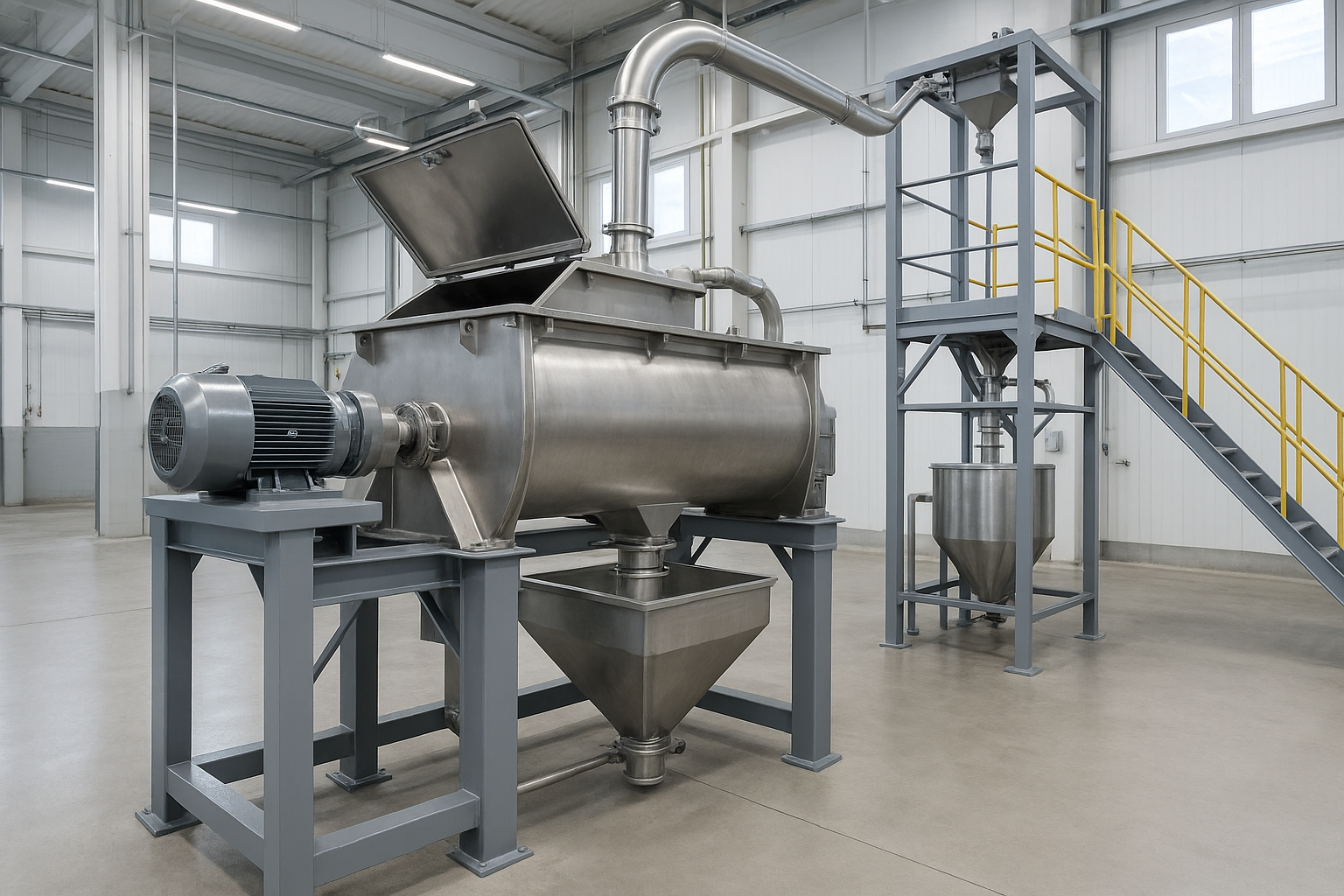
The category spans several distinct machine families. Ribbon and paddle mixers move material with a rotating agitator inside a horizontal trough, relying on convective flow to fold the batch over itself. Conical screw mixers lift material with an orbiting screw for gentle, low-shear blending suited to fragile or free-flowing powders. Plow and high-shear mixers use faster-moving tools to break up agglomerates and disperse liquids into powders.
Tumble and intermediate-bulk-container blenders rotate the entire vessel, avoiding contact parts altogether. Continuous mixers process a steady feed rather than discrete batches, trading batch-to-batch flexibility for throughput. A plant planner choosing among these needs figures that go beyond a product photo: capacity ranges, cycle times, achievable homogeneity, and hygienic design options.
Gericke AG, Hosokawa Solids Solutions, and Dec Group cover double-shaft, single-shaft, and continuous mixing, conical screw, ribbon screw, conical paddle, and high-shear designs, and pneumatic blending without moving parts. The order reflects mixing principles and product range, mixing performance, hygienic design and explosion safety, applications and pilot-scale work, and scale range.
The three suppliers stand for three different mixing principles. Gericke's GMS Multiflux double-shaft mixer forms a mechanical fluidized zone and runs up to 16 cycles per hour in usable volumes from 40 to 4,000 liters, while its continuous GCM spans 1 kg/h to 100 t/h.
The Hosokawa Micron range adds the Nauta conical screw mixer, which blends at low shear in sizes from 5 to 100,000 liters, the Vitomix ribbon screw mixer from 50 to 10,000 liters, and the Cyclomix with paddle tip speeds up to 30 m/s for cohesive powders with liquids. Dec Group's PTS Batchmixer blends without rotating or moving parts by circulating the batch with vacuum and pressure, in sizes from 2 to 6,000 liters.
Gericke AG ranks first on the reach and precision of its batch and continuous mixers. The GMS double-shaft batch mixer, sold under the Multiflux name, forms a mechanical fluidized zone at a Froude number of 1.1, runs up to sixteen mixing cycles per hour in usable volumes from 40 to 4,000 liters, and distributes micro-ingredients below 0.001 percent. The single-shaft GBM takes ploughshare, ribbon, or paddle tools for batches from 1.4 to 28,000 liters.
The Continuous Mixer GCM covers throughputs from 1 kilogram per hour in pharmaceutical solid dosage up to 100,000 kilograms per hour for plastics processing, is available for ATEX and IECEx categories 1, 2, or 3, and comes with FDA and EC 1935/2004 food-contact certificates. Hygienic versions follow EHEDG and GMP guidelines with extractable tools for fast dry cleaning, and test centers in seven countries run trials on original machines.
Hosokawa Solids Solutions, drawing on the mixer range of Hosokawa Micron, places second with the widest choice of mixing principles on this list. The Nauta conical screw mixer blends at low shear in sizes from 5 to 100,000 liters and at fill levels from 15 to 100 percent. The Vitomix ribbon screw mixer covers vessel volumes from 50 to 10,000 liters and motor power from 1.5 to 110 kilowatts, with up to eight times the mixing throughput of a conical screw mixer.
The high-shear Cyclomix runs rotor tip speeds up to 30 meters per second and is available down to laboratory sizes of 0.1 liter, and the continuous Modulomix covers 2.5 to 1,080 kilograms per hour. The Nauta takes optional CIP/SIP cleaning, vacuum or pressure operation, and ATEX-compliant configurations for all explosion zones. The test center in the Netherlands runs batch mixing trials from 1 to 6,000 liters.
Dec Group takes third place with a single mixer family built on an unusual principle. Its PTS Batchmixer uses no rotating parts at all: a static central deflector and a transfer chamber with two tangential inlets cycle powder through converging jets under vacuum and pressure pulses.
It handles blending ratios down to 1 part in 10,000 and blended a tracer at 0.01 percent by weight within about six minutes, with relative standard deviations of 1.5 to 7 percent on 30 gram samples. Production, R&D, and aseptic versions cover sizes from 2 to 6,000 liters, run under inert gas for oxygen-sensitive or explosive powders, clean in place, and sterilize with 90 °C water or steam. That suits contained and aseptic duties, even though the choice of mixing principles is the narrowest on this list.
Capacity, power, and cycle time describe the size of a mixer, not its result. The real measure of whether a mix is done is the coefficient of variation or relative standard deviation of samples taken from the actual blend. Treat this list as a starting point for a shortlist, not a substitute for a trial run with the actual material and a direct conversation with the supplier's process engineers.
Partner with powderbulkvideos.com
Show your equipment where buyers compare suppliers.
Booked places and Featured Listings are limited to 40 percent of a Top List, clearly labelled and separate from the editorial ranking.
Selected companies
-
Best for: Double-shaft batch mixing with up to 16 cycles per hour and continuous mixing from 1 kg/h to 100 t/h
Gericke's GMS Multiflux double-shaft mixer forms a mechanical fluidized zone at a Froude number of 1.1, runs up to 16 cycles per hour in usable volumes from 40 to 4,000 liters, and distributes micro-ingredients below 0.001 percent; in a confectionery plant it reaches a homogeneous mix within 2 minutes.
- The single-shaft GBM takes ploughshare, ribbon, or paddle tools for batches from 1.4 to 28,000 liters, also under vacuum or pressure.
- The continuous GCM spans 1 kg/h in pharmaceutical solid dosage to 100 t/h ahead of plastics extrusion, and the inline TCM blends a main stream with up to three minor streams.
- Hygienic versions follow EHEDG and GMP guidelines with extractable tools; GCM and GBM are available for ATEX and IECEx categories 1, 2, or 3.
View related CompanyTechnical score breakdown
- Mixing principles and product range
- 5/5 · GMS double-shaft fluidized-zone mixer, GMS Compact for development work, single-shaft GBM with ploughshare, ribbon, or paddle tools, continuous GCM, and the inline TCM.
- Mixing performance
- 5/5 · GMS with up to 16 cycles per hour and micro-ingredients below 0.001 percent, a homogeneous mix within 2 minutes in confectionery service, GCM from 1 kg/h to 100 t/h, and TCM up to 20,000 l/h.
- Hygienic design and explosion safety
- 4.5/5 · Hygienic executions to EHEDG and GMP guidelines with extractable tools for dry cleaning, ATEX and IECEx categories 1, 2, or 3 on GCM and GBM, FDA and EC 1935/2004 certificates, and overpressure housings.
- Applications and pilot-scale work
- 5/5 · Test centers with original machines in Switzerland, France, England, the Netherlands, Brazil, the USA, and Singapore; the GMS is a standard mixer in infant formula lines with rates up to 12 t/h.
- Laboratory-to-production scale range
- 5/5 · GBM from under 2 liters to 40,000 liters total volume, GMS from 40 to 4,000 liters usable volume, and GCM from 1 kg/h to 100 t/h.
-
Best for: Conical screw, ribbon screw, conical paddle, and high-shear batch mixers from laboratory size to 100,000 liters
Hosokawa Solids Solutions builds bulk handling systems around the Hosokawa Micron mixer range and its wide choice of mixing principles.
- The Nauta conical screw mixer blends at low shear in sizes from 5 to 100,000 liters and keeps its mixing quality at fill levels from 15 to 100 percent.
- The Vitomix ribbon screw mixer, 50 to 10,000 liters, delivers up to eight times the mixing throughput of a conical screw mixer.
- The Cyclomix runs its paddle rotor at tip speeds up to 30 m/s for cohesive powders with liquids, and the continuous Modulomix covers 2.5 to 1,080 kg/h.
- For hygienic and hazardous duties the Nauta takes optional CIP/SIP cleaning, vacuum or pressure operation, and ATEX-compliant configurations for all explosion zones.
View related CompanyTechnical score breakdown
- Mixing principles and product range
- 5/5 · Nauta conical screw, Vitomix ribbon screw, CPM conical paddle, Cyclomix high-shear, and the continuous Modulomix horizontal paddle mixer.
- Mixing performance
- 4/5 · Nauta from 5 to 100,000 liters at fill levels of 15 to 100 percent, Vitomix with up to eight times the throughput of a conical screw mixer, Cyclomix tip speeds up to 30 m/s, and Modulomix from 2.5 to 1,080 kg/h.
- Hygienic design and explosion safety
- 4/5 · Optional CIP/SIP with sterilization by steam above 121 °C, vacuum or pressure operation, ATEX-compliant Nauta configurations for all explosion zones, a gas-, dust-, and liquid-tight ball segment discharge valve, and Cyclomix seals and bearings above the product zone.
- Applications and pilot-scale work
- 4.5/5 · Test center in the Netherlands with more than 30 machines, batch mixing trials from 1 to 6,000 liters and continuous mixing from 100 to 1,500 kg/h, plus a Cyclomix pigment blending demonstration and a compounding collaboration with Zebra-chem.
- Laboratory-to-production scale range
- 5/5 · From the 5 liter Nauta Minimix and 0.1 liter Cyclomix laboratory units to 100,000 liter Nauta production mixers.
-
Best for: Closed pneumatic blending without moving parts for potent, sterile, or explosive powders, CIP/SIP cleanable
Dec Group's PTS Batchmixer blends without any rotating or moving parts.
- A powder transfer unit with two tangential inlets circulates the batch by vacuum and pressure through a vessel with a central deflector, at low velocity so particles are not damaged.
- In trials on a 100 liter unit it blended a tracer down to 0.01 percent by weight within 6 minutes, with relative standard deviations between 1.5 and 7 percent on 30 gram samples.
- The mixer handles ratios down to 1 in 10,000 and comes in sizes from 2 to 6,000 liters.
- It runs under inert gas for hygroscopic, oxygen-sensitive, or explosive powders, cleans in place with a spray nozzle, dries by vacuum, and sterilizes with 90 °C water or steam.
View related CompanyTechnical score breakdown
- Mixing principles and product range
- 2.5/5 · One pneumatic mixing principle, the PTS Batchmixer, in production, laboratory, and aseptic versions, with an optional high-shear propeller running at 400 to 800 rpm.
- Mixing performance
- 4.5/5 · Tracer blends down to 0.01 percent by weight within 6 minutes with relative standard deviations of 1.5 to 7 percent on 30 gram samples, ratios down to 1 in 10,000, and filling from 10 to 100 percent of vessel volume.
- Hygienic design and explosion safety
- 5/5 · Closed vessel without internal moving parts, operation under inert gas for explosive powders, CIP with spray nozzle and vacuum drying, sterilization with 90 °C water or steam, and contained inline sampling.
- Applications and pilot-scale work
- 3.5/5 · Blending trials on a 100 liter unit at 25, 50, and 90 percent fill, an in-house testing facility for scale-up, and a POWTECH showing with an online sampling accessory.
- Laboratory-to-production scale range
- 4/5 · Laboratory and pilot units from a few liters to 50 liters and production sizes from 2 to 6,000 liters.
-
Work with usAvailable
2 places on this Top List are open
Bookable places are limited, clearly labelled and separate from the editorial ranking above.
Frequently asked questions
Which mixing principle suits fragile or free-flowing powders?
Conical screw mixers such as the Nauta lift material with an orbiting screw turning at about 70 rpm while the arm orbits at 1 to 2 rpm, which gives gentle, low-shear blending. Double-shaft mixers running at a Froude number of 1.1 mix in a fluidized zone and also protect sensitive particles. High-shear mixers are the opposite choice: rotor tip speeds up to 30 m/s break up agglomerates and disperse liquids into cohesive powders.
When does a continuous mixer make sense instead of a batch mixer?
A continuous mixer processes a steady, gravimetrically fed stream and avoids intermediate buffers where a blend can segregate. Gericke's GCM covers 1 to 1,000 kg/h in pharmaceutical solid dosage and up to 100 t/h ahead of plastics extrusion. A batch mixer such as the Gericke GMS keeps recipes flexible and still reaches up to 16 mixing cycles per hour.
How do you know a powder blend is actually homogeneous?
A blend that looks even on the surface can still carry pockets of concentration outside the tolerance a formulation needs. The measure is the coefficient of variation or relative standard deviation of samples taken from the blend, and the sample size matters. Dec Group's PTS Batchmixer, for example, showed relative standard deviations of 1.5 to 7 percent on 30 gram samples of a dilute tracer blend. A trial with your own material settles the question before purchase.
Which mixers handle micro-ingredients at very low concentrations?
Gericke's GMS double-shaft batch mixer distributes micro-ingredients below 0.001 percent in batches from 40 to 4,000 liters. Dec Group's PTS Batchmixer handles ratios down to 1 part in 10,000 and blended a tracer at 0.01 percent by weight within about 6 minutes; for concentrations below 0.1 percent the minor ingredient is fed into the circulation line.
Which mixers on this list suit hygienic, contained, or explosive-dust duties?
Dec Group's PTS Batchmixer is a closed vessel without moving parts that runs under inert gas, cleans in place, and sterilizes with 90 °C water or steam. Hosokawa's Nauta mixer takes optional CIP/SIP cleaning and ATEX-compliant configurations for all explosion zones. Gericke's GMS comes in hygienic executions to EHEDG and GMP guidelines with extractable tools, and its GCM and GBM mixers are available for ATEX and IECEx categories 1, 2, or 3.
Where can you run mixing trials before buying?
Gericke operates test centers with original machines in Switzerland, France, England, the Netherlands, Brazil, the USA, and Singapore. Hosokawa's test center in the Netherlands runs batch mixing trials from 1 to 6,000 liters and continuous mixing from 100 to 1,500 kg/h. Dec Group has its own testing facility for scale-up and laboratory mixers from a few liters to 50 liters.
Can a supplier buy a higher rank on this list?
No. The ranked positions follow the five technical criteria above, from mixing principles and product range to scale range. Booked and Featured places are labeled as such and carry no rank.
Sources and further reading
- A review of current techniques for the evaluation of powder mixing, Advanced Powder Technology (Elsevier) / University of Leeds, White Rose Research Online
- Blend Uniformity / Content Uniformity (BUCU) FAQs, International Society for Pharmaceutical Engineering (ISPE)
- EHEDG Guideline Catalogue, EHEDG
- Guideline 8: Hygienic Design Principles, European Hygienic Engineering & Design Group (EHEDG)
- Homogeneity of the selected food mixes (Czech Journal of Food Sciences, 2021), Czech Academy of Agricultural Sciences
- Meeting the challenges of powder mixing with closed and aseptic technology, BulkInside
- PTS Batchmixer Powder Mixer, Pharmaceutical Online
- PTS Batchmixer: the no rotation, no movement revolution, BulkInside
- Q13 Continuous Manufacturing of Drug Substances and Drug Products, United States Food and Drug Administration
- Safe handling of combustible dusts, Health and Safety Executive
Related content
Continue exploring
Move from this page to the companies, videos and technical topics that add useful context.
Companies

Videos


Gericke AG
Double Shaft Mixer GMS 5000 ECD Multiflux
Gericke presents the GMS 5000 Multiflux double-shaft mixer in a powder-mixing and hygienic-design context.
Total reach: 40,827


Hosokawa Solids Solutions GmbH
Hosokawa Solids Solutions: Solids Puls Pneu Conveying System
Hosokawa Solids presents the Solids Puls Pneu plug-conveying system with bypass, impulse-valve and relay-station components.
Total reach: 70,209

Gericke AG
Gericke: GFS Formulation Skid and Tablet Press
This video presents the Gericke Formulation Skid (GFS) combined with a tablet press, showing how pharmaceutical formulations move from blending through downstream processing in one controlled, scalable setup. The system runs semi-continuously or fully continuously and targets development, scale-up, and technology transfer.
Total reach: 3,732

Gericke AG
Nibbler and Deagglomerator Gericke GNB
Gericke's video explains the operating and cleaning concept of the GNB coarse grinder and deagglomerator: a low-speed paddle-and-screen arrangement works lumps down to size, and the unit opens for inspection. Particle size, capacity, heat input and wear still require representative material testing.
Total reach: 3,100

Gericke AG
Trusted Partnership: Why BigMuscles Chose Gericke for Efficient Powder Processing
This video features Jitika Gupta, Marketing Director of BigMuscles Nutrition, discussing why the company partnered with Gericke to establish their advanced production facility in India.
Total reach: 3,976

VAC-U-MAX
VAC-U-MAX: Direct Charge Blender Loading Whiteboard Video
VAC-U-MAX whiteboard video on direct-charge blender loading by vacuum conveying: the system boundary, the major components, and the data to verify before selecting equipment.
Total reach: 28,165

Coperion
Coperion: Cement Blending with Manufacturing Pull Principle
This video presents a smarter way to produce blended cement without storing tons of product no one has ordered yet.
Total reach: 5,279