
Application
Powder Blending in Plastics Compounding
Answer in brief
In compounding the blend has to present additives evenly to the extruder.
Additives, stabilisers and pigments are dosed at low percentages into a resin that is many times their particle size, so segregation between the mixer and the feed throat shows up as variation in the product.
- Match the carrier to the resin, not to the additive.
- Keep the route to the extruder short.
- Ground everything; the dust is explosible even when pellets are not.
Reviewed October 21, 2026
The problem
A compounding blend is usually a coarse resin with a set of fine additives at a few percent or less: stabilisers, antioxidants, flame retardants, pigments, processing aids. The particle size difference between the resin and the additives is exactly the condition that produces segregation.
What makes it visible is the extruder. Feed variation becomes a property variation in the compound, and a flame retardant or a stabiliser that is unevenly present produces a product that fails a test rather than one that looks different.
Static then complicates handling. Polymer powders charge readily, which makes fine additives stick to surfaces and to the resin unevenly, and a blend that looked right in the mixer can arrive at the throat with the additives on the hopper wall.
And the dust is a hazard. Polymer fines and many additives are explosible, so the mixer, the transfer and the hopper are equipment inside a dust explosion risk even though the pellets everyone is looking at are not.
Desired outcome
A blend that presents the additive package to the extruder at the intended level continuously, not on average, with the route from mixer to throat designed to preserve it.
Static managed by grounding and, where necessary, by carrier selection, so additives stay with the resin instead of on the equipment.
Explosion protection and bonding designed for the dust that is actually present, with the whole blending and transfer system treated as one system.
In battery material production the required homogeneity scale is set by the electrode, and the hardened mixing element that survives the duty is also the source of the iron.
Process approach
The formulation and the handling are looked at together. Where an additive can be supplied on a carrier of similar particle size to the resin, or as a masterbatch, the segregation driving force is removed rather than managed. That is usually cheaper than any equipment answer.
Where powders are blended directly, the mixer is chosen for its ability to distribute fines into a coarse bed: convective rather than tumble, with attention to whether the additive is being distributed or just carried along.
After the mixer the route matters more than the mixer. Short, direct, with mass flow hoppers and minimal drop height, and loss in weight feeding of the additive at the throat where accuracy really matters. Many plants find that feeding separately at the extruder solves what no blending change could.
Grounding and bonding are designed as a system and measured. Hoppers, liners, flexible connections and the mixer itself are bonded, continuity is tested at commissioning and periodically after, and the explosion characteristics of the fines are measured rather than assumed from the polymer grade.
- Additive supplied on a matched carrier or as masterbatch where segregation can be designed out.
- Convective mixing where fines have to enter a coarse bed.
- Short direct route to the extruder with mass flow hoppers and low drop heights.
- Loss in weight feeding at the throat where additive accuracy is critical.
- Full bonding and grounding of mixer, hoppers and flexible connections, measured.
- Explosion characteristics measured on the fines actually present in the plant.
Selection factors
- Particle size ratio between resin and additives, which is the segregation driving force.
- Additive tolerance of the product specification, since some additives fail a test rather than a sight check.
- Static behaviour of the resin and additives and the grounding concept.
- Route to the extruder, counted in drops and metres rather than described.
- Explosibility of the fines, measured on plant material.
- Whether separate feeding at the throat is a better answer than blending at all.
Common failure modes
- Fine additive blended into coarse resin with no carrier matching, so it segregates on the way to the throat
- Additive found on the hopper wall rather than in the blend, with static never investigated
- Mixing time extended to fix a feed variation that the transfer route is causing
- Explosion characteristics taken from the polymer grade rather than measured on the plant fines
- Flexible connection or liner left unbonded in a system handling explosible dust
- Blending retained where loss in weight feeding at the throat would have solved the accuracy problem
Partner with powderbulkvideos.com
Put a relevant technical solution in this decision path.
Connect your company and video evidence with clearly labelled visibility where engineers evaluate this material, application, industry or product.
Frequently asked questions
Why do additives segregate from resin powder?
Because of the particle size and density difference. Every drop and every sloping surface sorts the fine additive from the coarse resin, and the extruder then sees a varying additive level.
Is blending or separate feeding better?
Where additive accuracy is critical, separate loss in weight feeding at the throat is usually more reliable, because it removes the transfer where segregation happens. Blending suits packages that tolerate more variation.
Are polymer powders an explosion risk?
The fines are, for most polymers, and so are many additives. The pellets draw attention away from it, but the mixer, hoppers and transfers handle dust and have to be bonded and protected accordingly.
Related content
Continue exploring
Move from this page to the companies, videos and technical topics that add useful context.
Companies

Videos
Gericke AG
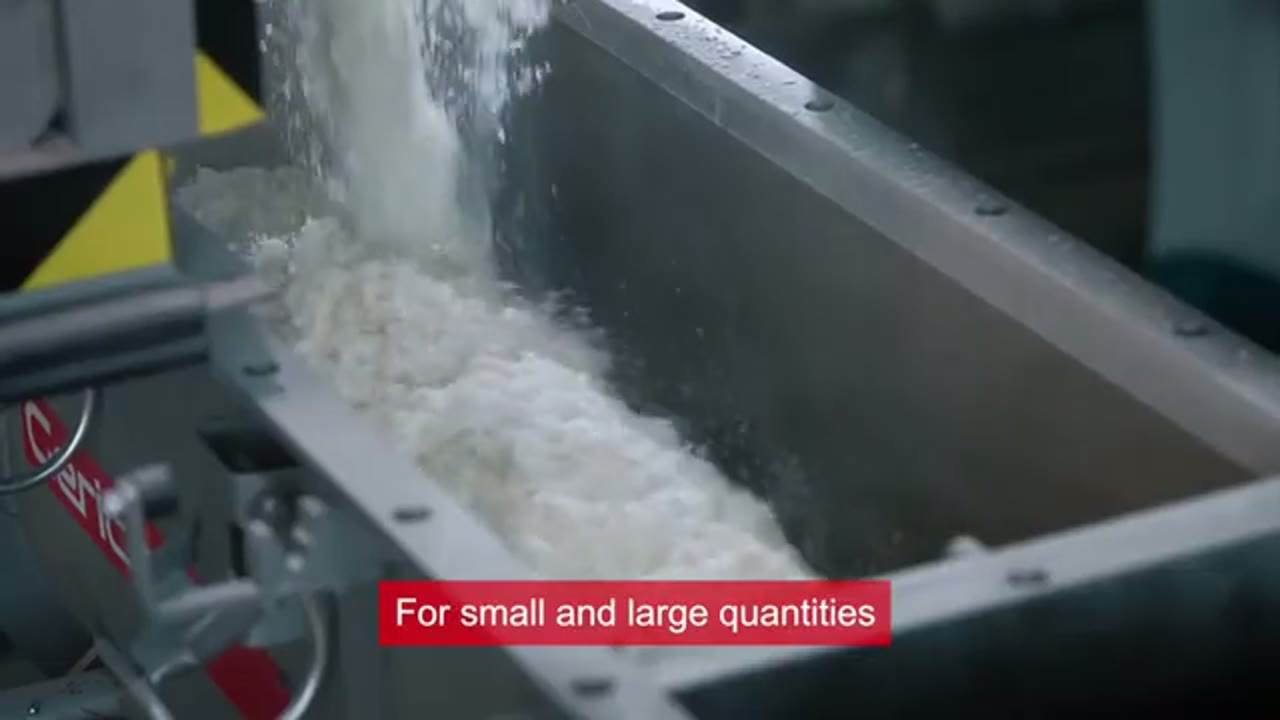
Continuous Mixer Gericke GCM
Gericke shows the GCM continuous mixer, which combines radial and axial mixing for throughputs that range from 10 l to 150,000 l/h.
Total reach: 4,638

Gericke AG
Nibbler and Deagglomerator Gericke GNB
Gericke's video explains the operating and cleaning concept of the GNB coarse grinder and deagglomerator: a low-speed paddle-and-screen arrangement works lumps down to size, and the unit opens for inspection. Particle size, capacity, heat input and wear still require representative material testing.
Total reach: 3,385

Gericke AG
See Gericke's Leading Bulk Mixing Technology in Action
Gericke shows its bulk mixing portfolio in operation, from laboratory scale double shaft mixers to continuous mixers that cover inline mixing from 1 kg/h to more than 100,000 kg/h.
Total reach: 2,699