Case Study
Johnson Matthey Mobile Powder Feeding Case Study
Answer in brief
Coperion K-Tron built two mobile batch-feeding stations for Johnson Matthey. Each unit docks for vacuum refill, then moves between mixers, so one feeder serves several process points. Integrating the receiver function into the feeder hopper, with filtration in the return-air line, resolved the tight headroom above the feeder.
By Editorial Team · Published July 17, 2026 · Updated July 26, 2026

The process needed one feeder to serve several mixers
Johnson Matthey required powder batches to be dispensed from big bags and delivered to different mixers without installing a complete fixed feeding train at every destination.
The solution had to move, dock repeatably and refill without placing a conventional vacuum receiver above the feeder.
System boundary: The project joined big-bag discharge, vacuum transfer, feeder refill, mobile positioning, batch dosing, return-air filtration and dust recovery.
The feeder hopper also performs the first separation duty
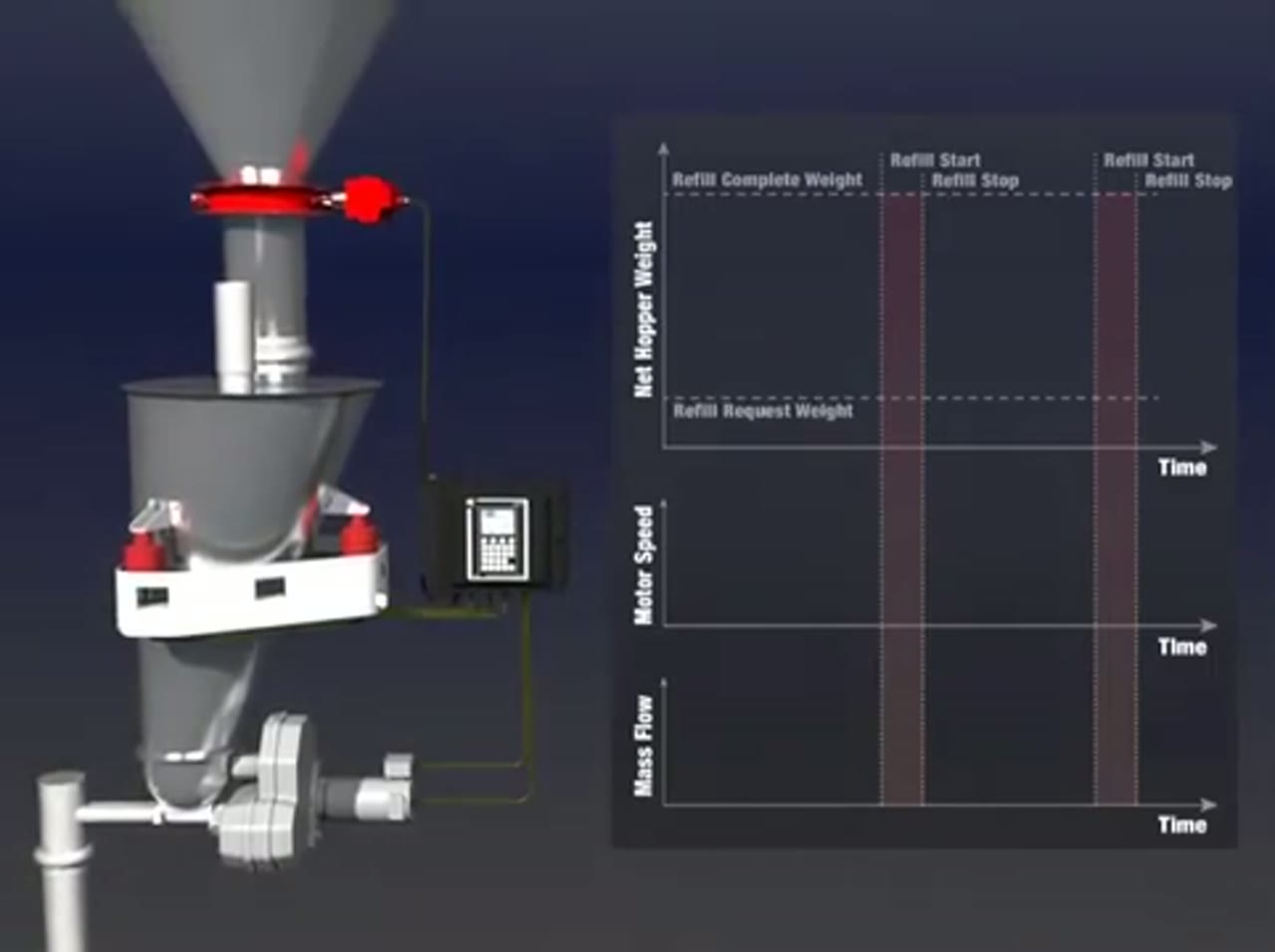
At the refill station, powder-laden air enters the feeder hopper directly.
The larger hopper cross-section reduces air velocity so that most solids settle. The return air then passes to a separate filter receiver.
A rotary valve below that receiver returns collected fines to the conveying line, limiting product loss from the return-air path.
Mobility changes the interface design
A mobile feeder needs repeatable mechanical, electrical and pneumatic connections at every operating point.
Docking confirmation, earth continuity, hose condition, feeder identity, mixer availability and batch recipe should become permissives rather than operator assumptions.
Flexible connections must not impose force on weighing equipment. Otherwise the scale can read the hose and frame constraint along with the powder mass.
Engineering visual guide
How the system behaves
These conceptual diagrams connect the operating principle, equipment internals and engineering review points. They are explanatory and not fabrication drawings or a substitute for project-specific calculations.
Engineering infographic
Evidence-bounded system context
Conceptual evidence-bounded system context for Johnson Matthey; use it to structure an engineering review, not as a fabrication drawing or project-specific design.
Batch accuracy depends on refill and weighing states
The feeder should distinguish refill, settling, dosing and move states.
Material aeration after vacuum transfer can change bulk density and apparent flow through the feeder. A short stabilization rule may be needed before the next weighed batch begins.
The acceptance test should therefore evaluate complete batches after representative refills, not only a steady discharge test with a settled hopper.
The return-air circuit is part of material accounting
Integrating the first separation duty into the feeder hopper solved the headroom problem, but it also made the return-air path part of the feeding process.
If the filter blinds, the refill rate can fall. If the fines-return path blocks or leaks, the system can lose product or disturb the conveying airflow.
Commissioning should reconcile the mass loaded at the big-bag station, the mass delivered in batches and the residue retained in filters, hoses and docking connections.
Partner with powderbulkvideos.com
Put your expertise beside the decisions engineers are making.
Connect a relevant company profile and technical video portfolio with clearly labelled visibility on this topic.
Weighing needs a mechanically quiet state
A mobile loss-in-weight or batch-weighing assembly is sensitive to forces that bypass the load cells.
Hoses, cables, an uneven floor or a docking clamp can create a repeatable-looking offset that changes when the station moves.
Each mixer location should therefore have a verified parking geometry and a zero check after connection. Weighing behavior can differ between stations, so verify it at each one.
Engineering infographic
Evidence-to-claim map
Conceptual evidence-to-claim map for Johnson Matthey; use it to structure an engineering review, not as a fabrication drawing or project-specific design.
The project delivered two mobile batch-feeding stations
Coperion supplied two mobile batch-feeding stations and additional custom mobile feeders.
According to Johnson Matthey plant manager Ben Miller, the complete solution significantly increased process efficiency.
A comparable design should set its own baseline for cycle time and batch accuracy and measure against it.
Cleaning follows the same mobile route
A station that serves several mixers can carry residue between destinations if the hopper, feeder, outlet or flexible connections are not cleared.
The operating plan should define when a material change requires dry cleaning, dismantling or another validated method.
Access is especially important around the integrated receiver head and the separate return-air filter because both contact conveyed fines.
A practical cleaning verification checks the product path after a realistic refill and dosing sequence, not only an unused machine on the workshop floor.
Movement and production permissions should be interlocked
The feeder should not dose while it is being moved or before the destination connection is proven.
Likewise, the refill station should not start vacuum transfer until the return-air circuit and fines recovery are available.
These controls follow from the mobile architecture. The exact safety functions and performance levels remain site-specific design work.
Engineering infographic
Reuse decision workflow
Conceptual reuse decision workflow for Johnson Matthey; use it to structure an engineering review, not as a fabrication drawing or project-specific design.
Commissioning should prove every operating location
- Confirm safe movement, parking and docking at each mixer.
- Verify identification and recipe control before material can be dosed.
- Test vacuum refill, separation, filter cleaning and fines return with the real powder.
- Measure batch error after refill and across minimum and maximum batch sizes.
- Challenge loss of vacuum, blocked return line, failed docking confirmation and interrupted dosing.
- Document cleaning boundaries and cross-contamination controls between materials.
The wider control problem is covered in feeding and dosing control.
Frequently asked questions
What does this case study cover?
It covers the Johnson Matthey mobile powder-feeding project: the mobile architecture, the integrated receiver function, the return-air path and the commissioning checks for each operating location.
Related content
Continue exploring
Move from this page to the companies, videos and technical topics that add useful context.