
Comparison
Plug Conveying vs Conventional Dense Phase
Answer in brief
Both move material slowly at a high solids loading; the difference is how the flow is organised.
Conventional dense phase lets the material form whatever pattern it will, often moving dunes along the pipe bottom. Plug conveying actively divides the material into discrete plugs with gas cushions between them.
- Fragile or blend-sensitive material: plug conveying.
- Robust powders and granules over normal distances: conventional dense phase.
- Both demand a material that can actually be conveyed in dense phase.
By Editorial Team · Published October 21, 2026 · Updated October 21, 2026
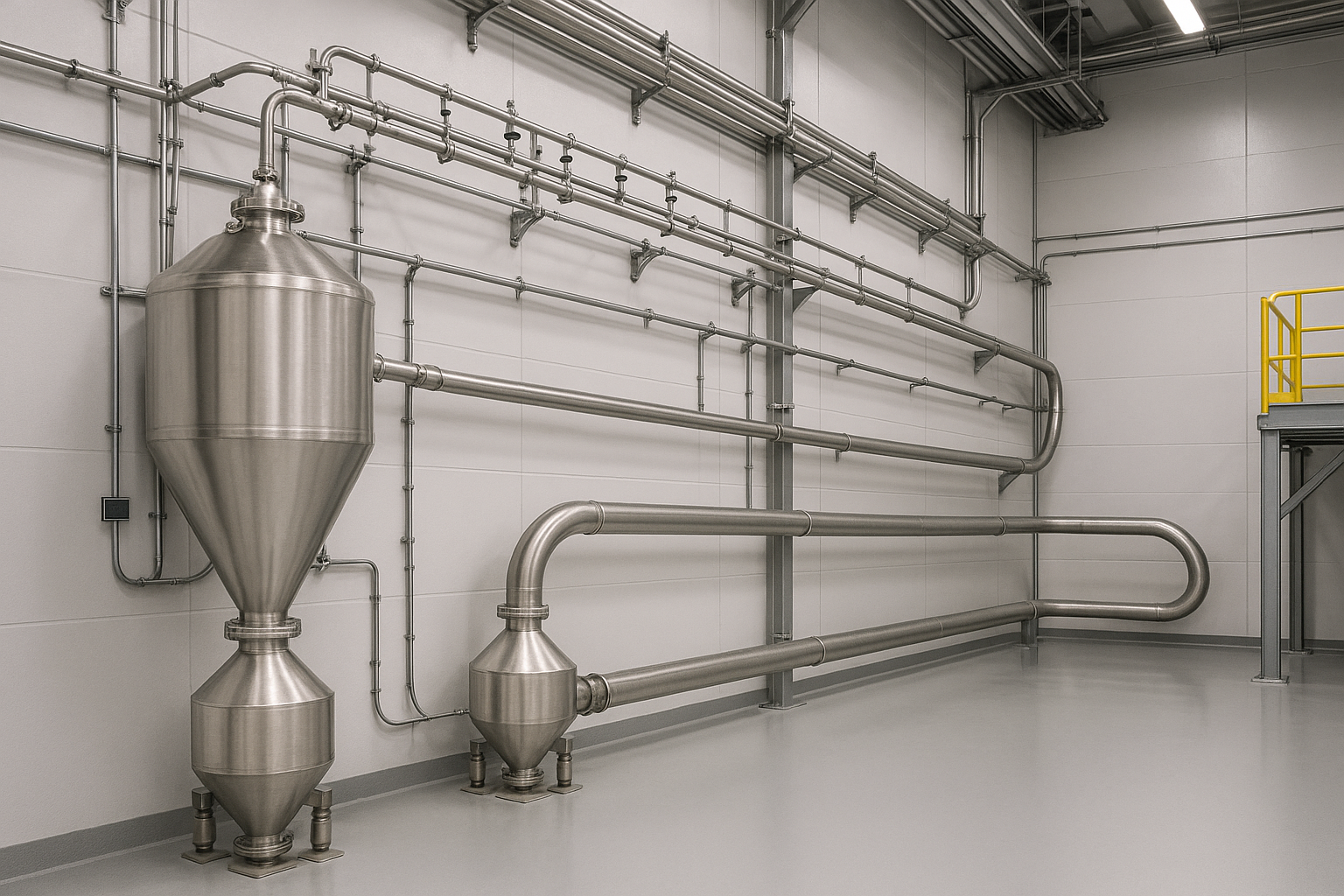
What actually differs
In conventional dense phase the material moves as dunes or slugs that form by themselves, and their size and spacing vary with pressure, distance and material condition.
In plug conveying, equipment such as a bypass line or air injection points divides the flow into short plugs separated by gas, so the behavior is imposed rather than emergent.
Short, controlled plugs mean lower pressure drop across each plug and less stress on the material.
Decision criteria
| Criterion | Plug conveying | Conventional dense phase |
|---|---|---|
| Flow organisation | Imposed by the system | Emergent |
| Product damage | Lowest of the pneumatic options | Low |
| Segregation of blends | Very low | Low to moderate |
| Equipment complexity | Higher, bypass or injection | Lower |
| Distance capability | Good, controlled pressure profile | Good |
| Material range | Wider, including poorly conveying powders | Needs suitable material behavior |
Where plug conveying is the better choice
- Friable granules and coated products where every impact counts.
- Pre-blended mixtures that must not separate between mixer and packer.
- Materials that tend to form long, unstable slugs and cause pressure surges.
Partner with powderbulkvideos.com
Put your expertise beside the decisions engineers are making.
Connect a relevant company profile and technical video portfolio with clearly labelled visibility on this topic.
Where conventional dense phase is the better choice
- Robust powders and pellets where the additional hardware brings no benefit.
- Simple point-to-point transfers at moderate distance.
- Plants that prefer fewer components in the line.
Where neither fits
Neither variant helps a material that aerates and flushes rather than forming a moving bed; such powders usually convey better in dilute phase or by mechanical means.
Neither compensates for an undersized receiving filter: dense phase delivers material in surges, and the filter has to absorb them.
What to measure before deciding
- Conveying trials on the real material, since dense phase behavior is not reliably predicted from bulk properties alone.
- Permeability and deaeration rate, which decide whether stable plugs can form.
- Acceptable particle damage and the measurement method for it.
- Distance, rate and the available air pressure.
Frequently asked questions
Can every material be conveyed in dense phase?
No. The material needs suitable permeability and deaeration behavior. Materials that hold air and flush are usually better suited to dilute phase or mechanical conveying.
Does plug conveying need more air?
Generally less, because the velocity is low and the solids loading is high. The additional complexity is in the hardware that forms the plugs, not in the air supply.
Why do conveying trials matter so much here?
Because the pressure drop and the stability of the flow depend on how the specific material behaves in a pipe. Two powders with similar bulk density can behave completely differently.
Related content
Continue exploring
Move from this page to the companies, videos and technical topics that add useful context.
Companies

Videos

Hosokawa Solids Solutions GmbH
Hosokawa Solids Solutions: Solids Puls Pneu Conveying System
Hosokawa Solids presents the Solids Puls Pneu plug-conveying system with bypass, impulse-valve and relay-station components.
Total reach: 70,320

Coperion
E-finity Continuous Dense Phase Conveying
Coperion presents E-finity, a continuous dense phase conveying system for fragile granular and pelleted materials that monitors pressure and corrects the airflow during the run.
Total reach: 1,829