
Comparison
Dense Phase vs Dilute Phase Conveying
Answer in brief
Dilute phase conveying suspends particles in a relatively large gas flow at higher velocity and is usually the more flexible choice for robust materials.
Dense phase conveying moves a higher concentration of solids at lower velocity and is often preferred when attrition, segregation, or pipeline wear must be limited. The right regime follows from tested material behavior, required capacity, route geometry, pressure limits, hygiene, safety, and total operating cost.
By Editorial Team · Published July 14, 2026 · Updated July 26, 2026

Sponsored visibility
Featured videos for this topic
Paid placements are clearly marked and remain separate from the editorial related-video selection.
Choosing a pneumatic conveying mode is a materials engineering decision, not a choice between two standard packages. The same powder can behave differently when particle size distribution, moisture, temperature, bulk density, or the conveying route changes. A useful comparison therefore starts with the bulk solid and the process duty, then considers the flow regime, equipment arrangement, controls, and safety concept.
What dense phase and dilute phase mean
Both methods move a bulk solid through a closed pipeline with air or another gas. The distinction describes how the particles travel inside that pipe. It does not describe whether the system uses pressure or vacuum. Pressure and vacuum are separate design choices, and either can be combined with an appropriate conveying regime.
In dilute phase conveying, most particles remain suspended in the gas stream, a classic particle-laden flow. The system uses a comparatively high gas velocity and a lower concentration of solids.
In dense phase conveying, the solids concentration is higher and the conveying velocity is lower. Depending on the material, the solids can move as strands, dunes, slugs, plugs, or a fluidized bed close to the bottom of the pipe.
There is no single velocity or solids loading value that separates every dilute phase system from every dense phase system. Particle size, particle density, shape, permeability, air retention, cohesion, moisture, pipe diameter, and pressure all influence the observed regime, as reviews of dilute and dense phase conveying characteristics document. Published velocity ranges are useful orientation values, not a substitute for material testing and system calculation.
Engineering visual guide
How the system behaves
These conceptual diagrams connect the operating principle, equipment internals and engineering review points. They are explanatory and not fabrication drawings or a substitute for project-specific calculations.
Engineering infographic
Side-by-side operating principles
Conceptual side-by-side operating schematic for Pneumatic Conveying; use it to structure an engineering review, not as a fabrication drawing or project-specific design.
Comparison at a glance
| Decision factor | Dilute phase | Dense phase |
|---|---|---|
| Particle movement | Particles are mainly suspended in the gas stream | Solids move at higher concentration as strands, dunes, slugs, plugs, or fluidized flow |
| Gas velocity | Generally higher | Generally lower |
| Solids concentration | Lower solids loading relative to conveying gas | Higher solids loading relative to conveying gas |
| Material range | Broad and comparatively forgiving | More dependent on powder behavior and system design |
| Product attrition | Greater risk for fragile particles because impacts are more energetic | Often lower because particle velocity is reduced |
| Pipeline wear | Can be significant with abrasive material, especially at bends | Often lower due to reduced velocity, although pressure and solids loading still require suitable components |
| Feeding | Often continuous with a rotary valve, screw, or similar metering device | Often batch based from a pressure vessel, although continuous dense phase designs also exist |
| Controls | Usually simpler, but stable air flow and feed rate remain essential | Often more involved because pressure, air injection, vessel cycles, and plug behavior may require active control |
| Development method | Established calculations can provide a useful design basis for many duties | Material testing and pilot conveying are especially important |
When dilute phase conveying is usually the stronger option
Dilute phase is widely used because it handles many powders, granules, and pellets with a relatively straightforward equipment arrangement. It is often a sound starting point when the material is robust, the route changes between several sources or destinations, and continuous transfer is important.
Typical reasons to select dilute phase
- The material tolerates impact and sliding contact.
- The process needs continuous and responsive conveying.
- The route or throughput changes frequently.
- The application benefits from a simpler feeding and control concept.
- The bulk solid does not convey reliably in a stable dense regime.
The main tradeoff is velocity. Higher particle velocity increases the energy of impacts at bends and other changes in direction. Fragile granules can break, mixtures can segregate, and abrasive solids can wear piping. These effects must be assessed for the actual material and route rather than assumed from the conveying label alone.
Engineering infographic
Selection envelope
Conceptual selection envelope for Pneumatic Conveying; use it to structure an engineering review, not as a fabrication drawing or project-specific design.
When dense phase conveying is usually the stronger option
Dense phase is considered when product quality or equipment life would suffer at dilute phase velocity. It can be well suited to friable granules, abrasive minerals, premixed powders that should not segregate, and materials whose temperature or surface condition is sensitive to energetic impact.
The phrase dense phase covers several flow patterns. Some fine powders retain air and can move in a fluidized dense phase. Coarser, permeable materials may form plugs. Other materials cannot sustain a stable dense regime without controlled secondary air injection. This is why a general claim that dense phase works for every delicate or abrasive product is unsafe.
Typical reasons to investigate dense phase
- Particle breakage directly affects product value.
- Abrasive material causes unacceptable wear in bends or piping.
- A premixed product must arrive with minimal segregation.
- The process can accommodate pressure vessel cycles or a specialized continuous feeder.
- Representative material is available for conveying trials.
Dense phase equipment can require higher pressure capability, more sophisticated controls, and a carefully developed start and stop sequence. A lower gas velocity does not automatically mean lower total energy consumption. Compressor efficiency, pressure drop, throughput, cycle time, leakage, filter duty, and auxiliary air all contribute to operating cost.
Partner with powderbulkvideos.com
Put your expertise beside the decisions engineers are making.
Connect a relevant company profile and technical video portfolio with clearly labelled visibility on this topic.
Material behavior should drive the selection
The AIChE selection guidance places material evaluation at the beginning of the decision process. This reflects a practical reality. Bulk solids do not scale as predictably as a single phase liquid. A design team needs representative samples and process conditions, not only a product name.
The Geldart classification groups powders by particle size and density to describe fluidization behavior. It remains a useful first screen, but later research shows that it should not be treated as a complete pneumatic conveying selector.
Permeability, air retention, fine content, particle size distribution, cohesion, and deaeration can change whether a powder forms a stable dense flow. Recent work on conveying classification diagrams still identifies pilot trials as the most reliable method when a material sits near a classification boundary.
Data required before a design review
- Particle size distribution and particle shape.
- Loose and compacted bulk density.
- Moisture range and hygroscopic behavior.
- Cohesion, permeability, air retention, and deaeration behavior.
- Abrasion and attrition sensitivity.
- Temperature and chemical compatibility.
- Combustibility and electrostatic properties where relevant.
- Required capacity, conveying distance, vertical lift, bends, and destinations.
- Cleaning, cross contamination, containment, and validation requirements.
Pressure, vacuum, and feeding arrangement
A conveying phase cannot be selected independently from the complete system. In a dilute pressure system, a rotary airlock often meters material into a pressurized pipe while limiting gas leakage.
Vacuum dilute systems commonly use a receiver and filter ahead of the air mover. Dense pressure systems often introduce material through a pressure vessel, while continuous dense phase designs can use specialized rotary valves or other feeding arrangements.
A pressure system can push material from one source toward one or more destinations and can serve longer routes efficiently, but leakage direction and the integrity of downstream equipment need attention. A vacuum system can draw from several pickup points toward a receiver and helps with containment, because air tends to enter an opening rather than letting dust escape.
Vacuum has a price at the receiving end: the receiver and filter must handle the full incoming gas and solids load. The final arrangement depends on plant layout, cleanliness requirements, destination pressure, the complete pressure profile, and the way material enters and leaves the conveying line.
Reliability and maintenance questions
Many conveying problems are system problems rather than component failures. Insufficient pickup velocity, unstable feeding, excessive bends, poor acceleration length, filter restriction, air leakage, and an incorrect pipe diameter can all reduce capacity or cause plugging.
For dilute phase, inspection usually focuses on bend wear, particle damage, filter loading, and stable feed control. For dense phase, operators also need clear procedures for vessel filling, pressurization, conveying, depressurization, line clearing, and recovery after an interrupted cycle. Pressure trends and conveying time can provide valuable early warning when material behavior changes.
Safety cannot be separated from conveying mode
If the material can form a combustible dust cloud, the conveying system needs a documented hazard assessment. Potential concerns include electrostatic discharge, frictional heating, foreign material, fire propagation, pressure rise, and the transfer of burning material to connected equipment. HSE guidance also highlights pressure monitoring, adequate air removal at receiving vessels, and reliable level detection to prevent overfilling.
The required protective measures depend on the dust properties, process, jurisdiction, and equipment arrangement. They can include bonding and grounding, ignition control, explosion venting, suppression, isolation, pressure containment, inert gas, and suitable shutdown logic. These measures must be engineered for the actual installation.
Engineering infographic
Failure and safety comparison
Conceptual failure and safety comparison for Pneumatic Conveying; use it to structure an engineering review, not as a fabrication drawing or project-specific design.
A practical selection sequence
- Define the material and collect representative test data.
- Set the required capacity and map the complete conveying route.
- Identify product quality limits such as attrition, segregation, and contamination.
- Define hygiene, containment, cleaning, and safety requirements.
- Screen feasible pressure, vacuum, dilute, and dense concepts.
- Test uncertain materials at representative scale.
- Compare lifecycle cost, including energy, wear parts, filters, controls, cleaning, and downtime.
- Validate the selected operating window and recovery procedures before production release.
The best system is the one that maintains capacity and product quality across the expected operating range. Dense phase is not automatically the premium answer, and dilute phase is not merely the basic answer. Each method is valuable when it matches the material and the process.
Frequently asked questions
What is the main difference between dense phase and dilute phase conveying?
Dilute phase uses a comparatively large gas flow to keep most particles suspended at higher velocity. Dense phase moves a higher concentration of solids at lower velocity, in strands, dunes, slugs, plugs, or fluidized flow. Where the boundary falls depends on the material and the system conditions.
Is dense phase conveying always gentler?
Dense phase often reduces attrition and pipeline wear because velocity is lower, but it does not suit every powder. Plug stability, pressure requirements, feeding, and the response of the actual material all have to be confirmed by testing.
Can both conveying modes operate under vacuum?
Yes. Dense phase and dilute phase describe the solids flow regime, while pressure and vacuum describe how the gas flow is produced. Which combination is feasible depends on the material, route, receiver, filter, and required pressure difference.
Why are conveying trials important?
Powders with similar names or bulk densities can differ in permeability, air retention, cohesion, attrition, and fine content. Trials establish the stable operating window and provide measured values for capacity, pressure drop, product quality, and control settings.
Which system uses less energy?
Neither mode is always more efficient. Dilute phase generally moves more gas at lower pressure; dense phase moves less gas at higher pressure. Total energy depends on the complete duty, including air mover efficiency, pressure drop, throughput, leakage, and controls.
Related content
Continue exploring
Move from this page to the companies, videos and technical topics that add useful context.
Companies


Videos

Hosokawa Solids Solutions GmbH
Hosokawa Solids Solutions: Solids Puls Pneu Conveying System
Hosokawa Solids presents the Solids Puls Pneu plug-conveying system with bypass, impulse-valve and relay-station components.
Total reach: 70,219

HS Umformtechnik GmbH
HS Umformtechnik Company Video
HS Umformtechnik presents large-radius pipe bends, pipe couplings and branch pipes for pneumatic conveying systems.
Total reach: 6,258
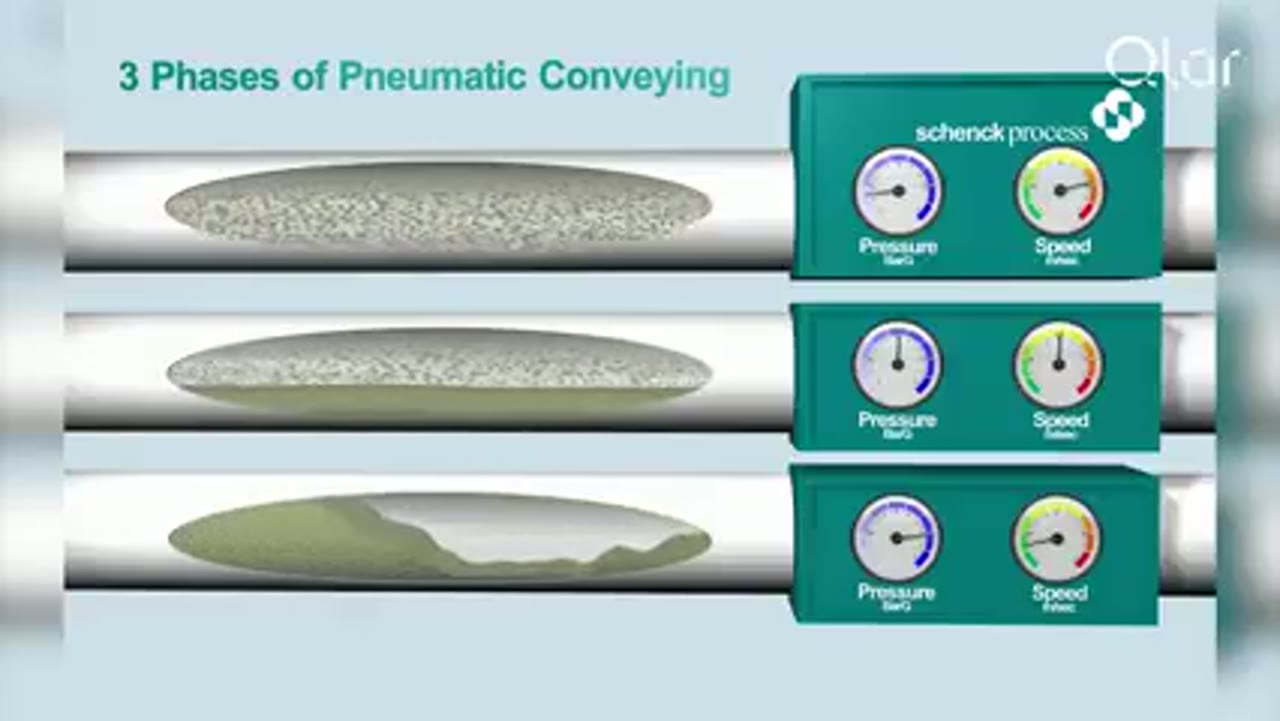
Qlar
Pneumatic Conveying Explained: The 3 Key Phases of Dense Phase Conveying
Qlar explains the three phases of dense phase pneumatic conveying and where each one fits when powders, granules and bulk solids have to move without being damaged.

VAC-U-MAX
VAC-U-MAX: 10 Critical Design Factors to Consider When Designing Vacuum Conveying Systems
VAC-U-MAX presents ten design factors for vacuum conveying, including pickup, material behavior, route, receiver, filtration, discharge and controls.
Total reach: 10,989

VAC-U-MAX
VAC-U-MAX: Signature Series Packaged Vacuum Conveying Systems
With over 65 years of experience in pneumatic conveying and more than 10,000 powders and granular materials handled, VAC-U-MAX packages its Signature Series vacuum conveying systems as complete units: receiver, UL-listed controls, convey hose, filters, and vacuum producer.
Total reach: 10,587
Powder Process-Solutions
Pressure Dilute Phase
The Powder Process-Solutions animation shows a positive-pressure dilute-phase arrangement in which a gas stream pushes suspended material through the conveying line toward the receiver.
Total reach: 92,214