
Application
Valve and Airlock Selection for Chemical Powder Lines
Answer in brief
In chemical service the valve is a containment device first and a flow device second.
What leaks out matters, what gets in matters, and the seals and wetted parts have to survive a product that was chosen for its reactivity rather than its kindness to elastomers.
- Fix compatibility and leak class before looking at capacity.
- Decide what a failed seal is allowed to do.
- Check the valve against the area classification, not just the duty.
Reviewed October 21, 2026
The problem
A chemical powder line asks a valve to do several things that pull against each other. It is a pressure boundary for the conveying air, a barrier against the atmosphere for a product that may be hygroscopic or oxygen sensitive, and a barrier in the other direction for a product that is toxic, corrosive or both.
Every one of those duties lands on the same seals. A gland packing that gives acceptable wear life on an inert powder may swell, harden or dissolve in contact with the process stream, and the failure is not a leak of air but a release of product into the room.
The plant around it adds constraints. Much of the equipment stands in a classified area, so the actuator, the drive and any instrument on the valve have to be suitable for it. Temperature ranges are wider than in most industries, and a valve that seals cold can bind hot as the rotor grows into the housing.
And several products share a line. A valve that is easy to clean on one campaign is a cross contamination path on the next.
Choosing between valves, gates and airlocks usually comes down to duty and pressure. In a chemical line the seal material decides it first.
Desired outcome
A valve with a stated leak class in both directions, wetted parts and seals verified against every product that will pass through it, and a defined behaviour when a seal eventually fails.
Suitable for the area it stands in, including the actuator and instruments, and documented that way rather than assumed.
Cleanable between campaigns to a standard that the quality plan recognises, with the cleaning route known before the valve is installed.
Where the line carries food, the governing figure is the changeover time the plant allows rather than compatibility, and a valve that cleans slowly fails for a reason chemistry never sees.
Process approach
Compatibility comes first and it is a list, not a conversation. Every wetted component against every product in the campaign plan, at the temperature it will see, including the cleaning agent. The cleaning agent is the part most often left off, and it is frequently more aggressive than the product.
Then the leak duty. Outward leakage to the room sets the shaft sealing concept: a packed gland for a nuisance dust, an air or nitrogen purged seal where exposure matters, a double seal with a monitored interspace where it matters a great deal. Inward leakage of air or moisture sets the opposite requirement and sometimes needs an inert purge rather than a better seal.
Temperature then adjusts the clearances. A rotor set for a cold fit seizes when the housing and rotor reach working temperature at different rates, so hot service valves run looser cold and the leakage calculation uses the hot figure.
Area classification is checked against the complete assembly. The valve body is rarely the problem; the actuator, the position switch and the speed monitor are.
- Compatibility matrix built for products, temperatures and cleaning agents together.
- Outward and inward leak duties stated separately, with a sealing concept for each.
- Purge medium and its failure case defined where a purged seal is used.
- Clearances set for working temperature, with the hot leakage figure used in the conveying design.
- Complete assembly, including actuator and instruments, certified for the area.
- Cleaning route between campaigns defined before installation.
Selection factors
- Chemical compatibility of rotor, housing, seals and lubricants with every product and cleaning agent in the plan.
- Required leak tightness outward, driven by the exposure limit of the product rather than by convention.
- Inward tightness, where the product is hygroscopic or oxygen sensitive and an inert purge may be needed.
- Temperature range including transients, which sets clearance and material pairing.
- Area classification for the whole assembly, actuator and instruments included.
- Campaign plan, which decides whether the valve is cleaned, dedicated or lined with a changeable sleeve.
Common failure modes
- Seal material qualified against the product but not against the cleaning agent
- Clearance set cold, so the rotor binds as the valve reaches working temperature
- Purged seal installed with no defined action on loss of purge pressure
- Valve body certified for the area while the actuator and position switch are not
- Outward leak class assumed from the catalogue rather than derived from the exposure limit
- Shared valve cleaned to no stated standard between campaigns, so cross contamination is undocumented rather than absent
Partner with powderbulkvideos.com
Put a relevant technical solution in this decision path.
Connect your company and video evidence with clearly labelled visibility where engineers evaluate this material, application, industry or product.
Frequently asked questions
What is usually forgotten in a compatibility check?
The cleaning agent. Seals are checked against the product and then meet a caustic or solvent wash that is harder on them than anything the process does, often at a higher temperature.
When is a purged shaft seal justified?
When the exposure limit of the product makes a packed gland unacceptable. The purge then becomes a utility with its own duty: a defined pressure, a monitor, and a stated action if it is lost.
Why does a hot valve leak more?
Because it has to. Clearances are set so the rotor does not bind when the housing and rotor reach temperature at different rates, which means the cold fit is looser and the design leakage is the hot figure.
Related content
Continue exploring
Move from this page to the companies, videos and technical topics that add useful context.
Companies
Videos
ACS Valves
ACS Quick Clean Rotary Valve Demonstration
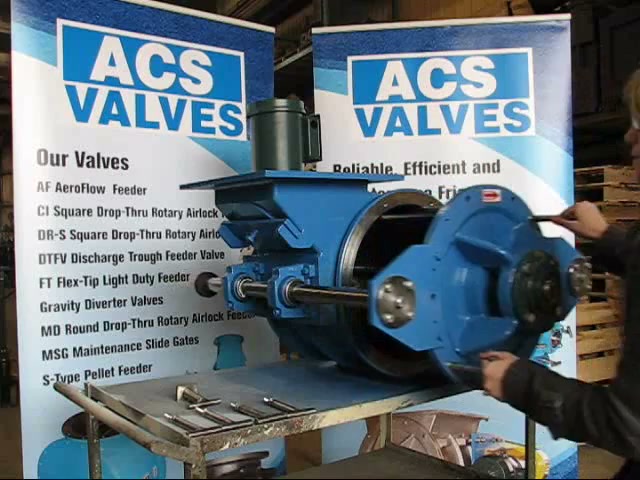
In this 65-second ACS Valves clip, a presenter opens a Quick-Clean rotary valve without tools: handles release, the rotor and endplate slide out on RotorRail supports, and a locating key guides reassembly. What the demo establishes is physical access to the product-contact zone — cleaning validation and sanitary certification still depend on the supplied model and the site's procedure.

Coperion
Coperion ZRD Rotary Valve for Powder Applications
Coperion presents the ZRD rotary valve and the design choices that adapt it to powder discharge, metering and pneumatic-conveying service.
Total reach: 10,524

Vortex – Solids & Bulk Handling Components
Vortex®: Orifice Slide Gate Valve
Vortex's video presents the Orifice Slide Gate Valve: a linear blade carries a machined orifice that moves into or out of alignment with the process connection to isolate or regulate dry-bulk flow.
Total reach: 68,292