
Independent industry shortlist for Pneumatic Conveying
Pneumatic Conveying Suppliers & Manufacturers 2026
Answer in brief
Coperion, Hosokawa Solids Solutions, KREISEL Industries, VAC-U-MAX, and Hefei Teclion Machinery Technology are five pneumatic conveying suppliers to compare in 2026.
Coperion builds dilute and dense phase systems, with dense phase pumps for 10 to 200 t/h over up to 1,000 m. Hosokawa Solids Solutions offers nine conveying systems from dilute phase to slow plug conveying.
KREISEL Industries covers long-distance conveying of abrasive mineral dusts, VAC-U-MAX specializes in vacuum conveying up to 25,000 lb/h, and Hefei Teclion supplies rotary and diverter valves.
Start supplier selection with your material, route, conveying mode, pressure boundary, and acceptance test.
By Editorial Team · Published July 14, 2026 · Updated October 9, 2026

How we selected these companies
ShowHide
We compared pneumatic conveying suppliers on five technical areas that decide whether a supplier fits a transfer duty.
- Pneumatic conveying range (25%) looks at the conveying modes a supplier builds, vacuum and pressure, dilute and dense phase, plug conveying, and at the rates, distances, and pressures those systems cover.
- Application coverage (25%) looks at the materials and duties the equipment is applied to, from pellets and food powders to cement, fly ash, and battery materials, and from truck unloading to blender loading.
- System integration (20%) covers how far the scope reaches beyond the conveying line into storage, feeding, dosing, weighing, dedusting, process equipment, and automation.
- Component design and certifications (15%) covers rotary valves, diverters, and receivers with their sizes, pressure and temperature ratings, wear protection, hygienic finish, and hazardous-area approvals.
- Testing and service (15%) covers test centers where your material can be conveyed before purchase, their line lengths and capacities, and support from startup through maintenance.
Range and application coverage carry the most weight because the first question for any powder and route is whether the supplier builds the conveying mode the duty needs, at the required rate and distance, and has applied it to a comparable material. Integration follows, because a conveying line only performs as well as its feeding, receiving, and control interfaces.
Pneumatic conveying range 25%
Which conveying modes are built, vacuum and pressure, dilute and dense phase, and the rates, distances, and pressures they cover.
Application coverage 25%
The materials, industries, and duties the equipment is applied to, such as unloading, blender loading, feeder refill, and ash or cement transfer.
System integration 20%
How far the supply scope reaches into storage, feeding, dosing, weighing, dedusting, process equipment, and automation.
Component design and certifications 15%
Rotary valves, diverters, and receivers with their sizes, pressure and temperature ratings, wear protection, hygienic finish, and approvals.
Testing and service 15%
Test centers for conveying trials with your material, their line lengths and capacities, and support from startup through maintenance.
Last reviewed October 7, 2026
Disclosure: Up to 40 percent of the places on this list can be booked. Booked and Featured entries are commercially supported, clearly labeled and carry no bought rank. Payment does not determine the editorial assessment or the ranked positions.
How to read this shortlist
Coperion, Hosokawa Solids Solutions, KREISEL Industries, VAC-U-MAX, and Hefei Teclion Machinery Technology supply pneumatic conveying equipment and systems, from complete dilute and dense phase plants to vacuum receivers and conveying valves. The order reflects conveying range, application coverage, system integration, component design and certifications, and testing and service.
The five differ in scope. Coperion and Hosokawa Solids Solutions build conveying into complete plants with feeding, dosing, and weighing. KREISEL Industries concentrates on long-distance conveying of abrasive mineral dusts and on wear-protected rotary valves. VAC-U-MAX centers on vacuum conveying, and Hefei Teclion Machinery Technology supplies rotary and diverter valves for dense and dilute phase lines. Decide first whether your project needs a system supplier or a component supplier.
Define the conveying question
Pneumatic conveying spans vacuum pickup, positive-pressure transfer, batch vessels, continuous feeding, and dilute or dense phase flow, often in combination. The right arrangement depends on material behavior, source and destination conditions, route, capacity, product quality, utilities, cleaning needs, and hazards. Qualify suppliers against these facts, not against one preferred label.
State the objective plainly. The plant may need to replace manual handling, cut dust, protect product, work around a layout constraint, raise capacity, or link several sources and destinations. Each objective shifts the value of flexibility, automation, containment, energy, and maintenance. A strong proposal explains the tradeoffs and names the requirement that controls the design.
Build a complete material and route data set
Material data: particle size, bulk density, permeability, cohesion, moisture, temperature, fragility, abrasiveness, electrostatic behavior, and relevant hazard information. Send representative samples when testing is planned. A familiar product name is not enough, because grade, supplier, storage, and process history all change conveying behavior.
Route data: horizontal distance, vertical lift, bends, flexible sections, source and destination pressures, available space, and future expansion. Define minimum and maximum rate, batch pattern, operating hours, changeover expectations, and the cost of a line stop. With this in hand, bidders can state their assumptions and you can compare designs on an equivalent basis.
Use videos to sharpen the inquiry
A good video shows equipment arrangement, operating sequence, access, and application context more clearly than a short product page, and it helps a buyer ask sharper questions. It still has boundaries: the filmed configuration may be old, may show one material, and may omit utilities, safeguards, control details, or problems met during operation.
A video shows one installation, not your duty. Ask the bidder for the current configuration of the proposed solution. When a point seen in a video affects selection, have the proposal confirm it with conditions, model details, and an acceptance method.
Compare system engineering rather than components
A pneumatic conveying package covers feeding, motive air, pipeline, bends, receiving equipment, filtration, controls, and interfaces. The proposal should say who owns each element and who guarantees the complete cycle. Component selection without system responsibility invites capacity disputes, unstable operation, overloaded filters, or a line that is hard to recover after a blockage.
Ask for an operating narrative covering startup, normal transfer, rate change, shutdown, line clearing, cleaning, and fault recovery, then review the instruments, alarms, permissives, and operator actions behind it. Availability lives in these details. A nominal rate says little about a system that needs frequent manual intervention or cannot restart reliably after routine disturbances.
Protect people, product, and plant
Combustible dust, hazardous-area suitability, pressure protection, food contact, and pharmaceutical compliance each need their own check against the offered configuration. Your engineering team must supply current requirements and verify the offered safeguards. Review dust containment, grounding, isolation, pressure relief, stored energy, hot surfaces, access, and maintenance for the complete connected system.
Product quality needs its own acceptance basis. If breakage, segregation, temperature rise, contamination, or residual product matters, define the sampling method and the allowable change. Cleaning claims should spell out access, sequence, waste handling, inspection, and verification. Pneumatic transfer reduces manual handling; it does not remove the need for disciplined hygiene and hazard review.
Evaluate commercial scope and support
Compare one installed-cost boundary that includes utilities, structures, electrical work, controls, installation, commissioning, training, spares, and performance testing, and record the exclusions. Compare energy at the same duty with the full motive-air system included. Compare maintenance across filters, valves, seals, bends, vacuum producers, blowers, and cleaning labor.
Support should turn into named commitments: who runs tests, who completes detailed design, who attends startup, and who responds when the system misses its guarantee. Ask for references with similar material behavior and route. A rank helps direct the inquiry, but the award belongs to the supplier that demonstrates the best fit for the project in testing and in the proposal.
For project use, keep a decision record of what the bidder committed to in writing and which claims were confirmed through testing. That record makes later review easier and keeps a figure from one model or duty from being carried over to another.
Partner with powderbulkvideos.com
Show your equipment where buyers compare suppliers.
Booked places and Featured Listings are limited to 40 percent of a Top List, clearly labelled and separate from the editorial ranking.
Selected companies
-
1Best for: Dilute and dense phase systems up to 200 t/h and 1,000 m with in-house valves and feeders
Coperion
Coperion
Coperion builds pressure and vacuum systems in dilute and dense phase for powders, pellets, and granules.
- Its dense phase pumps handle 10 to 200 t/h over distances up to 1,000 m at temperatures up to 480 °C, with the Spheri valve as the only moving part, and the E-finity system conveys fragile pellets continuously in slug form.
- Blower packages serve line sizes from 38 to 400 mm at up to 700 mbar vacuum or 1 bar pressure.
- The component range includes more than 150 rotary valve models, two-way diverter valves rated to 6 barg, and Series 2400 receivers for up to 6,800 kg/h.
- Test centers in Weingarten, Niederlenz, and Salina, Kansas, offer more than 2,000 m of conveying line.
View related CompanyTechnical score breakdown
- Pneumatic conveying range
- 5/5 · Pressure and vacuum systems in dilute and dense phase; dense phase pumps for 10 to 200 t/h over up to 1,000 m at up to 480 °C, blower packages for 38 to 400 mm lines.
- Application coverage
- 4.5/5 · Plastics, food and pet food, pharmaceutical, chemical, mineral, battery, and recycling duties, from railcar and truck unloading to feeder refill and fly ash transfer.
- System integration
- 5/5 · Conveying combined with loss-in-weight feeder refill, batch weighing on load cells, scale hoppers, PLC controls with recipe functions, and complete processing plants with extrusion and mixing.
- Component design and certifications
- 5/5 · More than 150 rotary valve models from 80 to 1,000 mm for 3.5 bar, 6 bar, or above 20 bar; diverter valves to 6 barg and 100 °C; sanitary, flameproof, and ATEX designs.
- Testing and service
- 5/5 · Test centers in Weingarten, Niederlenz, and Salina with more than 2,000 m of conveying line and above 300 t/h capacity; round-the-clock technical support, start-up service, and training.
-
Best for: Nine conveying systems from dilute phase to slow plug conveying, with storage, dosing, and weighing
Hosokawa Solids Solutions offers nine pneumatic conveying systems, from Solids Fly Pneu dilute phase conveying in vacuum or pressure operation to Solids Puls Pneu, a slow plug conveying system with bypass line, impulse valve, and relay stations that moves product at 0.5 to 6 m/s with loadings of 20 to 60 kg of product per kg of gas.
- Operating pressures reach 6 bar absolute on Solids Step Pneu.
- Senders, DBS and ZRS rotary valves, and MWW multi-way diverters with up to 20 outlets come from its own production, in basic, clean, hygienic, and heavy design lines.
- Storage, dosing, weighing, and automation belong to the same scope, and pressure vessels are built to AD 2000.
View related CompanyTechnical score breakdown
- Pneumatic conveying range
- 4.5/5 · Nine systems covering dilute phase, dense phase, and plug conveying in vacuum and pressure operation, with pressures up to 6 bar absolute, product speeds from 0.5 m/s, and loadings up to 100 kg per kg of gas.
- Application coverage
- 4/5 · Sugar, milk powder, instant coffee, pelletised carbon black, abrasives, hard minerals, PVC, and lime; more than 1,000 plug conveying systems built, including truck unloading with the silo vehicle as pressure vessel.
- System integration
- 4.5/5 · Storage, pneumatic conveying, dosing, weighing, big bag and sack handling, and process control from one supplier, with Diff Dos loss-in-weight dosing and Vacu Scale vacuum scales.
- Component design and certifications
- 4.5/5 · Hygienic design with internal surface roughness Ra of 0.8 µm or less and FDA-approved seals, designs following EHEDG guidelines, AD 2000 pressure vessels, ATEX 2014/34/EU certification, MWW diverters with up to 20 outlets.
- Testing and service
- 3.5/5 · Technical center for testing material properties, flow behavior, and process parameters; emergency support available around the clock, remote service, spare parts, and commissioning.
-
3Best for: Long-distance conveying of abrasive mineral dusts with wear-protected rotary valves
KREISEL Industries GmbH
KREISEL Industries GmbH
KREISEL Industries designs pneumatic conveying systems for distances beyond 1,000 m and rates above 200 t/h.
- The feeding devices are built in-house: high-pressure and blow-through rotary valves, pressure vessel systems, jet feeders, and airlifts.
- The RotoFeed high-pressure rotary valve feeds up to 200 m³/h against 1.5 bar differential pressure at up to 200 °C, with ceramic lining or UltraCarbide armouring against wear; it targets fine, non-caking dusts such as cement, lime, gypsum, ash, and coal dust.
- Standard rotary valves come in sizes from 70 to 2,500 mm for up to 1,000 m³/h and 800 °C, and dome valves shut off against 16 bar.
- A technical centre with a 160 m test line in DN 80 and DN 100 runs conveying trials with customer material.
View related CompanyTechnical score breakdown
- Pneumatic conveying range
- 4.5/5 · Conveying systems beyond 1,000 m and above 200 t/h, fed by high-pressure and blow-through rotary valves, pressure vessel systems, jet feeders, or airlifts.
- Application coverage
- 3.5/5 · Fine, abrasive, and hot bulk solids such as cement, lime, gypsum, ash, raw meal, and coal dust, including pulverized coal conveying with burner feeding.
- System integration
- 3.5/5 · Supply from storage silo through pneumatic conveying to dedusting filters, with slide gates, screw feeders, air slides, loading equipment, and automation engineering.
- Component design and certifications
- 5/5 · Rotary valves from 70 to 2,500 mm for up to 1,000 m³/h and 800 °C; RotoFeed for 1.5 bar and 200 °C with ceramic of Mohs hardness 8.5 to 9.0; dome valves DN 100 to DN 500 for 16 bar; ATEX designs; ISO 9001:2015.
- Testing and service
- 4.5/5 · Technical centre with a 160 m conveying line in DN 80 and DN 100, pressure measurement along the line, a filter test stand, and a bulk solids laboratory; inspection, repair, spare parts, assembly, and commissioning.
-
Best for: Vacuum conveying from handfuls to 25,000 lb/h, including direct charging of blenders
VAC-U-MAX builds vacuum conveying systems in dilute and dense phase; positive pressure takes over where dilute phase runs exceed about 300 ft or rates go beyond 25,000 lb/h.
- Each system combines a pickup point, a vacuum receiver, a vacuum producer, and UL-listed controls.
- The pre-engineered Signature Series moves up to 1,500 or 3,500 lb/h through 12 in or 16 in receivers built in 304 or polished 316L stainless steel, driven by a venturi, regenerative blower, or vacuum pump.
- Direct-charge systems load vacuum-tolerant blenders, mixers, and reactors at up to 6,000 lb/h.
- A 6,000 sq ft test lab runs customer materials over tubing runs up to 400 ft at 10 to 25,000 lb/h.
View related CompanyTechnical score breakdown
- Pneumatic conveying range
- 4/5 · Vacuum conveying in dilute and dense phase from 10 to 25,000 lb/h, with positive pressure for longer runs and higher rates; Signature Series packages for 1,500 and 3,500 lb/h.
- Application coverage
- 4/5 · Blender, mixer, and reactor loading at up to 6,000 lb/h, tablet press loading, loss-in-weight feeder refill, and combustible dust handling in food, pharmaceutical, and chemical plants.
- System integration
- 3/5 · Conveying tied into batch, continuous, loss-in-weight, and gain-in-weight processes, with the process vessel itself serving as vacuum receiver in direct-charge systems.
- Component design and certifications
- 4/5 · Receivers in 304 or polished 316L stainless steel with 180-grit finish and static-conductive PTFE filters; UL-listed NEMA 4X controls with NEMA 7/9 option; USDA-accepted receivers.
- Testing and service
- 4.5/5 · A 6,000 sq ft test lab with tubing runs up to 400 ft, convey rates from 10 to 25,000 lb/h, and vacuum pumps up to 30 HP; support through installation, startup, and operator training.
-
5Best for: Rotary and diverter valves for dense and dilute phase lines, rated from -52 °C to +200 °C
Hefei Teclion Machinery Technology Co. Ltd.
Hefei Teclion Machinery Technology Co. Ltd.
Hefei Teclion manufactures conveying valves and modules and integrates them into dense and dilute phase systems.
- The rotary valve range has eight powder series, among them the RDB blow-through, RDC quick-clean, and RDP polished sanitary types, plus valves for granular products.
- Diverter valves come in versions for pneumatic conveying lines and for gravity flow, alongside gate valves, feeding stations, chamber pumps, venturi eductors, and air control units.
- Valves are rated for temperatures from -52 °C to +200 °C, with pressure ratings set by valve type.
- Certifications and conformity marks include ISO 9001, ISO 14001, ISO 45001, CE, ATEX, FDA, and EAC.
- An on-site test facility runs durability tests over 7,500 switch cycles, and the plant covers more than 9,000 m².
View related CompanyTechnical score breakdown
- Pneumatic conveying range
- 3.5/5 · Valves and modules for dense and dilute phase systems: rotary valves, diverter valves, gate valves, feeding stations, chamber pumps, venturi eductors, and air control units.
- Application coverage
- 3/5 · Petrochemical, chemical, battery material, food, feed, pharmaceutical, mineral, dust, and ash duties, with users in more than 20 countries.
- System integration
- 2.5/5 · Module integration around the conveying line: feeding stations, chamber pumps, venturi eductors, and air control units.
- Component design and certifications
- 4.5/5 · Eight powder rotary valve series including blow-through, quick-clean, and polished sanitary types; ratings from -52 °C to +200 °C; ISO 9001, ISO 14001, ISO 45001, CE, ATEX, FDA, and EAC.
- Testing and service
- 3.5/5 · On-site test facility with durability testing over 7,500 switch cycles, plus testing and inspection equipment in a plant of more than 9,000 m².
-
Work with usAvailable
3 places on this Top List are open
Bookable places are limited, clearly labelled and separate from the editorial ranking above.
Frequently asked questions
Which pneumatic conveying supplier is best?
There is no universal best supplier. The right choice depends on the material, the conveying mode, the route, the transfer rate, and the process conditions. A plant moving fragile pellets needs a different system than one moving hot fly ash or loading a pharmaceutical blender, so compare bidders on trials with your own material.
Can a supplier pay for a higher position on this list?
No. The ranked positions follow the five technical criteria: conveying range, application coverage, system integration, component design and certifications, and testing and service. Booked and Featured places are labeled as such and carry no rank.
When does dense phase conveying make sense instead of dilute phase?
Dilute phase carries particles airborne at high gas velocity, typically 15 to 40 m/s, and suits free-flowing, insensitive, non-abrasive materials. Dense phase and plug conveying move product at low speed, down to about 0.5 m/s, under higher pressure. That protects fragile or blended products and cuts wear with abrasive ones, at the price of a more demanding feeder and control design.
What should buyers provide to a pneumatic conveying supplier?
Provide representative material data, the required minimum and maximum rate, route geometry with distances, lift, and bends, pickup and destination conditions, the duty cycle, and your hygiene, containment, and safety requirements. Send a representative sample if a conveying trial is planned.
Why run a conveying trial before ordering?
Conveying behavior depends on particle size, bulk density, fluidization, and cohesion, and it changes with grade and moisture. A trial on a test line of known length and diameter yields pressure loss, air demand, and product degradation data for your material, which the supplier can scale to the real route and write into the guarantee.
Sources and further reading
- A review of characteristics and influencing factors of dilute and dense phase pneumatic conveying of particles in pipelines, Particuology
- Combustible Dust Safety and Health Topics, OSHA
- Developing pneumatic conveying classification diagram for powders, Powder Technology
- Dilute or Dense Phase Pneumatic Conveying?, American Institute of Chemical Engineers
- Dual-Purpose Vacuum Conveyor Triples Production Throughput, PCI Magazine
- GL 36: Hygienic Engineering of Transfer Systems for Dry Particulate Materials, EHEDG
- Inside the Bulk Solids Innovation Center: Full-Scale Test Lab, Powder & Bulk Solids
- NFPA 660: Now the Only NFPA Standard for Combustible Dusts, Powder & Bulk Solids
- Overview of Particulate Handling Technology (short course), The Wolfson Centre, University of Greenwich
- Pneumatic conveying system for bulk material handling, making.com
- Safe handling of combustible dusts, Health and Safety Executive
- Solids pneumatic conveying systems, BulkInside
- Teclion exhibitor profile, POWTECH TECHNOPHARM
- Vac-U-Max Introduces Vacuum Receivers, Chemical Processing
Related content
Continue exploring
Move from this page to the companies, videos and technical topics that add useful context.
Companies


Videos


Hosokawa Solids Solutions GmbH
Hosokawa Solids Solutions: Solids Puls Pneu Conveying System
Hosokawa Solids presents the Solids Puls Pneu plug-conveying system with bypass, impulse-valve and relay-station components.
Total reach: 70,221

HS Umformtechnik GmbH
HS Umformtechnik Company Video
HS Umformtechnik presents large-radius pipe bends, pipe couplings and branch pipes for pneumatic conveying systems.
Total reach: 6,262
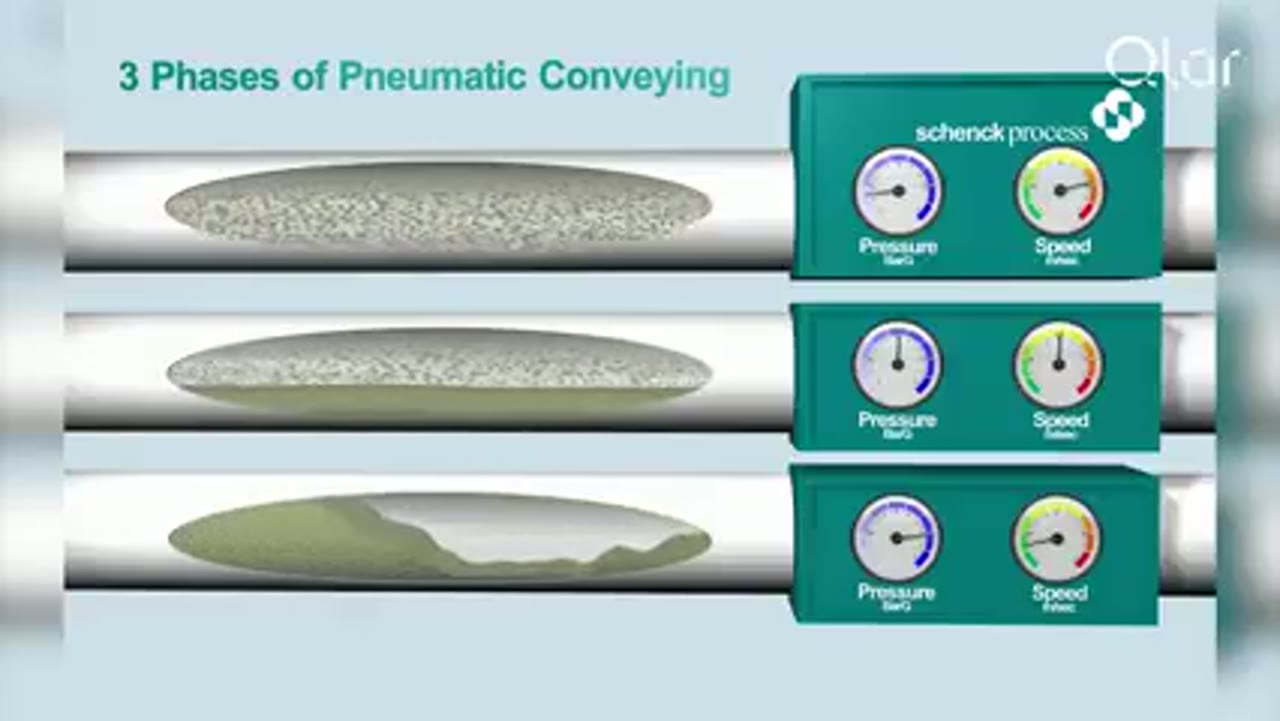
Qlar
Pneumatic Conveying Explained: The 3 Key Phases of Dense Phase Conveying
Qlar explains the three phases of dense phase pneumatic conveying and where each one fits when powders, granules and bulk solids have to move without being damaged.


VAC-U-MAX
VAC-U-MAX: 10 Critical Design Factors to Consider When Designing Vacuum Conveying Systems
VAC-U-MAX presents ten design factors for vacuum conveying, including pickup, material behavior, route, receiver, filtration, discharge and controls.
Total reach: 10,990

VAC-U-MAX
VAC-U-MAX: Signature Series Packaged Vacuum Conveying Systems
With over 65 years of experience in pneumatic conveying and more than 10,000 powders and granular materials handled, VAC-U-MAX packages its Signature Series vacuum conveying systems as complete units: receiver, UL-listed controls, convey hose, filters, and vacuum producer.
Total reach: 10,588
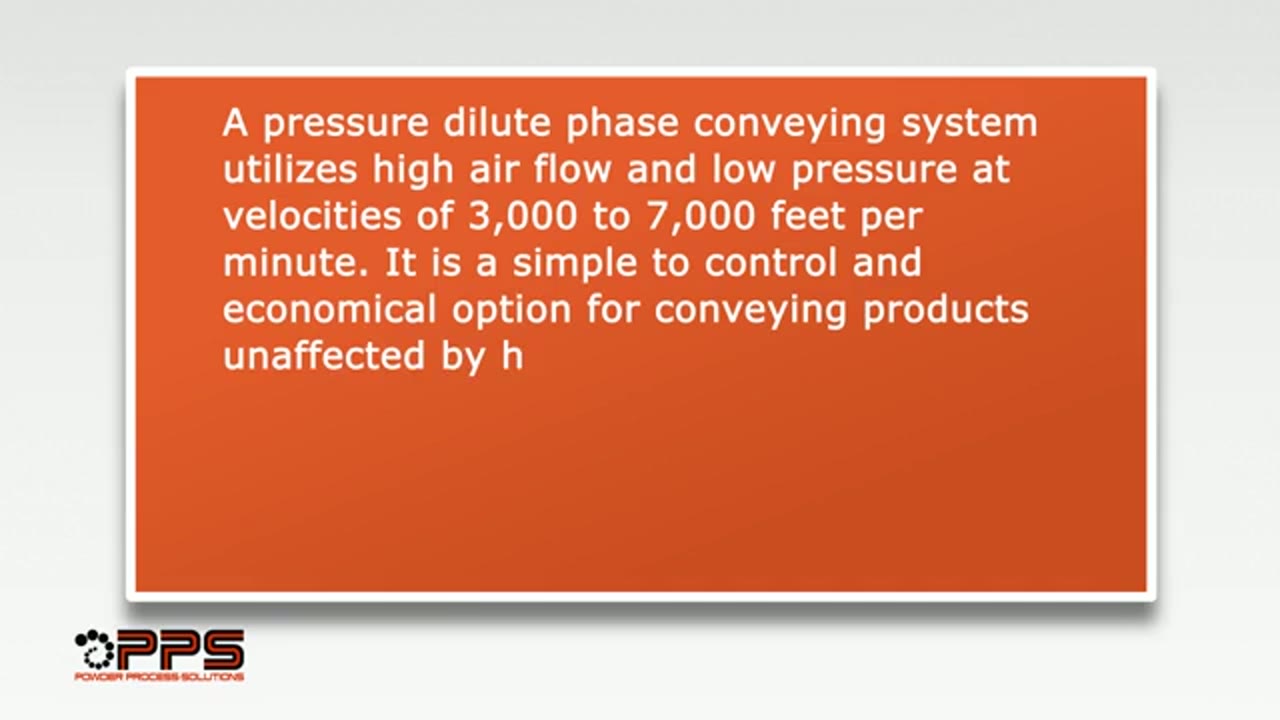
Powder Process-Solutions
Pressure Dilute Phase
The Powder Process-Solutions animation shows a positive-pressure dilute-phase arrangement in which a gas stream pushes suspended material through the conveying line toward the receiver.
Total reach: 92,214