
Comparison
Cartridge vs Baghouse Dust Collector
Answer in brief
Cartridges give far more filter area in the same footprint; bags tolerate harder conditions.
The decision usually turns on the dust itself: sticky, moist, hot or fibrous dust blinds pleated media quickly, while fine dry dust suits it well.
- Fine, dry, ambient temperature dust in a tight space: cartridge.
- Moist, sticky, hot or fibrous dust: bags.
- Both need explosion protection assessed on the collected dust, not on the product.
By Editorial Team · Published October 21, 2026 · Updated November 10, 2026
Sponsored visibility
Featured videos for this topic
Paid placements are clearly marked and remain separate from the editorial related-video selection.
What actually differs
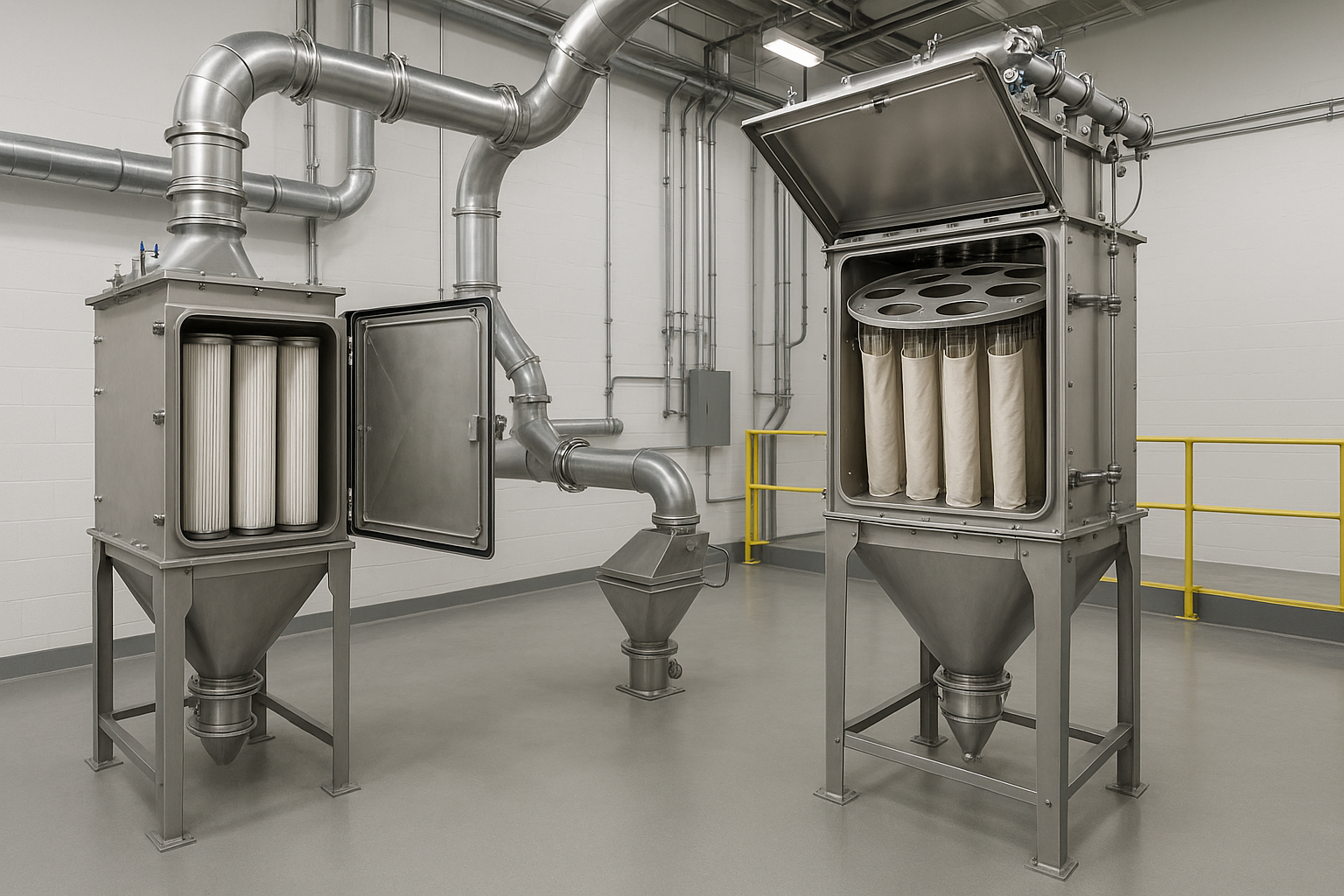
A cartridge filter is pleated media, which packs a large surface into a small volume.
A bag filter is a cylindrical sleeve with far less area per unit of volume but an open surface that releases its cake more readily.
Pleats are the advantage and the weakness: they multiply area, and they trap anything that will not shake loose.
Decision criteria
| Criterion | Cartridge | Baghouse |
|---|---|---|
| Filter area per footprint | High | Lower |
| Suits | Fine, dry, free-releasing dust | Moist, sticky, fibrous, hot dust |
| Temperature | Limited by media, usually moderate | Higher with the right fabric |
| Blinding risk | Higher, pleats hold material | Lower |
| Change-out | Fast, fewer elements | Slower, many bags and cages |
| Element cost | Higher each, fewer needed | Lower each, more needed |
Where the cartridge collector is the better choice
- Fine dry dust from grinding, blending or packing.
- Installations with limited floor space or height.
- Plants that value quick filter changes with minimal exposure.
Where the baghouse is the better choice
- Dust carrying moisture, oil or condensation risk.
- High temperature streams where fabric selection matters.
- Fibrous or coarse dust that would bridge between pleats.
Bags also tolerate higher dust loads, which makes them the usual choice directly downstream of a process generating large quantities rather than at a general extraction point.
Partner with powderbulkvideos.com
Put your expertise beside the decisions engineers are making.
Connect a relevant company profile and technical video portfolio with clearly labelled visibility on this topic.
Where neither fits
Neither handles a stream that is above the dew point on one side and below it on the other; condensation turns any filter into a blocked filter.
Sticky or condensable streams often need conditioning, a pre-separator or a wet system instead.
Explosion protection is not a differentiator
Both collector types contain a dust cloud in an enclosure, and both need the same assessment: venting, suppression or containment, plus isolation of the ducts.
The protection is designed from the explosion characteristics of the collected fines, which are usually finer and more reactive than the product being handled.
What to measure before deciding
- Dust characteristics: particle size, moisture, stickiness and temperature.
- Air volume and the resulting air-to-cloth ratio for each media type.
- Available footprint and height.
- Explosion characteristics of the collected fines.
Frequently asked questions
Which collector type is cheaper to run?
It depends on filter life. A cartridge collector with a dust that blinds pleats can cost more per year than a baghouse, even though the element count is lower.
Can I retrofit cartridges into a baghouse?
Retrofit kits exist and can increase filter area, but they only make sense where the dust genuinely suits pleated media. Fitting them to a moist or sticky dust moves the problem rather than solving it.
Does a dust collector need explosion protection?
If the dust is combustible, yes. The collector is the vessel with the highest dust concentration in most plants, and it is the single most commonly protected item.
Related content
Continue exploring
Move from this page to the companies, videos and technical topics that add useful context.
Companies


Videos

Camfil APC
Overview of Gold Series Industrial Dust Collectors
Camfil APC provides an official overview of its Gold Series industrial dust collector platform and the role of cartridge collection in industrial dust-control systems.
Total reach: 3,407

VAC-U-MAX
VAC-U-MAX: Vacuum Receiver Designs, Features, Benefits and Filter Types
This VAC-U-MAX video explains vacuum receiver configurations and the roles of filtration, discharge, and cleaning. It helps define the system boundary and major components. Capacity, filtration, pressure loss, discharge, and combustible dust suitability depend on the material and the complete installation.
Total reach: 18,139

DSH Systems
DSH Systems: Before & After DSH7 Truck Loading Limestone Sand
Side-by-side comparison of truck loading operations before and after installing the DSH 7 Corten-steel Dust Suppression Hopper, loading limestone sand at up to 950 metric tons per hour with almost no airborne dust.
Total reach: 25,048

DSH Systems
DSH Systems: Installation Profile – Phu My Port in Vietnam
DSH Systems documents a dust-suppression hopper installation for dry granular material transfer at Phu My Port in Vietnam.
Total reach: 23,752

DSH Systems
DSH Systems: Introduction Dust Suppression Hopper
DSH Systems introduces its dust-suppression hopper for controlling dust fallout during dry-bulk loading.
Total reach: 24,860

HS Umformtechnik GmbH
HS Umformtechnik Company Video
HS Umformtechnik presents large-radius pipe bends, pipe couplings and branch pipes for pneumatic conveying systems.
Total reach: 6,384

VAC-U-MAX
VAC-U-MAX: Model 1050 Continuous-Duty Industrial Vacuum Cleaner
This VAC U MAX video explains the Model 1050 portable continuous duty vacuum system for dense material recovery. It helps define the system boundary and major components. Capacity, filtration, pressure loss, discharge and combustible dust suitability depend on the material and complete installation.
Total reach: 46,553

Imperial Systems
CMAXX Dust and Fume Collector Install Video
Imperial Systems demonstrates installation steps and site interfaces for a CMAXX dust and fume collector.
Total reach: 1,939
Technologies
Applications
- Automated Sack Emptying in Chemical Plants
- Automated Sack Emptying in Food Production
- Automated Sack Emptying in Mineral Processing
- Automated Sack Emptying in Pharmaceutical Plants
- Automated Sack Emptying in Plastics Plants
- Belt Conveying in Building Materials Plants
- Belt Conveying in Food Production
- Belt Conveying in Mining and Mineral Plants
- Belt Conveying in Pet Food Plants
- Belt Conveying in Recycling Plants
- Bulk Bag Discharge in Building Materials Plants
- Bulk Bag Discharge in Chemical Batching
- Bulk Bag Discharge in Food Production
- Bulk Bag Discharge in Mineral Processing
- Bulk Bag Discharge in Pet Food Plants
- Bulk Bag Discharge in Pharmaceutical Production
- Bulk Bag Discharge in Plastics Compounding
- Dust Collection in Building Materials Plants
- Dust Collection in Food Production
- Dust Collection in Grain and Feed Plants
- Dust Collection in Mineral Processing
- Dust Suppression at Transfer Points in Grain Handling
- Dust Suppression in Cement and Aggregate Loading
- Dust Suppression in Food Ingredient Handling
Materials
- Activated Carbon
- Alumina
- Battery Black Mass
- Bentonite
- Breakfast Cereal
- Calcium Carbonate
- Carbon Black
- Cocoa Powder
- Coffee Beans & Ground Coffee
- Detergent Powder
- Dry Pasta
- Expanded Polystyrene Beads
- Fly Ash
- Glass Cullet
- Gypsum Powder
- Hydrated Lime
- Infant Formula Powder
- Milk Powder
- Pet Food Kibble
- Petroleum Coke
- Polysilicon
- Potato Chips & Snack Foods
- Pulverized Coal
- PVC Resin