
Application
Bulk Bag Discharge in Pet Food Plants
Answer in brief
In pet food plants bulk bags carry the premixes, and the premixes are the ingredients with the smallest inclusion and the biggest consequence.
A bridging bag that empties unevenly shows up as an out-of-specification batch rather than as a flow problem.
- Empty the bag completely and verify it.
- Sieve before the mixer.
- Keep medicated and standard premixes physically separated.
Reviewed October 21, 2026
The problem
Pet food plants run many recipes through the same equipment, so the bulk bag station is a changeover problem as much as a discharge one.
The materials range from free-flowing grain meals to fat-coated premixes that stick to everything they touch. Medicated and species-specific feeds add a carryover concern that is regulated rather than cosmetic, and the fat content makes residues cling where a dry powder would fall away.
Desired outcome
A station that empties every material on the recipe list completely, and that can be cleaned between recipes in the time the production plan allows.
The practical measure is not the discharge rate but the changeover: how long from the last bag of one product to the first bag of the next, with the carryover demonstrably controlled.
A verified empty bag rather than an assumed one. A premix at a fraction of a percent that only half discharged is an out of specification batch, and the symptom appears in an analysis rather than at the station.
Medicated and standard premixes kept physically apart, through dedicated stations or dedicated contact parts, because the carryover limit here is regulated and a cleaning procedure has to be validated to count.
For pharmaceutical production the containment band governs, and the usual gap is the discard of the empty liner rather than the transfer itself.
Process approach
The bag is lifted into the frame and the spout sealed into the hopper before it is opened.
Massaging is usually needed for the meals and almost always for anything containing fat, which consolidates while the bag stands. Paddles working the lower third do most of the useful work.
Below the spout the hopper feeds a screw or rotary valve, and the geometry matters more than usual: every ledge is a place where a fat-bearing residue stays behind and carries into the next recipe. Smooth transitions, full access and a design that can be dry cleaned are worth more than extra capacity.
Sieving sits between the station and the mixer as a routine step. Bulk bags are the most likely source of foreign material in the plant, the liner itself sheds, and a premix at low inclusion gives the mixer no chance to disperse a lump that arrived intact.
Fat is the aggravating factor throughout. It consolidates the material in the bag so massaging becomes essential, and it leaves a film on every surface below, which is where the previous recipe stays. Geometry without ledges matters more here than extra capacity.
- Seal, open, massage, meter.
- Geometry chosen for cleaning, not only for flow.
- Changeover time measured, not estimated.
- Sieving between the station and the mixer as a routine step, not a correction.
- Dedicated stations or contact parts where medicated premixes are involved.
- Empty bag verified, since a partly discharged premix becomes an analysis failure.
Selection factors
- The recipe list in full, including the stickiest premix rather than the most common meal.
- Carryover requirement, which is regulated where medicated feeds are involved.
- Cleaning method and time, which decide how flexible the line really is.
- Fat content, which drives both consolidation in the bag and residue on the equipment.
- Dust explosion characteristics of the meals, which are organic and explosible.
- Verification of complete discharge, which for a low inclusion premix is a batch quality control.
- Sieve mesh and position, since the bag is the main foreign body route.
- Regulated carryover limits and whether a cleaning procedure can be validated against them.
Common failure modes
- Station designed around the free-flowing meal and used for the fat-coated premix
- Ledges and dead corners that hold a residue no dry cleaning will remove
- Changeover time estimated rather than measured, so the plan assumes a cleaning that does not happen
- No massaging, so bags of consolidated premix are opened and worked by hand
- Medicated feed carryover treated as a quality matter rather than a regulated one
- Partly discharged premix accepted as empty, producing an out of specification batch
- No sieve between the station and the mixer, so bag liner fragments reach the product
- Medicated premix handled on a shared station with an unvalidated cleaning procedure
Partner with powderbulkvideos.com
Put a relevant technical solution in this decision path.
Connect your company and video evidence with clearly labelled visibility where engineers evaluate this material, application, industry or product.
Frequently asked questions
What limits flexibility in a pet food line?
Changeover time. The discharge rate is rarely the constraint; how long it takes to clean the station between recipes decides how often the plant is willing to switch.
Why does fat content matter so much?
It makes the product consolidate in the bag and leave a clinging residue on the equipment. Both affect the design: massaging for the first, cleanable geometry for the second.
Is carryover a quality or a compliance question?
Both, and with medicated feeds it is a compliance question. That raises the cleaning from a good practice to a documented requirement.
Why sieve after a bulk bag station?
Because the bag is the most likely source of foreign material in the plant, and the liner itself sheds. At low inclusion rates the mixer cannot disperse a lump that arrives intact, so it reaches the product.
Related content
Continue exploring
Move from this page to the companies, videos and technical topics that add useful context.
Companies
Videos
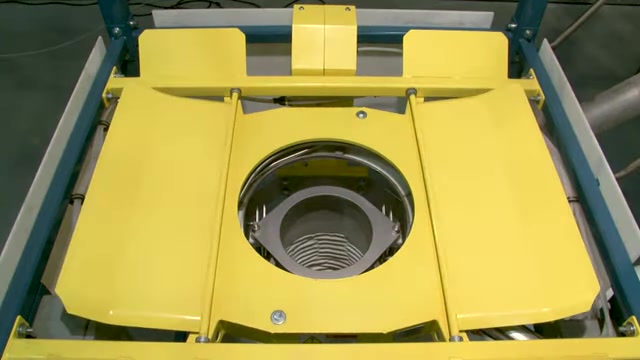
Flexicon
Flexicon BULK-OUT Bulk Bag Dischargers
Flexicon presents its BULK-OUT bulk bag discharger range: forklift-loaded BFF frames, hoist-and-trolley BFC frames, split and half frames, and accessories for dust-free untying, retying and flow promotion.
Total reach: 73,122
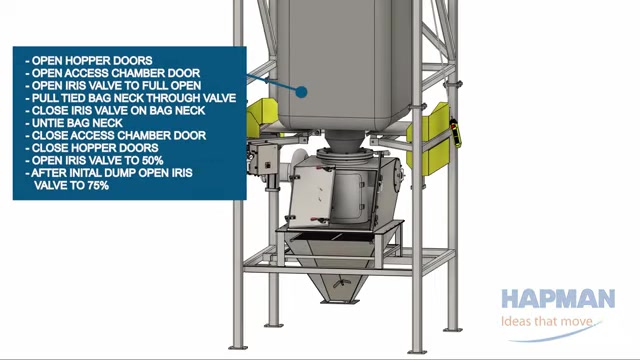
Hapman
Hapman Bulk Bag Hoist Unloader with Dust Collection
Hapman shows a hoist-loaded bulk bag unloader with a round access chamber and integrated dust collection for dust-free discharge.
Total reach: 2,978
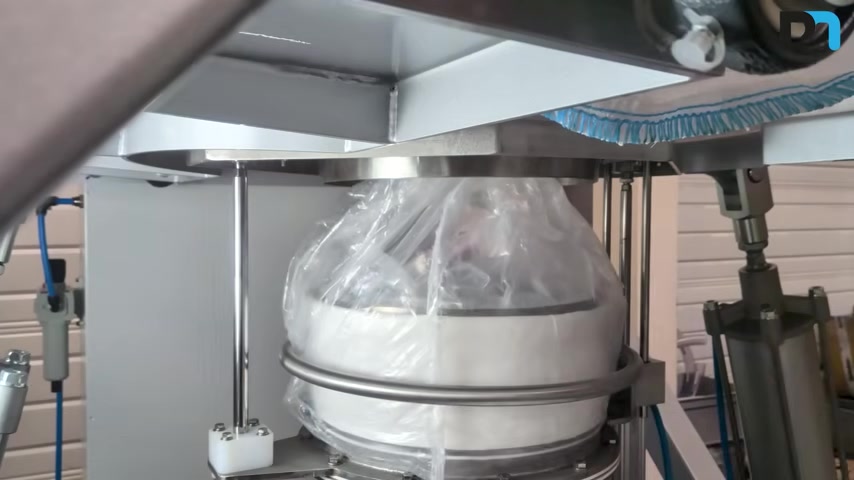
Palamatic Process
Palamatic Process: Emptying Big Bags of Sensitive Powders with OEB Containment
A Palamatic Process engineer explains the OEB big bag discharge station for toxic, CMR and ultra-fine powders, including the sleeve tie-off that keeps containment through a bag change.
Total reach: 18,760
Technologies
- Bulk Bag Unloading Systems
- Bulk Bag Unloading Systems: Selection and Design
- Dust Collection & Air Pollution Control
- Dust Collection & Air Pollution Control Technology Guide
- Feeding & Dosing Control
- Feeding & Dosing Control
- Screening & Sieving Systems
- Screening & Sieving Systems for Powder and Bulk Solids
- Vacuum Conveying
- Vacuum Conveying Systems