
Comparison
Bulk Bag Unloading vs Sack Tipping
Answer in brief
The decision is usually made by people and dust rather than by tonnage.
Bulk bags remove repetitive lifting and cut the number of open transfers per tonne, while sacks keep flexibility for small batches and many recipes.
- Above roughly one tonne per charge point per hour, bulk bags win on labour alone.
- Many products in small quantities keep sacks economic.
- Both need containment at the open point; neither is dust free by default.
By Editorial Team · Published October 21, 2026 · Updated October 21, 2026
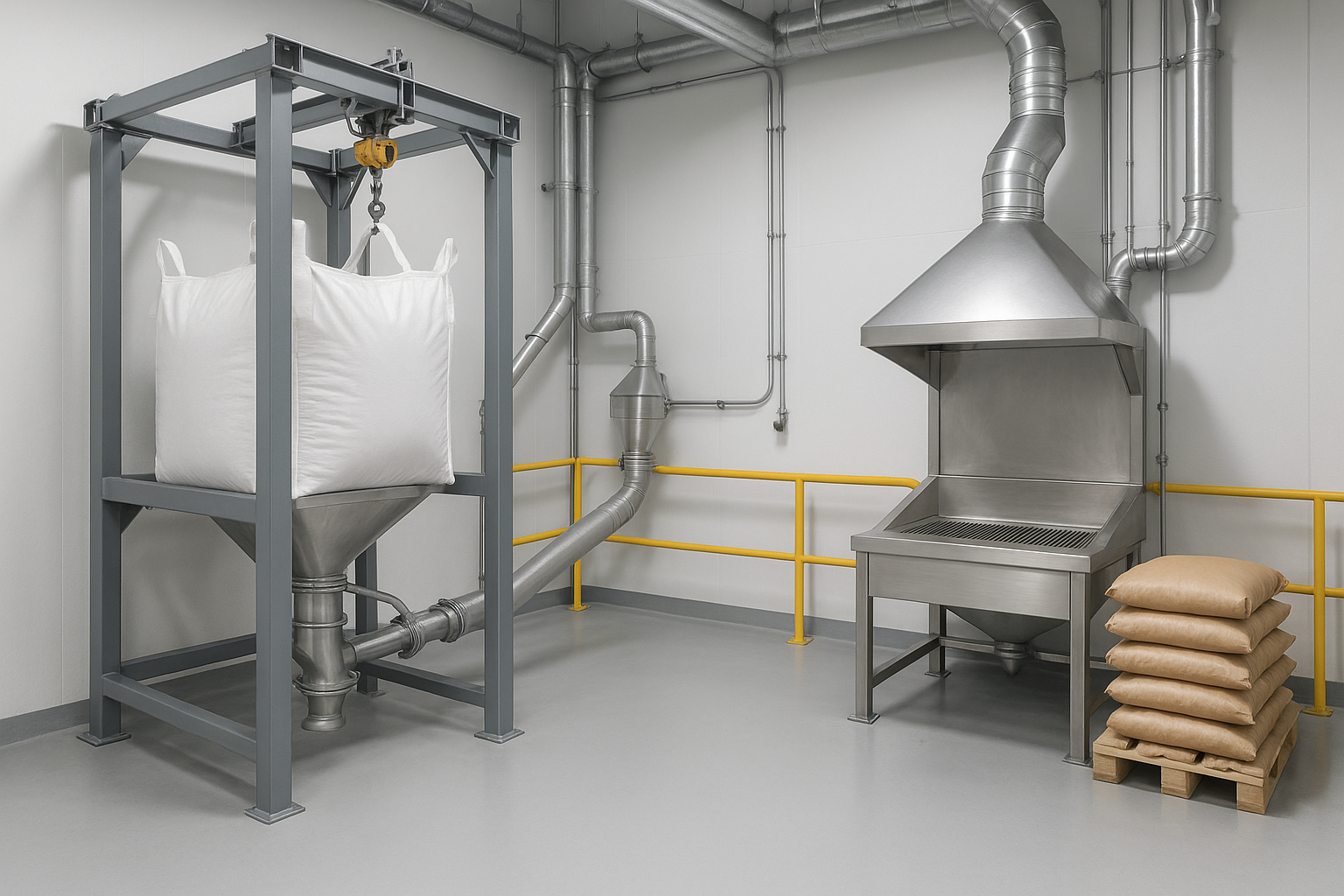
Sponsored visibility
Featured videos for this topic
Paid placements are clearly marked and remain separate from the editorial related-video selection.
What actually differs
The physical difference is the number of open transfers per tonne and the weight a person lifts.
A tonne delivered in 25 kg sacks means forty lifts and forty cut-and-tip operations, each one a dust release and a manual handling event.
The same tonne in one bulk bag means one crane or hoist movement and one spout connection.
The second difference is changeover. A sack station can switch product in minutes; a bulk bag station holds a part-used bag that has to be resealed, tracked and stored.
Decision criteria
| Criterion | Bulk bag unloading | Sack tipping |
|---|---|---|
| Labour per tonne | Low | High |
| Manual handling risk | Low, mechanical lifting | High, repetitive lifting |
| Open transfers per tonne | One | Around forty |
| Changeover | Slower, part bags to manage | Fast |
| Equipment cost | Higher, includes lifting | Lower |
| Suits | High volume, few products | Many recipes, small quantities |
Where bulk bag unloading is the better choice
- One or two main ingredients consumed in tonnes per shift.
- Products with a meaningful occupational exposure limit, where fewer open transfers directly reduce exposure.
- Plants with a manual handling injury history at the charge point.
A discharger with a sealed spout connection, bag massaging for cohesive powders and integrated extraction gives the dust reduction that justifies the investment.
Partner with powderbulkvideos.com
Put your expertise beside the decisions engineers are making.
Connect a relevant company profile and technical video portfolio with clearly labelled visibility on this topic.
Where sack tipping is the better choice
- Recipe-driven plants with many minor ingredients.
- Products bought in small quantities where a bulk bag would sit part-used for weeks.
- Sites where the ingredient is only available in sacks.
A dust-controlled tip station with an integrated sack compactor and extraction removes most of the exposure that manual tipping is criticised for.
Where neither fits
Highly potent or highly toxic materials need contained transfer rather than either open method, usually a closed docking system rated to a defined containment performance.
Very cohesive powders need the question answered upstream: a bag that will not discharge is a problem in both formats.
What to measure before deciding
- Consumption per product per shift, not per year.
- Number of products charged at the same point.
- Exposure limit of each material and current measured exposure.
- Flow behavior of the powder, which decides whether massaging or agitation is needed.
Frequently asked questions
Is a bulk bag station automatically dust free?
No. The spout connection, the bag untying method and the extraction decide the exposure. An open cuff over a hopper releases dust regardless of the bag size.
What happens to a part-used bulk bag?
It has to be resealed, labelled and stored, and in a food or pharmaceutical plant also protected against contamination. This is the main practical cost of bulk bags in recipe plants.
Can one station handle both formats?
Yes, combined stations exist, and they suit plants in transition or with one bulk ingredient and several minor ones.
Related content
Continue exploring
Move from this page to the companies, videos and technical topics that add useful context.
Companies
Videos
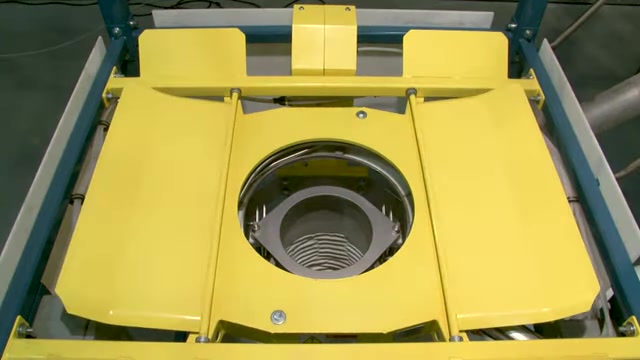
Flexicon
Flexicon BULK-OUT Bulk Bag Dischargers
Flexicon presents its BULK-OUT bulk bag discharger range: forklift-loaded BFF frames, hoist-and-trolley BFC frames, split and half frames, and accessories for dust-free untying, retying and flow promotion.
Total reach: 72,335
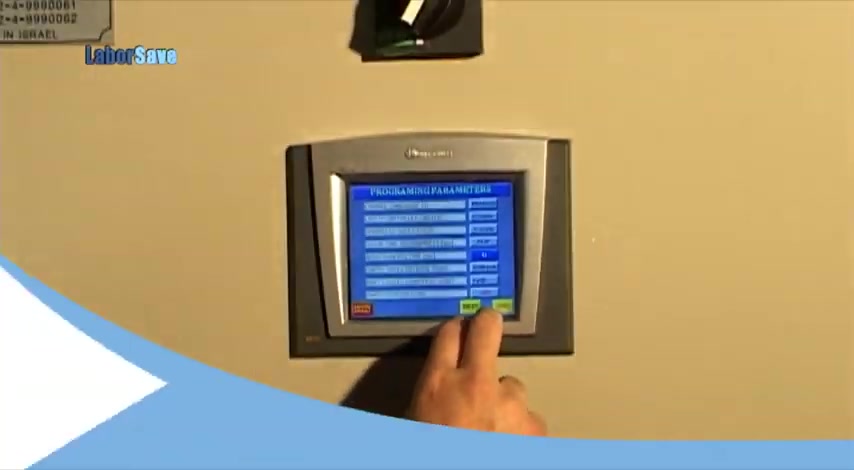
LaborSave
LaborSave: The Original Automatic Bag Emptying Machine
LaborSave presents its fully automated bag emptying machine: whole pallets of sacks are lifted, cut open and emptied into a hopper without an operator handling a single bag.
Total reach: 15,164
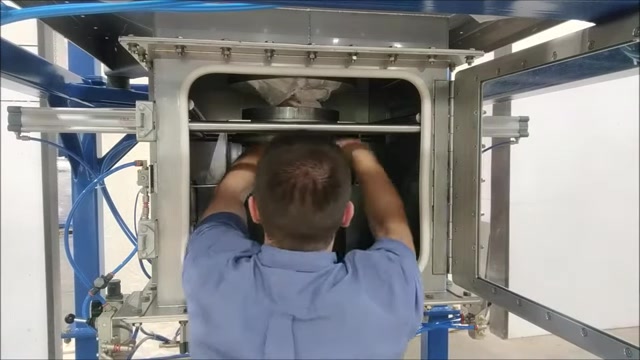
Carolina Conveying
Carolina Conveying Bulk Bag Unloader: Clamping Down on Dust
Carolina Conveying shows how its bulk bag discharge station contains dust: the spout is untied inside a sealed access module and clamped pneumatically to a feed tube.
Total reach: 17,876
Hapman
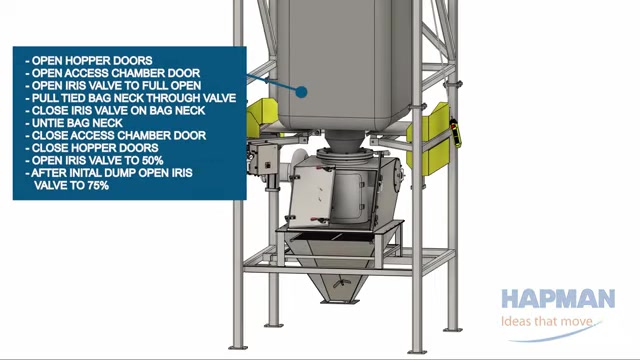
Hapman Bulk Bag Hoist Unloader with Dust Collection
Hapman shows a hoist-loaded bulk bag unloader with a round access chamber and integrated dust collection for dust-free discharge.
Total reach: 2,889
Hapman
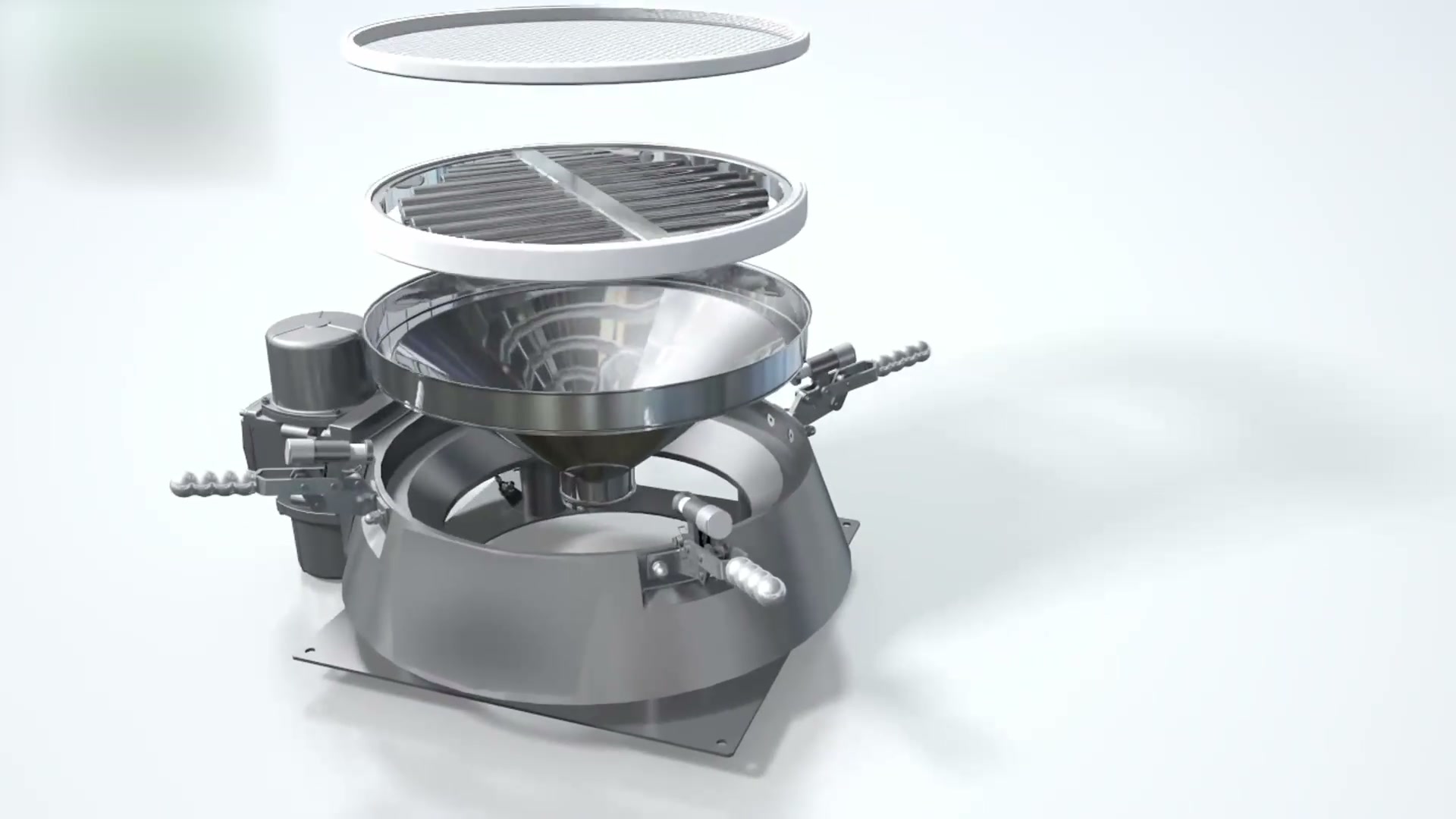
Hapman Compact Sieve Animation
Hapman's animation shows a compact vibratory sieve mounted beneath a bulk bag unloader, screening powder before it enters the next process step. The sieve is a high-capacity, easy-clean option for restricted spaces.
Palamatic Process
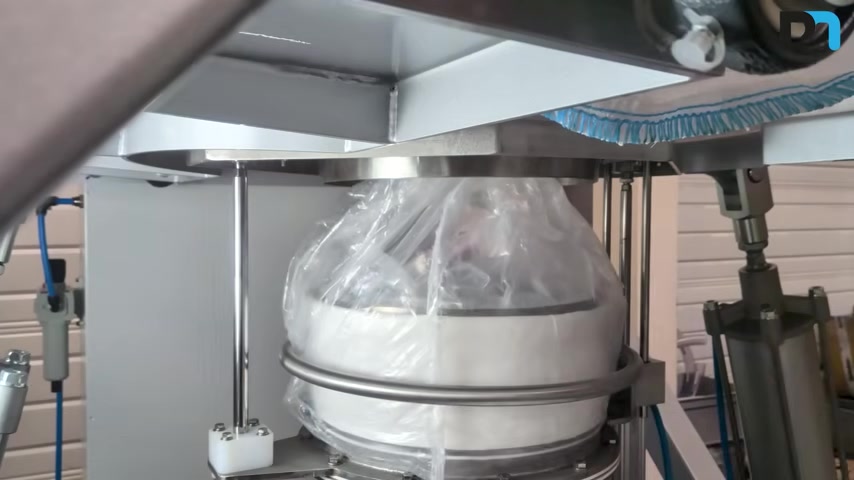
Palamatic Process: Emptying Big Bags of Sensitive Powders with OEB Containment
A Palamatic Process engineer explains the OEB big bag discharge station for toxic, CMR and ultra-fine powders, including the sleeve tie-off that keeps containment through a bag change.
Total reach: 18,653

F.lli Sacchi S.n.c.
Smart Pick – Fully Automated Bag Emptying and Processing of Complex Recipes
The video shows the F.lli Sacchi SmartPick robotic bag emptying system. A robot selects bags from pallet stations, presents them to a cutting and emptying station, and supports recipe controlled ingredient handling.
Total reach: 23,051

Vortex – Solids & Bulk Handling Components
Vortex®: Telescoping Loading Spout
Vortex presents a telescoping spout for guiding dry bulk material into a truck, railcar, vessel or stockpile. The video is useful for understanding the internal flow path and moving components. Pressure, leakage, wear, material compatibility and cleaning still require verification for the actual duty.
Total reach: 77,050