
Application
Bulk Bag Discharge in Plastics Compounding
Answer in brief
In compounding the bulk bag station is where fillers and additives enter the process and where most of the dust is released.
Fine fillers bridge inside the bag and flood once they start, which makes the connection and the flow aid as important as the frame.
- Seal the spout connection; the cuff over a hopper is not enough.
- Expect bridging with fine fillers and specify massaging.
- Feed from a conditioned hopper, not straight from the bag.
Reviewed October 21, 2026
The problem
In compounding the bulk bag station feeds a formulation, and contamination is the failure that costs most.
Pellets and powders both arrive in bags, and the two behave differently: pellets flow and charge, powders bridge and dust. Static makes both cling to the liner and to the equipment, and a few granules of the wrong colour or grade carried over ruin the next batch invisibly.
Desired outcome
Complete discharge with no carryover between grades and no static-driven build-up in the transfer path.
The measurable results are a clean changeover and a feed rate steady enough for the extruder downstream to hold its own tolerances.
A conditioned hopper between the bag and the line, so the extruder sees a rate rather than a bag. A fine filler discharging straight from a bulk bag floods when the bridge breaks and starves while it holds, and neither is a feed.
Earth continuity that is measured at commissioning and re measured periodically, because a corroded bonding strap is visually indistinguishable from a working one and the fines in this line are explosible.
In a building materials plant the same outlet is sized against consolidation after the longest standstill, not against fresh powder.
Process approach
The bag is lifted into the frame and the spout sealed before opening, as in any station.
Earthing and bonding are the distinguishing feature here: the frame, the hopper, the liner support and the transfer line all have to be connected, because charged pellets cling and charged powder forms a coating on every wall.
Below the hopper, the metering device feeds the compounding line, usually under gravimetric control so that the formulation holds when the bulk density of a grade changes.
Changeover is a cleaning task with an inspection at the end: the path has to be visibly empty, because a few granules are enough.
Fine fillers are the difficult case and they fail in two directions. Talc and precipitated calcium carbonate bridge over the spout while the bag is still largely full, and then flood once the bridge collapses. Massaging controls the first and a conditioned hopper with a metering device controls the second.
Bulk density is the other moving target. A filler that arrived aerated settles in the bag, so the same volume is a different mass from one bag to the next. Gravimetric metering absorbs that, and a volumetric device simply passes the variation into the formulation.
- Earth and bond everything in the path.
- Gravimetric metering for formulation tolerance.
- Changeover ends with an inspection, not with a timer.
- Conditioned hopper and metering device between the bag and the line.
- Massaging for bridging, metering for flooding: both failures need their own answer.
- Earth continuity measured and re measured, not inferred from an installed strap.
Selection factors
- Grade range, from free-flowing pellets to fine additive powders.
- Static behaviour, which decides conductive components rather than standard ones.
- Formulation tolerance, which decides volumetric against gravimetric metering.
- Changeover frequency, which decides whether a dedicated path is cheaper than cleaning.
- Dust explosion characteristics of the additive powders, which are often more severe than those of the base polymer.
- Bulk density variation between aerated and settled, which is what gravimetric metering has to absorb.
- Flooding behaviour of fine fillers once a bridge collapses.
- Earth continuity verification interval, given explosible fines in the path.
Common failure modes
- Non-conductive components in the transfer path, so charged material clings and builds up
- Changeover judged by time rather than by inspection, leaving granules behind
- Volumetric metering where the formulation tolerance is tighter than the density variation
- Station designed for pellets and then used for fine additive powders
- Additive dust explosion characteristics assumed from the base polymer
- Filler fed straight from the bag, so the line alternates between flooding and starving
- Volumetric metering used on a filler whose bulk density changes between bags
- Bonding strap installed and never measured again
Partner with powderbulkvideos.com
Put a relevant technical solution in this decision path.
Connect your company and video evidence with clearly labelled visibility where engineers evaluate this material, application, industry or product.
Frequently asked questions
Why does static matter in a bulk bag station?
Charged pellets cling to the liner and the equipment, and charged powder coats the walls of the transfer path. Earthing and bonding the whole path is the control, and it has to include the frame and the liner support.
How should changeover be verified?
By inspection of the path, not by a timer. A few granules of the wrong grade are enough to ruin a batch and they are invisible in a hopper.
Are the additives more hazardous than the polymer?
Often yes. Fine additive powders can have more severe dust explosion characteristics than the base polymer, and the protection has to follow the worst case in the material list.
Why does a fine filler flood?
Because it bridges first. While the bridge holds the flow starves; when it collapses, a large mass arrives at once. Massaging prevents the bridge and a metering device below the hopper controls what follows.
Related content
Continue exploring
Move from this page to the companies, videos and technical topics that add useful context.
Companies
Videos

Carolina Conveying
Carolina Conveying Bulk Bag Unloader: Clamping Down on Dust
Carolina Conveying shows how its bulk bag discharge station contains dust: the spout is untied inside a sealed access module and clamped pneumatically to a feed tube.
Total reach: 18,065
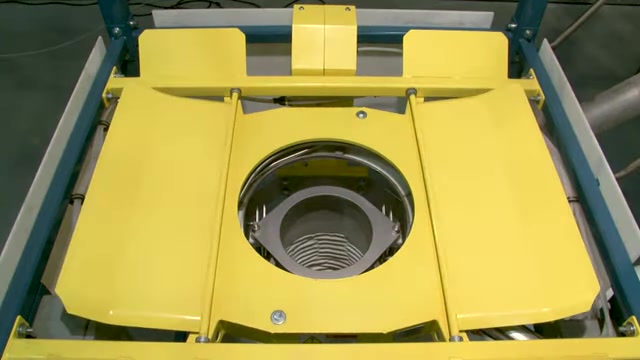
Flexicon
Flexicon BULK-OUT Bulk Bag Dischargers
Flexicon presents its BULK-OUT bulk bag discharger range: forklift-loaded BFF frames, hoist-and-trolley BFC frames, split and half frames, and accessories for dust-free untying, retying and flow promotion.
Total reach: 73,122
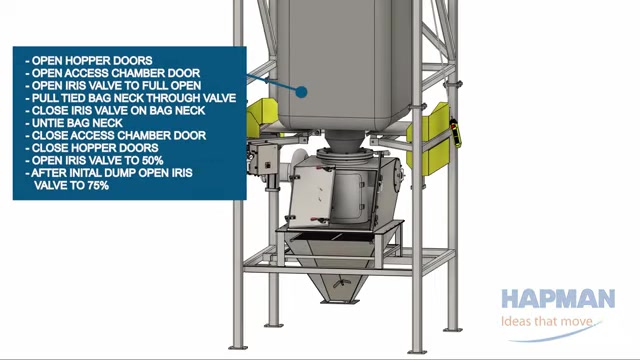
Hapman
Hapman Bulk Bag Hoist Unloader with Dust Collection
Hapman shows a hoist-loaded bulk bag unloader with a round access chamber and integrated dust collection for dust-free discharge.
Total reach: 2,978