
Technology guide
Bulk Bag Unloading Systems
Answer in brief
A bulk bag unloading system suspends a filled FIBC, gives the operator controlled access to the discharge spout, promotes reliable flow, and contains dust while the material transfers into the next process step.
Selection hinges on how the powder actually behaves after transport and consolidation, the bag geometry, the required discharge rate, dust and explosion hazards, and what the downstream equipment needs. Specify those conditions first; the frame itself is the easy part.
By Editorial Team · Reviewed July 27, 2026 · Updated July 27, 2026
Sponsored visibility
Featured Bulk Bag Unloading Systems videos
Paid placements are clearly marked and remain separate from the editorial related-video selection.
What a bulk bag unloader has to accomplish
Four functions share one machine. The system has to carry the suspended load, let an operator connect the bag safely, keep material moving and deliver it to the next process without turning the surrounding floor into a dust collection tray.
A typical installation includes a support frame, hoist or forklift loading arrangement, bag-loop restraints, a means of reaching and controlling the discharge spout, an enclosed hopper and a transition to a feeder, conveyor or vessel.
The apparent simplicity is deceptive.
A free-flowing plastic pellet in an unlined bag behaves very differently from a cohesive food powder that has consolidated during sea freight. The same frame may hold both bags, but the flow aid, spout interface, extraction duty and downstream control will not be the same.
Engineering visual guide
How the system behaves
These conceptual diagrams connect the operating principle, equipment internals and engineering review points. They are explanatory and not fabrication drawings or a substitute for project-specific calculations.
Cross-section
Bulk bag unloader: functional cross-section
A representative unloading station separates the suspended-load path from the product path and the dust-extraction path. The drawing is conceptual and not a fabrication design.
Define the design basis before choosing hardware
FIBC construction and handling history
Bag data is process data. Record the maximum filled mass, base dimensions, height, lifting-loop arrangement, discharge-spout diameter and length, liner type, closure method and whether the bag can be safely suspended for the full emptying cycle.
ISO 21898:2024 covers the materials, construction, testing, marking, selection and safe use of FIBCs for non-dangerous goods. It does not turn every bag into a universal process vessel. The actual bag specification still has to match the product, filling method, transport history and unloading equipment.
A bag that has spent weeks under vibration and compression may arrive with a material bed that is far stronger than the sample tested in a laboratory jar. Ask how the bag was filled, stacked, transported and stored.
Material flow behavior
Flow problems usually start above the outlet. Cohesive powders can form a stable arch over the spout or leave a stagnant annulus while a narrow central channel drains. Granular material may interlock. Hygroscopic powder may gain strength as moisture changes.
Useful inputs include bulk density range, particle size distribution, moisture sensitivity, wall friction against the bag and liner, compressibility, permeability, dustiness and any evidence of segregation or degradation.
Do not reduce the decision to an angle of repose. That observation says little about stress-dependent strength in a consolidated bag.
Research on hopper obstruction also warns against transferring one flow-prediction method indiscriminately between materials and stress states. For difficult powders, test the representative product after realistic consolidation.
Downstream demand
Emptying is not the same as metering. The bag unloader may release material in surges even when the receiving process needs a steady mass flow.
A screw feeder, rotary valve, vibratory feeder or loss-in-weight device may be needed below the hopper. The correct choice depends on the rate range, accuracy, refill strategy, product sensitivity and pressure difference.
If the receiver is a pneumatic conveying system, account for air leakage through the bag connection and hopper. A rotary valve or another pressure boundary may be required, and its leakage must be included in the conveying-air balance.
For controlled addition to a batch, review the wider feeding and dosing architecture rather than asking the unloader itself to behave like a precision feeder.
How the unloading sequence works
Loading and suspension
The bag is placed in the frame by integral hoist, external hoist or forklift. The lifting loops must remain retained, the bag must clear obstructions and the support structure must carry the specified load with the required safety basis.
Headroom often decides the practical loading method. An integral hoist can reduce dependence on a forklift at the discharge point, but it needs runway clearance and an operating zone that does not conflict with ductwork, sprinklers or maintenance access.
Spout access and connection
The first dust event is usually manual. The operator must open an access chamber or enclosure, locate the tied spout and connect it to the receiving interface before releasing product.
A clamp, iris valve, telescoping tube or closure bars can retain control of the spout while the tie is opened. The details are equipment-specific, but the engineering objective is constant: keep the spout supported, maintain a contained path and avoid an uncontrolled initial slug.
A loose sleeve over a hopper rim may be adequate for benign granules. It is a poor default for fine, hazardous or valuable powders.
Flow promotion
Bag massage paddles, base agitation, tensioning devices and other flow aids deform the bag or reduce the unsupported material bed.
More force is not automatically better. Aggressive squeezing can compact a cohesive powder, damage fragile granules or feed a large surge into undersized downstream equipment.
Flow aid should respond to an observed failure mode. If the powder bridges above the spout, work near that zone. If bag tension falls as the bag empties and folds trap material, maintain controlled stretching or lifting.
Discharge and empty-bag handling
The hopper should provide enough working volume for expected surges without becoming an unexamined storage bin. Its geometry, outlet size and wall finish must suit the material and feeder arrangement.
At the end of the cycle, residual powder may remain in folds, around a liner or above a closure device. Define the acceptable heel and how the operator verifies the bag is empty before disconnection.
Empty bags can still release dust. Collapsing, tying and transferring them should occur within the containment strategy, not after it.
Dust containment and local exhaust ventilation
Capture dust where the bag is opened. HSE guidance for local exhaust ventilation treats the hood or enclosure, duct, air cleaner and air mover as one control system. The capture point must match the way contamination is released.
An enclosed spout-access chamber can reduce the open area and place extraction close to the release. The required airflow then depends on enclosure geometry, openings, cross-drafts, powder dustiness and the energy of the release.
Excess extraction is not harmless. It can entrain saleable powder, load filters unnecessarily and draw a flexible liner into the outlet.
Commissioning should demonstrate inward air movement at openings and acceptable containment during connection, full-rate discharge, flow-aid operation and empty-bag removal. A quiet test with no product proves very little.
Coordinate the source enclosure with the central extraction system, and specify the required airflow, pressure and filter duty directly in the project documents.
Combustible dust, static and ignition control
A bag unloader can release and confine combustible powder. The hazard assessment must consider the powder, dust cloud, deposits, ignition sources, connected equipment and propagation paths.
Electrical classification, bonding and grounding, FIBC type, non-electrical ignition sources, extraction equipment and explosion protection must be selected under the applicable jurisdiction and site standards.
Do not infer protection from a generic label such as “antistatic”. Verify the actual FIBC construction, conductive path, grounding arrangement and intended atmosphere.
Where credible, coordinate the system with explosion protection and the required explosion-isolation concept. The unloader, collector, feeder and connected conveyor are part of the same hazard network.
Materials of construction and hygienic design
Carbon steel may suit dry, non-corrosive industrial duty. Stainless steel is common where corrosion resistance, washdown or hygiene matters. Product-contact finish, weld quality, gasket material and fastener design should follow the cleaning and contamination risk.
“Stainless” does not describe cleanability. A polished hopper attached to inaccessible crevices, exposed threads and a difficult liner connection is still hard to clean.
For allergen, pharmaceutical or high-value product changes, map every product-retaining surface. Decide which parts are tool-free, which require removal and how dry or wet cleaning will be verified.
A disposable liner connection can reduce equipment cleaning but adds handling steps and waste. It may also create a fold or restriction that affects flow.
Common configurations and when they fit
Forklift-loaded frame
This is mechanically straightforward where a suitable forklift and trained operator are always available. Check approach space, mast height, suspended-load rules and segregation from pedestrians.
Integral-hoist unloader
An integral hoist gives the station its own loading method and can improve repeatability. It adds structure, controls, inspection duties and headroom.
Low-headroom design
A split frame, removable upper section or alternative lifting arrangement can fit constrained rooms. The trade-off may be more operator handling or a less direct load path.
Contained or high-hygiene station
A glovebox-like spout chamber, inflatable seal, liner-management system or closed transfer interface may be justified for potent, allergenic or contamination-sensitive powders. Define the containment target and test method before buying elaborate hardware.
Mobile or semi-mobile unloader
Mobility helps shared processes, but services, structural stability, extraction connections and downstream alignment must remain controlled at every location.
Selection worksheet for an engineering specification
- FIBC envelope: minimum and maximum dimensions, mass, loop geometry, spout and liner details.
- Material: density range, flowability, consolidation history, dustiness, moisture, abrasiveness, fragility and hazard data.
- Rate: target average, acceptable surge, batch size, residual heel and changeover time.
- Interfaces: loading method, extraction, feeder, pressure boundary, conveyor, controls and available headroom.
- People: spout access height, reach, manual force, dust exposure, bag disposal and maintenance tasks.
- Cleaning: product-contact boundary, access, method, verification and acceptable cross-contamination.
- Safety: structural basis, suspended load, guarding, static, dust fire and explosion assessment, and local compliance.
Engineering infographic
From duty definition to acceptance evidence
Material, bag, hazard and downstream inputs must be converted into equipment responses and verified with representative acceptance evidence.
Factory and site acceptance testing
Use a representative bag and product. A water test or an empty mechanical cycle cannot reveal bridging, liner collapse, dust escape or a downstream surge.
Measure or observe loading time, connection steps, operator position, discharge-rate profile, flow-aid response, residual heel, dust release, extraction indicators, feeder stability and clean-down time.
Test abnormal conditions too: interrupted downstream equipment, a partially opened spout, loss of extraction, a damaged liner and a bag near the dimensional limit.
Site commissioning should establish baseline settings and inspection points. Photograph connections, record control setpoints and define what the operator does when flow stops. “Hit the bag until it moves” is common field practice, but it is not a control philosophy.
Troubleshooting
Material stops while the bag still looks full
Check whether the spout is twisted, the liner has collapsed or the material has formed an arch. Confirm that the flow aid acts at the blockage rather than simply shaking the frame.
Discharge arrives in large slugs
Review spout opening sequence, hopper working volume, flow-aid intensity and feeder capacity. A controlled closure above the feeder may be needed.
Dust escapes during connection
Inspect enclosure seals, extraction airflow, cross-drafts, spout-clamp sequence and operator technique. Verify performance during the real opening event.
Too much material remains in the bag
Look for folds, liner hang-up, loss of bag tension and stagnant zones above the outlet. Define whether the remaining heel is a flow, bag-design or operating problem before adding force.
Related equipment and alternatives
Small sacks may be better handled by a bag-dump station or automated bag-emptying machine. Rigid intermediate bulk containers can offer a repeatable outlet and easier pressure control but require return logistics and cleaning.
Pneumatic tanker delivery may remove individual-container handling at high consumption rates, though it introduces silo storage and conveying infrastructure.
The right comparison is therefore not only between unloader suppliers. Compare the full receiving route, labor, containment, storage, changeover and waste for the annual material flow.
Engineering takeaway
Treat the FIBC as part of the process. Reliable unloading comes from matching bag, material, interface, flow aid, extraction and downstream control.
A sound specification states the difficult cases and the acceptance evidence. That gives suppliers something engineering can verify, and it gives operators a system that works on the awkward bag at the end of a long shift, not only on the demonstration bag.
How to select Bulk Bag Unloading Systems
Start with the duty, not the frame. Record the FIBC dimensions and mass, liner and spout construction, material flow behavior, required rate, containment target, downstream pressure, cleaning regime, hazard basis and handling method.
Prove the interfaces. The lift arrangement, spout connection, flow aid, hopper, extraction connection and downstream feeder must operate as one system. A representative bag-discharge trial is more useful than a catalogue capacity quoted without the material, bag and receiving equipment.
Partner with powderbulkvideos.com
Place your video in the engineering context buyers are researching.
Use a relevant company profile and technical video to demonstrate this technology before engineers reach the supplier shortlist.
Continue your research
Bulk Bag Unloading Systems guides and answers
Popular on powderbulkvideos.com
Popular Bulk Bag Unloading Systems videos

Vortex – Solids & Bulk Handling Components
Vortex®: Telescoping Loading Spout
Vortex presents a telescoping spout for guiding dry bulk material into a truck, railcar, vessel or stockpile. The video is useful for understanding the internal flow path and moving components. Pressure, leakage, wear, material compatibility and cleaning still require verification for the actual duty.
Total reach: 76,986
Flexicon
Flexicon BULK-OUT Bulk Bag Dischargers
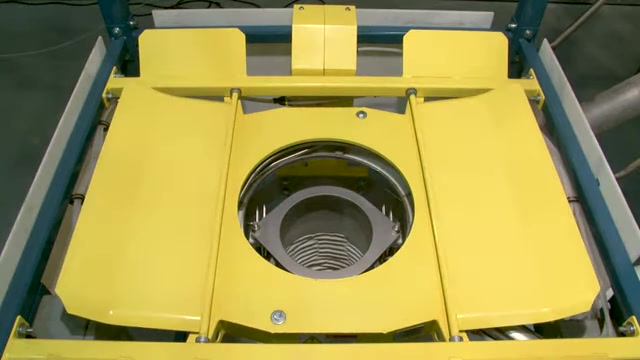
Flexicon presents its BULK-OUT bulk bag discharger range: forklift-loaded BFF frames, hoist-and-trolley BFC frames, split and half frames, and accessories for dust-free untying, retying and flow promotion.
Total reach: 72,124

F.lli Sacchi S.n.c.
Smart Pick – Fully Automated Bag Emptying and Processing of Complex Recipes
The video shows the F.lli Sacchi SmartPick robotic bag emptying system. A robot selects bags from pallet stations, presents them to a cutting and emptying station, and supports recipe controlled ingredient handling.
Total reach: 23,045
Palamatic Process
Palamatic Process: Emptying Big Bags of Sensitive Powders with OEB Containment
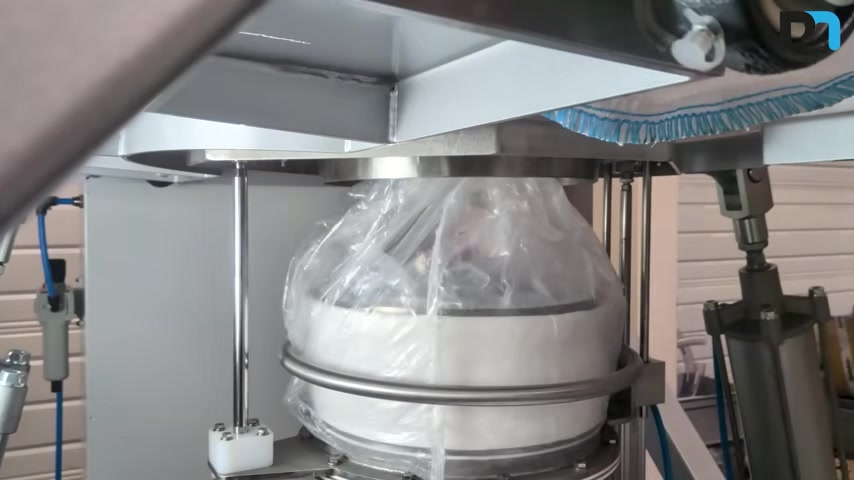
A Palamatic Process engineer explains the OEB big bag discharge station for toxic, CMR and ultra-fine powders, including the sleeve tie-off that keeps containment through a bag change.
Total reach: 18,637

Carolina Conveying
Carolina Conveying Bulk Bag Unloader: Clamping Down on Dust
Carolina Conveying shows how its bulk bag discharge station contains dust: the spout is untied inside a sealed access module and clamped pneumatically to a feed tube.
Total reach: 17,824
Hapman
Hapman Bulk Bag Hoist Unloader with Dust Collection
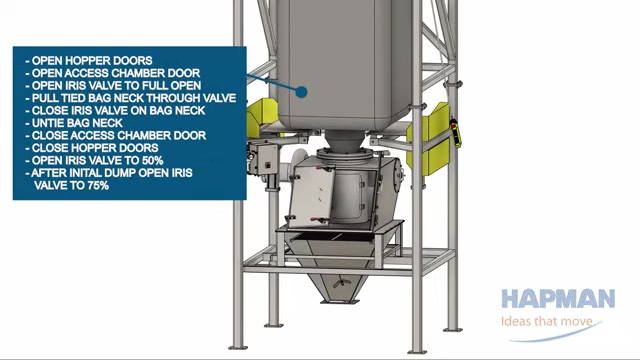
Hapman shows a hoist-loaded bulk bag unloader with a round access chamber and integrated dust collection for dust-free discharge.
Total reach: 2,864
Supplier discovery
Companies demonstrating Bulk Bag Unloading Systems
Frequently asked questions
What information is needed to select a bulk bag unloader?
Start with the FIBC data: dimensions, filled mass, loop geometry, liner and spout details. Add the material's flow behavior after realistic consolidation, the required rate, containment and cleaning targets, downstream equipment, available headroom, the loading method, and any dust or explosion hazards.
Does a bulk bag unloader meter the powder?
Usually not. The unloader supports and empties the FIBC. A separate screw, rotary, vibratory, or gravimetric feeder is normally used when the downstream process needs controlled or accurate flow.
How can bridging in a bulk bag be reduced?
First identify where the stable obstruction forms. Bag massage, base agitation, or tensioning can help when applied to the correct zone, but difficult cohesive powders should be tested after realistic consolidation.
How is dust controlled while opening the bag?
Enclose the spout-access area, keep the spout under control while the tie is opened, and place local exhaust extraction close to the release point. Prove containment with real product during connection, discharge, and empty-bag removal.
When is stainless steel required?
Stainless steel may be selected for corrosion resistance, hygiene, or washdown. The grade alone does not ensure cleanability; surface finish, welds, seals, crevices, and access must match the cleaning risk.
What should a bulk bag unloading acceptance test include?
Run it with a representative bag and real product. Verify loading, spout connection, the discharge-rate profile, flow-aid response, dust containment, residual heel, downstream stability, cleaning, and behavior under credible upsets such as a stopped feeder or a damaged liner.
Related content
Continue exploring
Move from this page to the companies, videos and technical topics that add useful context.