
Application
Bulk Bag Unloading with Weighing and Feeding
Answer in brief
Dosing directly from bulk bags works by combining the discharge frame with a metering device and a weighing concept: loss-in-weight from the suspended bag for continuous accuracy, or gain-in-weight into a weighed hopper for batch work. The design battle is keeping discharge aids, refill events and vibration away from the weight signal that the accuracy claim depends on.
Reviewed August 14, 2026 · Updated October 14, 2026
The problem
Desired outcome
Process approach
Selection factors
Common failure modes
- Discharge aids run while the outlet is closed and compact the powder into a bridge.
- Massage paddles or vibrators transmit force into the load cells and corrupt the weight signal.
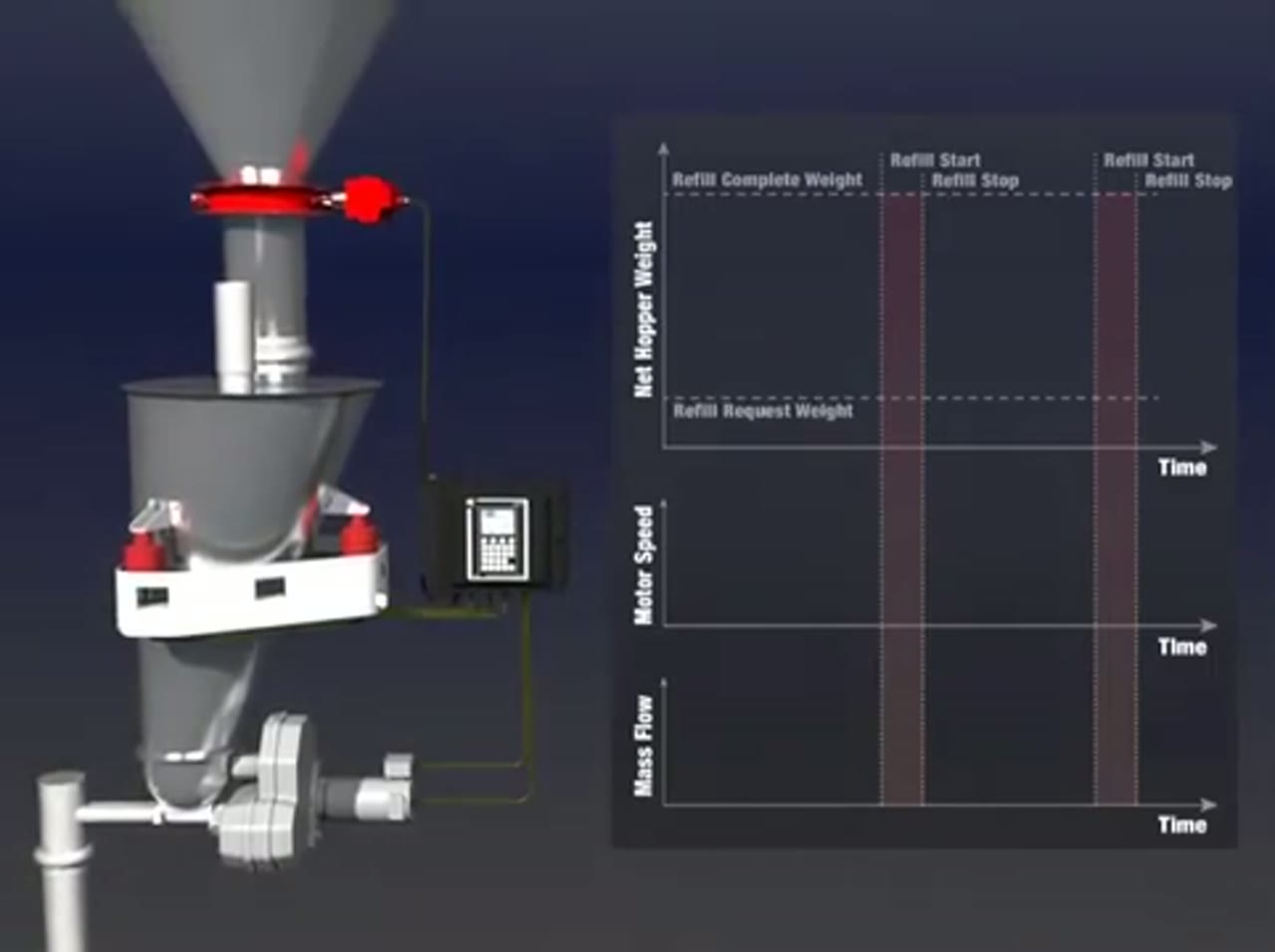
- Refill windows are longer than the control loop can bridge, so batch accuracy silently degrades.
- The metering device does not match the material and floods, pulses or starves.
- Headroom was calculated without lifting tackle and spout length, so the largest bags do not fit.
- Static grounding of the spout area is missing where combustible powders are handled.
Partner with powderbulkvideos.com
Put a relevant technical solution in this decision path.
Connect your company and video evidence with clearly labelled visibility where engineers evaluate this material, application, industry or product.
Frequently asked questions
What is the difference between loss-in-weight and gain-in-weight bulk bag dosing?
Loss-in-weight puts the bag frame on load cells and measures what leaves the station — continuous accuracy, but the structure must be vibration-isolated. Gain-in-weight weighs the receiving vessel and fills it to target — simpler and robust, but accuracy is verified per batch rather than per second.
Why do discharge aids interfere with dosing accuracy?
Massage paddles and vibrators transmit force into the weighing structure, and force is indistinguishable from weight for a load cell. Good stations isolate the aids mechanically, interlock them with the outlet state and pause fine dosing while aids are active.
What happens to accuracy during bag changes?
A loss-in-weight station is blind while the new bag settles and the hopper refills; the controller bridges volumetrically using learned material behavior. Fast, repeatable bag changes and a buffer hopper keep that blind window short enough not to matter.
Which metering device suits dosing from bulk bags?
Twin concave screws with agitation for cohesive powders, vibratory trays for fragile granules, rotary valves for free-flowing materials at steady rates. The bag frame is standard equipment — the metering device is where material behavior decides.
Related content
Continue exploring
Move from this page to the companies, videos and technical topics that add useful context.
Companies


Videos

VAC-U-MAX
VAC-U-MAX: Direct Charge Blender Loading Whiteboard Video
VAC-U-MAX whiteboard video on direct-charge blender loading by vacuum conveying: the system boundary, the major components, and the data to verify before selecting equipment.
Total reach: 28,517
Coperion
Coperion Loss-in-Weight Feeder Animation
The Coperion K-Tron animation shows a controller observing the decrease in combined hopper, feeder and material weight, comparing the measured rate with the setpoint and adjusting feeder output.
Total reach: 43,080

Volkmann GmbH
Product feeding of bagged goods (pellets)
Official Volkmann footage of bagged plastic pellets being fed into a vacuum conveying system. The clip documents one bag-feeding and vacuum-transfer boundary; suitability for a specific resin, additive package or receiving process must still be verified.
Total reach: 23,426