
Material
Calcium Carbonate
Answer in brief
Calcium carbonate is sold from sand-like grades to submicron powders, and the handling system has to match the grade rather than the chemical name.
Coarse ground material flows and wears; ultrafine and coated grades aerate, bridge and coat every surface they touch.
- Design around the finest grade the plant will ever run.
- Expect flooding after pneumatic transfer of fine grades.
- Treat coated grades separately, since the surface treatment changes flow.
Reviewed October 21, 2026 · Updated November 10, 2026
Handling challenges
Filler lines usually run several calcium carbonate grades through the same equipment, and that is where the trouble starts.
Fineness changes everything
- Coarse ground grades behave like a fine sand: free flowing, abrasive, easy to meter.
- Fine grades hold air, flood valves and then consolidate into a bridging powder.
- Coated grades flow differently again, since the stearate surface reduces friction but increases buildup on walls.
A hopper sized for the coarse grade will arch with the fine one, and a feeder tuned for the fine grade will wear with the coarse one.
Feeding into compounding
Filler loading determines product cost and properties, so dosing accuracy matters commercially.
Loss-in-weight feeding with deaeration and side-feeding into the extruder gives stable addition, while gravity charging of a fine filler produces surging.
Dust
Ultrafine grades escape through small gaps and settle on everything in the building.
Enclosed transfer, contained big bag discharge and extraction at the charge point are more effective than cleaning after the fact.
Wear
Even though the mineral is relatively soft, high velocity conveying of coarse grades erodes bends and valve seats over time.
What to establish before buying equipment
- Full grade list the line must handle, including future products.
- Aerated and settled bulk density for each grade.
- Required feed accuracy at the compounding line.
- Changeover and cleaning requirement between coated and uncoated grades.
Storage and conditioning
Calcium carbonate stores quietly and discharges deceptively.
Coarse ground grades flow well. Ultrafine and coated grades aerate during pneumatic filling and then behave like a fluid for some minutes, which floods anything underneath that was sized for a settled powder.
- Allow deaeration time between filling and extraction, and design a volume that can absorb the surge.
- Expect the apparent density to differ between a freshly filled and a settled silo, which matters for every volumetric device downstream.
- Fine grades also consolidate under their own weight, so size the outlet for the stood condition.
The material itself is stable: it does not degrade, does not take up much moisture and does not react in storage.
What this means for equipment
Two properties drive the selection: it is abrasive, and the fine grades aerate.
Abrasiveness sets the velocity limit. In pneumatic conveying that pushes a continuous line towards dense phase, and it decides the bend material rather than the bend radius alone. In mechanical conveying it sets the liner and the screw flight hardfacing.
Aeration decides the feeder. A volumetric device loses accuracy whenever the density moves, and it moves every time the silo is filled.
- Dense phase or low-velocity mechanical transfer for continuous duty.
- Wear-resistant bends and liners where the line cannot be taken out of service.
- Gravimetric feeding wherever the rate matters, with a deaeration volume above it.
Safety and regulatory
Calcium carbonate is not combustible and not toxic, which leaves respirable dust as the control that matters.
Ground limestone products can contain crystalline silica depending on the deposit, and where they do, the respirable fraction is a regulated exposure rather than a nuisance dust. That changes the capture requirement and the handling of collected dust.
- Check the supplier declaration for crystalline silica content, grade by grade.
- Capture at bag tipping, bulk bag discharge and every transfer point.
- Handle filter dust in closed containers; it is the finest fraction in the plant.
The physical hazard is the flooding behaviour of the fine grades: isolation has to be able to close against a flowing column, not only a settled one.
Material behavior
- Flowability
- Coarse grades free flowing, fine grades cohesive
- Abrasiveness
- Moderate
- Cohesiveness
- Rises sharply with fineness
- Moisture behavior
- Low moisture uptake; moisture still causes bridging
- Contamination risk
- Dust exposure and carryover between coated and uncoated grades
Partner with powderbulkvideos.com
Put a relevant technical solution in this decision path.
Connect your company and video evidence with clearly labelled visibility where engineers evaluate this material, application, industry or product.
Frequently asked questions
Why does fine calcium carbonate flood out of a silo?
It aerates readily and keeps the entrained air for minutes after pneumatic filling. Until the bed has deaerated it behaves closer to a liquid than a powder.
Is calcium carbonate abrasive enough to matter?
Yes, for continuous conveying. It erodes bends and screw flights, and the wear rises steeply with velocity, which is why continuous lines are usually dense phase.
Does calcium carbonate dust need respiratory protection?
It depends on the grade. Where the product contains crystalline silica from the deposit, the respirable fraction is a regulated exposure. The supplier declaration decides, not the chemical name.
Related content
Continue exploring
Move from this page to the companies, videos and technical topics that add useful context.
Companies
Videos

WAMGROUP
Tubular Screw Conveyors and Feeders
WAMGROUP presents enclosed tubular screw conveyors and feeders used to transfer or meter powders and bulk solids.
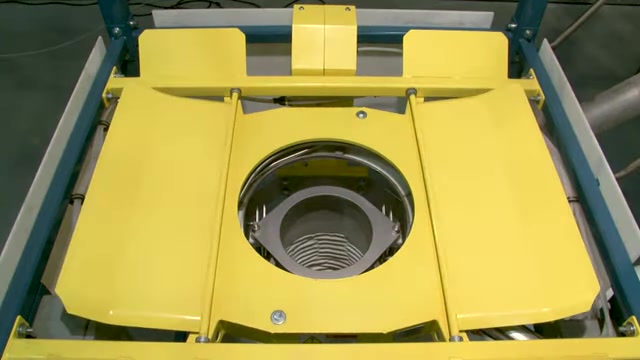
Flexicon
Flexicon BULK-OUT Bulk Bag Dischargers
Flexicon presents its BULK-OUT bulk bag discharger range: forklift-loaded BFF frames, hoist-and-trolley BFC frames, split and half frames, and accessories for dust-free untying, retying and flow promotion.
Total reach: 73,082
Technologies
- Bulk Bag Unloading Systems
- Bulk Bag Unloading Systems: Selection and Design
- Dust Collection & Air Pollution Control
- Dust Collection & Air Pollution Control Technology Guide
- Feeding & Dosing Control
- Feeding & Dosing Control
- Industrial Feeders
- Pneumatic Conveying
- Pneumatic Conveying Technology Guide
- Storage & Transportation
- Vacuum Conveying
- Vacuum Conveying Systems
Applications
- Automated Sack Emptying in Mineral Processing
- Automated Sack Emptying in Plastics Plants
- Bulk Bag Discharge in Building Materials Plants
- Bulk Bag Discharge in Mineral Processing
- Bulk Bag Discharge in Pet Food Plants
- Bulk Bag Discharge in Plastics Compounding
- Bulk Bag Unloading with Weighing and Feeding
- Chemical Powder Repackaging and Batching
- Dense Phase Conveying in Chemical Production
- Dense Phase Conveying of Abrasive Minerals
- Feeder Refill from Pneumatic Conveying
- Gravimetric Feeding in Cosmetics Production
- Gravimetric Feeding in Pet Food Production
- Gravimetric Feeding in Plastics Compounding
- Level Measurement and Inventory Control in Chemical Plants
- Powder Blending in Chemical Production
- Powder Blending in Cosmetics Production
- Powder Blending in Pet Food Production
- Powder Blending in Plastics Compounding
- Routing Powder to Multiple Destinations in Chemicals
- Valve and Airlock Selection for Chemical Powder Lines