
Application
Gravimetric Feeding in Cosmetics Production
Answer in brief
In cosmetics the feeders dose pigments in grams into a base measured in kilos, and the result is judged by eye.
A small drift in a pigment feeder is a visible shade shift, and the same pigment coats the machine it was fed through, so the next shade starts contaminated.
- Size the pigment feeders for grams, not for the batch.
- Plan for complete emptying and visible cleanliness.
- Contain the powder; pigments travel and they stain.
Reviewed October 21, 2026
The problem
A colour cosmetic recipe is a base of talc, mica or calcium carbonate with pigments at a fraction of a percent, and the ratio between those pigments sets the shade. The tolerance is whatever a trained eye accepts against a standard, which is tighter than most analytical specifications.
That puts the whole burden on small feeders handling difficult materials. Pigments are fine, cohesive, often agglomerated, and they have a low and variable bulk density, which is the worst combination for a volumetric relationship.
They also stain. Iron oxides and organic lakes mark every surface they touch, and a feeder that held a dark pigment yesterday will give up traces of it today unless it has been stripped. The contamination is not analytical; it is visible in the pressed product.
And the quantities are small enough that the feeder is often oversized simply because small feeders look unserious next to the mixer. The datasheet accuracy then describes a rate nobody is using.
In cosmetics manufacturing the tolerance is a visible one: a shade that drifts is a reject even when the recipe stayed inside its stated limits.
Desired outcome
Pigment feeders sized for the actual gram scale rates, with accuracy stated at those rates and verified by catch tests with the pigment itself.
Machines that strip quickly and completely, so a shade change is a cleaning operation that finishes inside the changeover window and can be signed off visually.
Pigment contained at charging, feeding and cleaning, with exposure controlled and the room kept out of the next batch.
In food production the same mistake takes a different shape: one feeder size for a recipe set spanning three orders of magnitude, accurate at the top and blind at the bottom.
Process approach
Feeder sizing starts from the smallest pigment rate in the shade range, not from the batch size. Small twin screw feeders handle cohesive pigments; where the rate is very low, a feeder with a reduced screw and a slow drive holds a better factor than a larger machine at the bottom of its range.
Hopper design follows the material. Steep walls, flexible sections with external massage, and agitation kept to the minimum that maintains flow, since working a pigment aerates it and moves the feed factor.
Changeover drives the construction. Quick release hopper, screw and tube, no internal ledge, and a design that can be inspected visually, because the sign off for a shade change is somebody looking at the inside of the machine. Dedicated screws and tubes per pigment family are common and usually cheaper than the cleaning they replace.
Containment is designed around charging and cleaning, which is where pigment escapes. Enclosed charging, extraction at the point of work and a clean down method that does not blow powder around; several of these pigments also have occupational exposure limits that make this a duty rather than a preference.
- Pigment feeders sized from the smallest rate in the shade range.
- Accuracy verified by catch tests with the actual pigment, not from a datasheet.
- Hopper designed for flow, with agitation limited to avoid aerating the pigment.
- Quick release contact parts, no internal ledges, and full visual inspection access.
- Dedicated screws and tubes per pigment family where changeover frequency is high.
- Enclosed charging and extraction at cleaning, with exposure limits respected.
Selection factors
- Smallest pigment rate in the shade range, which sets the feeder size.
- Shade tolerance and how it is assessed, usually visually and therefore tightly.
- Pigment flow behaviour and bulk density variability.
- Changeover frequency between shades, which decides cleaning versus dedicated parts.
- Staining and exposure, which set the containment requirement.
- Batch size range, including the smallest batch the line has to make accurately.
Common failure modes
- Feeder sized to look proportionate to the mixer, with no useful accuracy at the pigment rate
- Accuracy taken from a datasheet rather than from a catch test with the pigment itself
- Agitation working the pigment until the bulk density and the feed factor move continuously
- Internal ledge in the hopper holding a trace of the previous shade
- Shade change signed off without being able to see inside the machine
- Charging left open, so pigment reaches the room, the operator and the next batch
Partner with powderbulkvideos.com
Put a relevant technical solution in this decision path.
Connect your company and video evidence with clearly labelled visibility where engineers evaluate this material, application, industry or product.
Frequently asked questions
How small should a pigment feeder be?
Sized from the lowest rate it has to hold accurately. Accuracy is a percentage of the machine's own range, so a generous size spends that accuracy on a rate nobody uses.
Cleaning or dedicated parts between shades?
Where shades change frequently, dedicated screws and tubes per pigment family are usually cheaper and more reliable than a cleaning procedure that has to be signed off visually every time.
Why does agitation hurt a pigment feeder?
Because it aerates the powder. The feed factor is a mass per screw revolution, and an aerated pigment delivers less per revolution than the calibrated one, so the control chases a disturbance it is creating.
Related content
Continue exploring
Move from this page to the companies, videos and technical topics that add useful context.
Companies
Videos


Gericke AG
Gericke: GFS Formulation Skid and Tablet Press
This video presents the Gericke Formulation Skid (GFS) combined with a tablet press, showing how pharmaceutical formulations move from blending through downstream processing in one controlled, scalable setup. The system runs semi-continuously or fully continuously and targets development, scale-up, and technology transfer.
Total reach: 3,835

WAMGROUP
Tubular Screw Conveyors and Feeders
WAMGROUP presents enclosed tubular screw conveyors and feeders used to transfer or meter powders and bulk solids.
Dinnissen
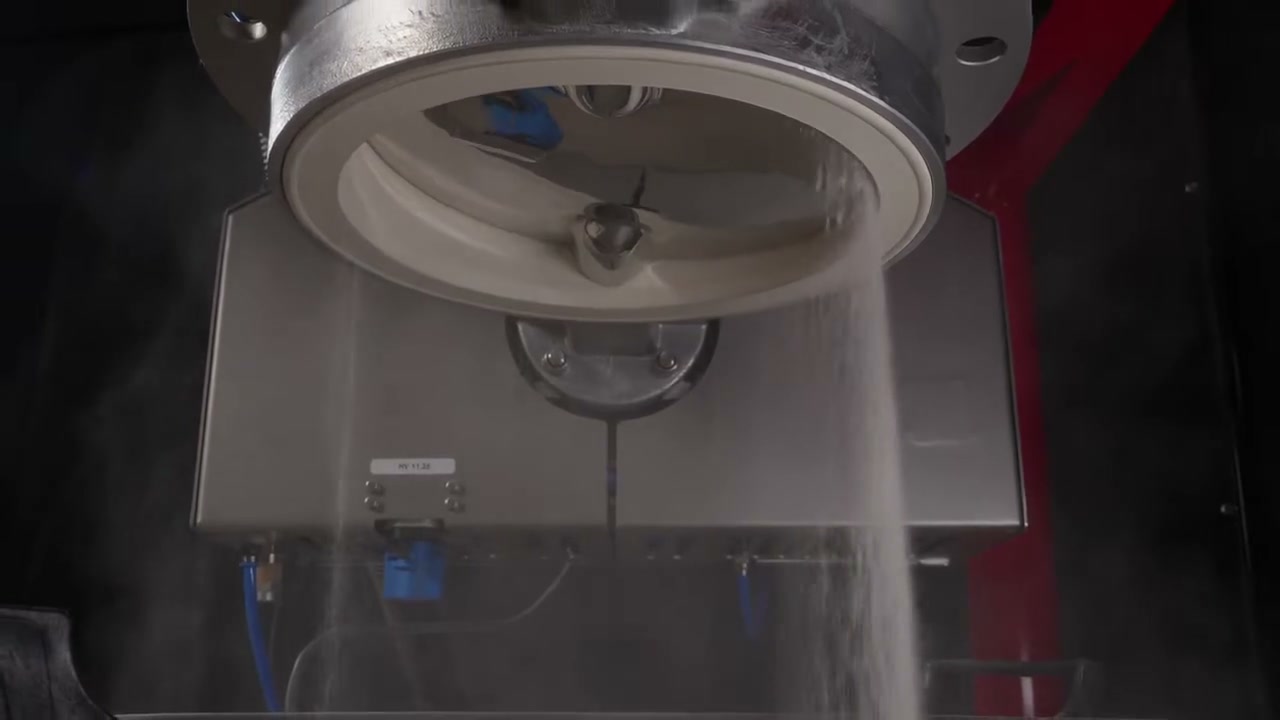
Feeder Valve
Dinnissen Process Technology shows a feeder valve developed for powder dosing at an accuracy that the older generation of equipment could not reach.