
Application
Gravimetric Feeding in Food Production
Answer in brief
Food lines feed everything from flour by the tonne to flavours by the gram, and one feeder rarely covers both.
The accuracy that matters is at the smallest inclusion, and that is where an oversized feeder fails quietly: the stated figure is a percentage of its range, not of your rate.
- Size the feeder for the smallest rate it must hold.
- Choose the discharge device for the powder, not from the catalogue.
- Design the refill, because that is when the feeder is blind.
Reviewed October 21, 2026
The problem
A food recipe spans several orders of magnitude. Flour, sugar and starch arrive by the tonne; a colour, a vitamin premix or a flavour is dosed in grams, and the small ones determine taste, appearance and label compliance.
The small ones are also the difficult powders. Flavours, colours and micronised ingredients are cohesive, they bridge in a hopper, they hang on screw flights and they change bulk density between aerated and settled by a large factor.
The quiet failure is sizing. A loss in weight feeder is accurate to a percentage of its own capability over a stated sample time, so a feeder sized generously for the largest rate in the recipe set has no useful accuracy at the smallest. The number on the datasheet is still true; it just does not describe what the plant needs.
And every recipe change means the feeder is opened. Hopper, screw, tube and outlet are all product contact parts with an allergen history, and a feeder that takes an hour to strip will not be stripped as often as the allergen matrix assumes.
Desired outcome
Each ingredient fed by a feeder sized for its own rate range, with the accuracy stated at the rate and the sample time the process actually uses.
Refill designed so that the blind period is short, infrequent and free of mechanical shock, and so that two feeders on a shared line are never refilled at once.
A machine that can be stripped, cleaned and reassembled within the changeover window, with every product contact part named in the allergen plan.
A pet food plant adds a regulated inclusion level, so the micro feeder is not only a question of accuracy but of what has to be demonstrated.
Process approach
The discharge device is matched to the powder. Twin screws are self wiping and handle cohesive flavours and colours; single screws suit free flowing sugar and salt; a vibratory tray moves flakes, granules and fragile pieces without shearing them. Getting this wrong is the single most common cause of a feeder that will not hold its rate.
Then the hopper is designed for flow rather than for volume. A steep cone, a flexible wall with external massage paddles or a vertical agitator keeps a cohesive powder moving; over agitation is its own fault, because it aerates the material and changes the feed factor continuously.
Refill is designed as a sequence. During refill the weight signal cannot be used, so the controller runs on the last known feed factor, and the longer that lasts the more the rate can drift. Fast, clean refills at a small fraction of the cycle, a refill valve that seals properly rather than trickling, and a sequence that staggers feeders on a shared conveying line are what keep the gravimetric control honest.
Finally the installation is checked for the things that corrupt a load cell: a stiff inlet sock, a cable tied across a flexible connection, vibration from a neighbouring mixer, or a pressure difference across the feeder that applies a force the controller reads as mass.
- Feeder sized for the smallest rate it has to hold, with accuracy stated at that rate and sample time.
- Discharge device matched to the powder: twin screw, single screw or vibratory tray.
- Hopper designed for flow, with agitation sufficient but not aerating.
- Refill short, clean and staggered, with a valve that seals rather than trickles.
- Flexible connections genuinely free of transmitted force, and vibration isolated.
- Every product contact part quick release and named in the allergen plan.
Selection factors
- Smallest inclusion rate and the tolerance on it, which sets the feeder size and often the number of feeders.
- Flow behaviour of each ingredient, measured, since the cohesive ones are usually the critical ones.
- Process sample time, because accuracy quoted over a minute means little to a process that varies over seconds.
- Allergen matrix and cleaning standard, which decide whether quick release construction is essential.
- Product fragility where granules, flakes or inclusions are fed.
- Dust explosion characteristics of the powder, including sugar and starch.
Common failure modes
- One feeder size chosen for a recipe set spanning three orders of magnitude
- Accuracy taken from the datasheet without checking the rate and sample time it refers to
- Refill valve that trickles, so the weight signal is never clean
- Two feeders on a shared conveying line refilled simultaneously, blinding both
- Cable tie or stiff hose across a flexible connection, adding a drifting tare force
- Cleaning time longer than the changeover window, so the allergen plan is not followed
Partner with powderbulkvideos.com
Put a relevant technical solution in this decision path.
Connect your company and video evidence with clearly labelled visibility where engineers evaluate this material, application, industry or product.
Frequently asked questions
Why does an oversized feeder lose accuracy?
Because the stated accuracy is a percentage of the feeder's own range over a sample time. At a small fraction of that range the absolute error stays similar while the rate shrinks, so the relative error grows.
What happens during refill?
The weight signal cannot be used, so the controller runs volumetrically on the last known feed factor. Short, clean, infrequent refills keep that blind period from becoming a rate error.
Which discharge device for a cohesive flavour powder?
A twin screw. The flights wipe each other, which stops the material packing and hanging on the screw, and it holds a far steadier feed factor than a single screw in the same duty.
Related content
Continue exploring
Move from this page to the companies, videos and technical topics that add useful context.
Companies
Videos


Gericke AG
Gericke: GFS Formulation Skid and Tablet Press
This video presents the Gericke Formulation Skid (GFS) combined with a tablet press, showing how pharmaceutical formulations move from blending through downstream processing in one controlled, scalable setup. The system runs semi-continuously or fully continuously and targets development, scale-up, and technology transfer.
Total reach: 3,835

WAMGROUP
Tubular Screw Conveyors and Feeders
WAMGROUP presents enclosed tubular screw conveyors and feeders used to transfer or meter powders and bulk solids.
Dinnissen
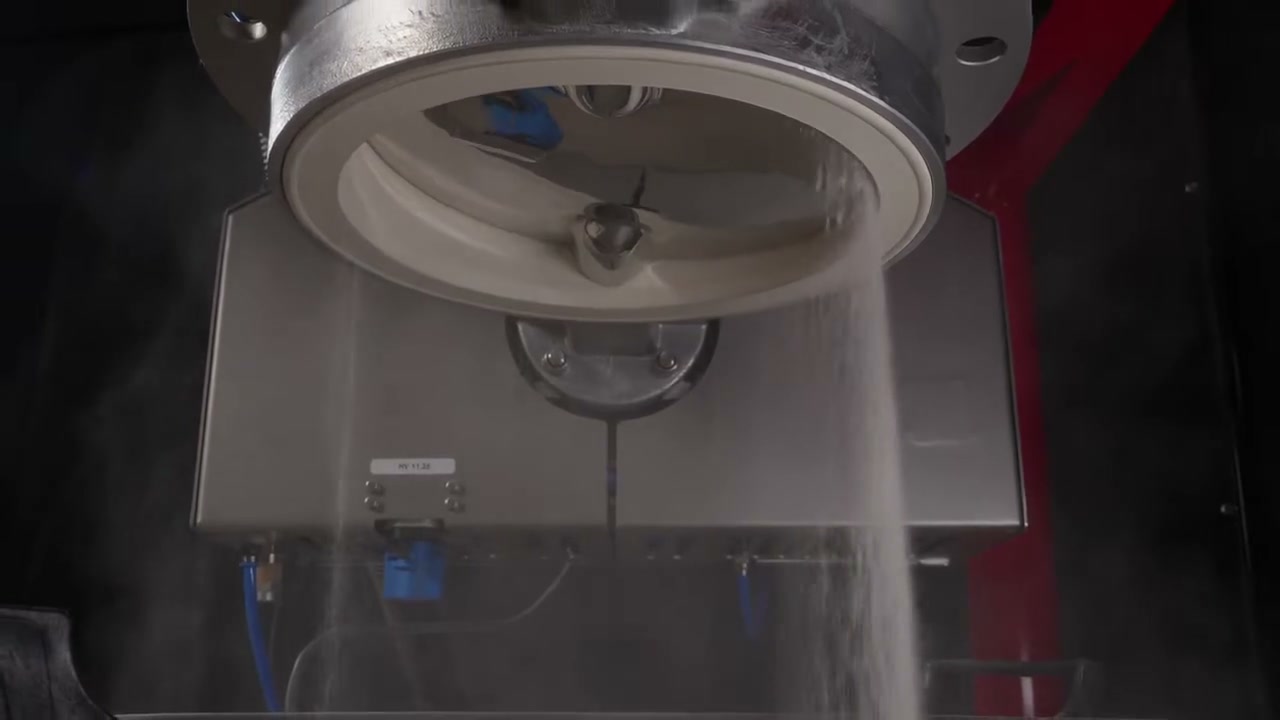
Feeder Valve
Dinnissen Process Technology shows a feeder valve developed for powder dosing at an accuracy that the older generation of equipment could not reach.