
Comparison
Ribbon Blender vs Paddle Mixer: Which Powder Mixer Fits?
Answer in brief
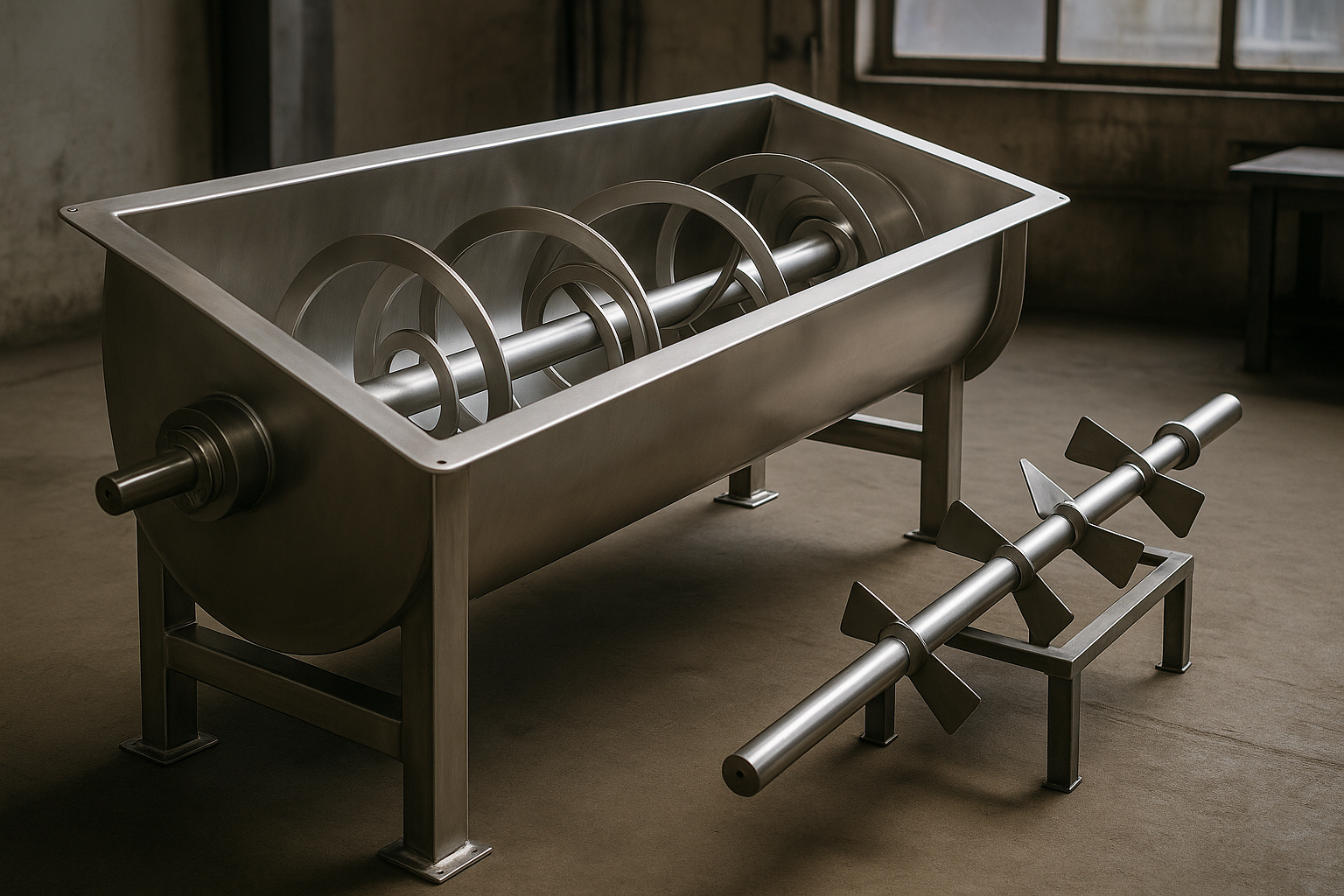
Ribbon blenders and paddle mixers share the same horizontal trough — the agitator decides the duty. Ribbons convect material in two counter-current spirals: efficient and economical for free-flowing to moderately cohesive powders at consistent fill levels.
Paddles lift and fold with lower shear, tolerate varying batch sizes and fragile or already-agglomerated products better, and handle liquid addition more gracefully. Fragile granules, wide fill ranges or wet stages favor paddles; long runs of one stable dry recipe favor the ribbon.
By Editorial Team · Published August 14, 2026 · Updated August 14, 2026
Sponsored visibility
Featured videos for this topic
Paid placements are clearly marked and remain separate from the editorial related-video selection.
Walk a food or chemical plant and most horizontal batch mixers look alike from the outside: a U-shaped or W-shaped trough, a top cover with charging ports, a center-bottom discharge valve. The decision between them lives inside, on the shaft. Ribbon agitators and paddle agitators mix by different mechanisms, and recipes that thrive in one can suffer visibly in the other.
How a ribbon blender mixes
A ribbon agitator carries two helical flights on one shaft: an outer ribbon that moves material toward the discharge and an inner ribbon that pushes it back. The counter-current convection folds the batch through itself continuously — an efficient, predictable action for free-flowing and moderately cohesive powders.
The geometry works close to the trough wall, which keeps dead zones small, but the narrow gap and the continuous shearing motion along the flights put mechanical work into the product whether the recipe needs it or not.
How a paddle mixer mixes
Paddle agitators replace the continuous helix with discrete blades set at angles along the shaft. Each paddle lifts, cuts and throws material rather than plowing it in a continuous channel; the batch spends more time in gentle free fall and less in wall shear.
Paddles maintain mixing action at fill levels a ribbon cannot handle well — half batches and overfilled batches both stay in motion — and their open geometry treats friable granules, instantized powders and finished agglomerates with visibly less attrition.
Where each one wins
- Long production runs of one stable, dry, free-flowing recipe at constant batch size: ribbon — simplest, cheapest, proven.
- Fragile, coated or agglomerated products where attrition is a quality defect: paddle.
- Recipes with meaningful liquid addition or paste-like stages: paddle geometry resists buildup on flights.
- Frequently changing batch sizes, including regular half batches: paddle keeps mixing at low fill.
- Trace-ingredient homogeneity at aggressive mixing times: both can achieve it — validate with a trial, not a brochure.
- Tight capital budgets in non-critical duties: ribbon, with eyes open about shear.
Shear, attrition and mixing time
Neither machine is a high-shear device, but the difference in mechanical stress is real: ribbon flights work material continuously against the trough wall, while paddles move it in discrete, gentler events. For robust powders the distinction is irrelevant — ribbon blenders often reach homogeneity slightly faster on free-flowing duties.
For fragile products the distinction is the whole decision: fines generated in the mixer change flow behavior, bulk density and dissolution downstream, and no dosing accuracy recovers what the agitator destroyed.
Partner with powderbulkvideos.com
Put your expertise beside the decisions engineers are making.
Connect a relevant company profile and technical video portfolio with clearly labelled visibility on this topic.
Fill level flexibility
Ribbon geometry assumes a working fill window — typically in the range of forty to seventy percent of trough volume. Below it, the inner ribbon stirs air while material pools under the shaft; above it, the top of the batch stops circulating.
Paddle mixers tolerate a wider window, which matters more than it sounds: plants rarely run the batch size the machine was sized for forever, and recipe portfolios grow. If half batches are part of honest production reality, the paddle's tolerance is worth real money.
Liquid addition and cleaning
Spraying oils, binders or flavors into a ribbon blender works until buildup starts on the flights and trough wall — continuous wall contact smears wetted product into films. Paddle mixers, with less wall shear and more open internals, take liquid stages more gracefully and clean faster afterward.
For hygienic duties the details decide either way: polished surfaces, crevice-free welds at the agitator hub, access doors large enough to actually reach the internals, and — in wet-cleaning plants — drainage that leaves no pooling. A mixer that is hard to clean will be cleaned badly, whatever its agitator.
Discharge and batch integrity
Both designs discharge through a center-bottom valve, and both leave a heel if the geometry is careless. Ribbon blenders discharge efficiently because the outer ribbon actively conveys toward the outlet; paddle mixers rely more on gravity and blade sweep.
In segregation-prone recipes the discharge phase matters as much as the mixing phase: a well-mixed batch can demix in a long, uncontrolled discharge stream. Short discharge paths, correctly sized valves and — for critical blends — discharge directly into the next process step protect the homogeneity the mixer just produced.
The decision in practice
Start from the recipe portfolio, not the machine: characterize the most fragile product, the widest fill range and any liquid stages, then test the shortlisted agitator with the real recipe at a supplier trial station.
Witnessed trials with defined acceptance criteria — blend uniformity at the critical ingredient, fines generation before and after — turn the ribbon-versus-paddle question from a debate into a measurement. The mixing and blending technology page describes the wider machine families, including the double-shaft fluidized-zone designs that take over where single-shaft machines run out of gentleness or speed.
Frequently asked questions
What is the main difference between a ribbon blender and a paddle mixer?
The agitator: ribbons mix by continuous counter-current convection along two helical flights, paddles by discrete lifting and folding events. Ribbons are efficient for stable free-flowing recipes; paddles are gentler, tolerate wider fill ranges and handle liquid addition better.
Which is better for fragile granules or instantized powders?
The paddle mixer. Its open geometry and discrete mixing events generate measurably less attrition than the continuous wall shear of ribbon flights. For attrition-critical products, verify with before/after fines analysis at a witnessed trial.
Can a ribbon blender run half batches?
Poorly. Ribbon geometry needs its working fill window — typically around forty to seventy percent — to circulate the batch. Regular half batches are a strong argument for a paddle agitator, which keeps mixing action across a wider fill range.
Is a ribbon blender cheaper than a paddle mixer?
Usually, at comparable size and execution — the ribbon is the commodity workhorse of dry blending. The price difference disappears quickly if attrition, cleaning time or half-batch flexibility become operational problems.
How do I verify blend quality before buying either mixer?
With a supplier trial on the real recipe: sample the batch at defined positions and times, measure uniformity at the critical ingredient, and compare fines before and after mixing. Acceptance criteria from the trial belong in the purchase order.
Related content
Continue exploring
Move from this page to the companies, videos and technical topics that add useful context.
Companies


Videos

Gericke AG
Double Shaft Mixer GMS 5000 ECD Multiflux
Gericke presents the GMS 5000 Multiflux double-shaft mixer in a powder-mixing and hygienic-design context.
Total reach: 40,862

VAC-U-MAX
VAC-U-MAX: Direct Charge Blender Loading Whiteboard Video
VAC-U-MAX whiteboard video on direct-charge blender loading by vacuum conveying: the system boundary, the major components, and the data to verify before selecting equipment.
Total reach: 28,506

Gericke AG
Gericke: GFS Formulation Skid and Tablet Press
This video presents the Gericke Formulation Skid (GFS) combined with a tablet press, showing how pharmaceutical formulations move from blending through downstream processing in one controlled, scalable setup. The system runs semi-continuously or fully continuously and targets development, scale-up, and technology transfer.
Total reach: 3,745

Gericke AG
Nibbler and Deagglomerator Gericke GNB
Gericke's video explains the operating and cleaning concept of the GNB coarse grinder and deagglomerator: a low-speed paddle-and-screen arrangement works lumps down to size, and the unit opens for inspection. Particle size, capacity, heat input and wear still require representative material testing.
Total reach: 3,169

Gericke AG
Trusted Partnership: Why BigMuscles Chose Gericke for Efficient Powder Processing
This video features Jitika Gupta, Marketing Director of BigMuscles Nutrition, discussing why the company partnered with Gericke to establish their advanced production facility in India.
Total reach: 3,984

Coperion
Coperion: Cement Blending with Manufacturing Pull Principle
This video presents a smarter way to produce blended cement without storing tons of product no one has ordered yet.
Total reach: 5,297