
Application
Powder Blending in Pet Food Production
Answer in brief
In pet food the mixer has to distribute a premix at a fraction of a percent into a fibrous meal and then empty cleanly.
Vitamins, minerals and medications are the components that matter, fat makes everything stick, and the next recipe may be for a different species.
- Pre blend the micro ingredients; the mixer alone will not do it.
- Expect fat to cost you discharge and cleanliness.
- Measure carryover, because some of it is regulated.
Reviewed October 21, 2026
The problem
The bulk of a pet food blend is easy. The difficulty is the micro ingredients: a vitamin and mineral premix, an amino acid, sometimes a veterinary additive, dosed at a fraction of a percent into a coarse, fibrous meal.
That is already the hardest distribution case in bulk solids, and fat makes it worse. Liquid fat added at the mixer coats the particles, which helps hold the blend together but also coats the mixer, the ribbon, the shaft seals and the discharge. The coated layer is where the previous recipe lives.
Carryover then stops being a quality preference. Medicated feeds and species restricted ingredients carry regulated limits, and a plant that produces for more than one animal group has to be able to state its carryover as a number it has measured.
Finally, the blend has to survive. After the mixer it travels to the extruder or the packing line, and the same segregation mechanisms that affect every powder apply here to the component that was hardest to distribute in the first place.
Desired outcome
A blend whose micro ingredients are uniformly present at the point of use, achieved through a pre blending step rather than through mixing time.
A mixer that discharges completely with fat in the recipe, with the residual mass measured and the carryover figure validated by sampling.
A cleaning and sequencing regime that satisfies the regulated limits for medicated and species restricted products, and that fits the number of recipe changes the plant actually runs.
For pharmaceutical production content uniformity is the acceptance criterion, and extending the blend time to rescue a marginal result segregates the very ingredient it was meant to spread.
Process approach
Micro ingredients are pre blended, either on site in a dedicated small mixer or bought as a premix. That step raises the inclusion rate for the distribution that has to happen and it is far more effective than extending the main mix. It also contains the handling of the most expensive and most potent components in one place.
Fat addition is designed as part of the mixer specification, not as an addition to it. Spray bars positioned where the material is moving, a sequence that adds fat after the dry distribution is achieved, and surfaces that can be cleaned once coated. A mixer that was quoted dry and then asked to take fat is the usual source of discharge problems.
Discharge completeness is measured. A full length discharge gate or a flush bottom valve leaves far less than a small outlet, and the residual mass is the input to the carryover calculation.
Sequencing then does the work that cleaning cannot. Running from the most restricted product to the least, flushing where required and accounting for the flush material is how feed mills meet their limits, and the mixer is one station in a sequence that covers the whole line.
- Micro ingredients pre blended on site or purchased as a premix.
- Fat addition designed into the mixer: spray position, sequence and cleanable surfaces.
- Discharge arrangement chosen for completeness, with residual mass measured.
- Carryover validated by sampling and stated as a number.
- Production sequenced from restricted to unrestricted, with flush batches accounted for.
- Post mixer transfer kept short and gentle to protect the distribution achieved.
Selection factors
- Lowest inclusion rate in the recipe set, which decides whether pre blending is optional or essential.
- Fat and liquid addition rate and where it enters, which drives build up and discharge behaviour.
- Regulated carryover limits for medicated and species restricted feeds.
- Recipe changes per shift and the time allowed for sequencing or cleaning.
- Fibre and particle size spread in the meal, which affects both mixing and later segregation.
- Discharge completeness, measured rather than claimed.
Common failure modes
- Micro premix added neat to the main mixer and never properly distributed
- Mixer specified dry and then asked to take fat, with discharge problems treated as a mixer fault
- Carryover stated from a supplier figure rather than measured on the installed plant
- Production sequence ignoring restricted products, so cleaning has to do work sequencing could have done
- Residual heel in the mixer never measured, so the carryover number has no basis
- Long or steep transfer after the mixer re sorting the component that was hardest to distribute
Partner with powderbulkvideos.com
Put a relevant technical solution in this decision path.
Connect your company and video evidence with clearly labelled visibility where engineers evaluate this material, application, industry or product.
Frequently asked questions
Why pre blend the micro ingredients?
Because distributing a tenth of a percent through a coarse fibrous meal is the hardest case there is. Pre blending raises the inclusion rate of the distributing step and achieves more than any change to the main cycle.
What does fat do to the mixer?
It coats everything, which helps hold the blend together and hurts discharge and cleaning. The coated layer is where the previous recipe stays, so fat addition has to be part of the mixer specification.
How do feed mills meet medicated feed carryover limits?
Mostly by sequencing rather than by cleaning: running from the most restricted product downwards, flushing where required, accounting for the flush, and validating the resulting carryover by sampling.
Related content
Continue exploring
Move from this page to the companies, videos and technical topics that add useful context.
Companies

Videos
Gericke AG
Continuous Mixer Gericke GCM
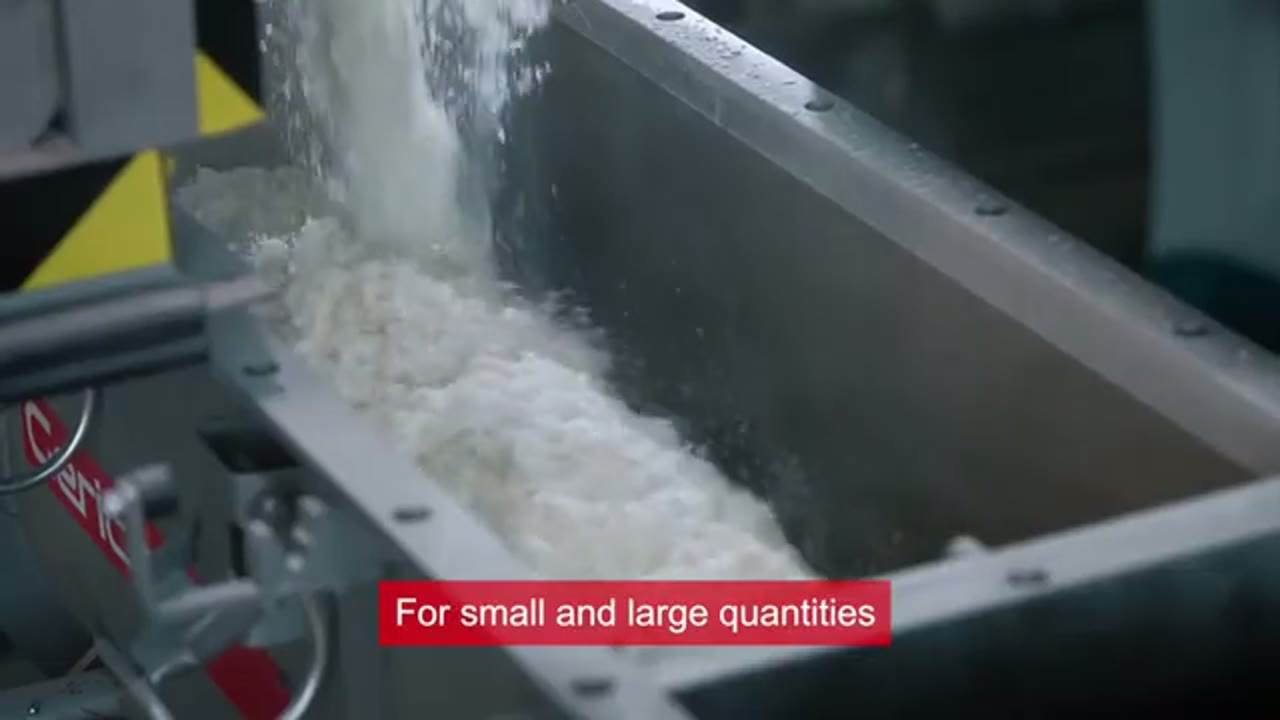
Gericke shows the GCM continuous mixer, which combines radial and axial mixing for throughputs that range from 10 l to 150,000 l/h.
Total reach: 4,638

Gericke AG
Double Shaft Mixer GMS 5000 ECD Multiflux
Gericke presents the GMS 5000 Multiflux double-shaft mixer in a powder-mixing and hygienic-design context.
Total reach: 41,100

Gericke AG
See Gericke's Leading Bulk Mixing Technology in Action
Gericke shows its bulk mixing portfolio in operation, from laboratory scale double shaft mixers to continuous mixers that cover inline mixing from 1 kg/h to more than 100,000 kg/h.
Total reach: 2,699