Skip to content
powderbulkvideos.com
Menu

Technology knowledge hub

Powder and Bulk Solids Technologies

In brief

Explore technologies used to convey, feed, mix, separate, store, measure and protect powders and bulk solids. Each cluster connects processes and systems with their relevant equipment, components, videos and companies.

Browse by Technology Cluster

Technology Clusters and Specialist Technologies

Technology Cluster

Cement Blending Systems

Cement raw meal blending reduces chemical variation before kiln processing by layering, controlled reclaim, pneumatic homogenization or mechanical mixing. Performance depends on the variability entering storage, the distribution of residence time and the way material is withdrawn. A blending ratio must be defined against measured inlet and outlet variation.

Cement blending system with silos, dosing lines and industrial blender

Technology Cluster

Dust Collection & Air Pollution Control

A dust-collection system captures contaminated air at the point of release, transports it through ductwork, separates particles from the air and discharges or returns the cleaned air under controlled conditions. Good performance depends more on capture, transport and safe discharge than on filter area alone.

Industrial dust collection system with filter housing, ducting and collection hopper
Photorealistic industrial process installation representing Industrial Vacuum Cleaning Systems.

Specialist Technology

Industrial Vacuum Cleaning Systems

An industrial vacuum-cleaning system removes settled powder through a controlled suction and separation path instead of redistributing it with compressed air or dry sweeping.

The machine, hose, tools, filters, recovery drum and disposal method must all match the dust’s toxicity, combustibility and physical behaviour.

Explore

Technology Cluster

Dust Collection Systems

A dust collection system captures contaminated air at a process source, transports it through ductwork, separates particulate in a cyclone or filter, moves the air with a fan and discharges collected solids without releasing them again. A reliable design begins with the emission mechanism and control target, then proves capture, airflow, pressure loss, cleaning, discharge, monitoring and combustible-dust protection under representative operating conditions.

Editorial illustration of an industrial dust collection system with filter housing, ductwork and collection hopper

Technology Cluster

Explosion Protection

Explosion protection for powder plants combines prevention, pressure control and propagation isolation. The correct design starts with the actual dust, process state and connected equipment; no single vent, valve or detector protects an installation by itself.

Explosion protected powder processing vessel with vent panels, isolation and grounding
Photorealistic industrial process installation representing Rupture Discs.

Specialist Technology

Explosion Isolation

Explosion isolation stops flame, pressure or burning material from propagating through process connections into adjacent equipment.

It is selected and located from tested system behaviour, not from pipe diameter alone, and it must remain effective under the plant’s actual flow, dust loading and maintenance condition.

Explore
Photorealistic industrial process installation representing Flameless Venting.

Specialist Technology

Flameless Explosion Venting

Flameless venting combines a pressure-opening explosion vent with a flame-arresting element that cools combustion products and limits external flame.

It can support indoor installation, but it does not eliminate pressure, hot gas, smoke, dust release or the need for explosion isolation.

Explore
Photorealistic industrial process installation representing Rupture Discs.

Specialist Technology

Rupture Discs

A rupture disc is a non-reclosing pressure-relief element that opens at a defined differential pressure.

Process rupture discs protect against overpressure or vacuum, while dust-explosion vent panels are designed and tested for rapid deflagration relief; the two functions must not be interchanged without an explicit approved basis.

Explore

Technology Cluster

High Containment & Powder Sampling

High containment powder handling limits transfer of hazardous material between the process, operator and environment. Sampling adds a second requirement, the sample must also represent the batch or stream. The containment target, exposure limit, material behavior, sampling location, cleaning method and verification plan determine the system.

High containment powder handling and sampling system in a clean processing room
Photorealistic industrial process installation representing Contained Powder Sampling.

Specialist Technology

Contained Powder Sampling

Contained powder sampling is the controlled removal of a representative portion of bulk material without creating an open transfer path.

A sound design must solve two problems at once: preserve sample integrity and keep the operator, room and batch protected from the powder.

Explore
Photorealistic industrial process installation representing High-Containment Powder Handling.

Specialist Technology

High Containment Powder Handling

High-containment powder handling keeps hazardous or potent solids inside a defined process boundary during charging, transfer, sampling, cleaning and waste handling.

The design is accepted by task-based exposure evidence and product-protection evidence, not by the name of a valve or isolator.

Explore

Technology Cluster

Industrial Feeders

An industrial feeder withdraws bulk material from storage and establishes a controlled flow into the next process. Reliable selection depends on measured material flow properties, bin outlet geometry, required rate range, accuracy, downstream pressure and the ability to start under load. The feeder and hopper must be engineered as one interface.

Industrial loss in weight feeder with hopper, enclosed screw and process controls
Photorealistic industrial process installation representing Feeding and Dosing Control.

Specialist Technology

Feeding & Dosing Control

Feeding and dosing control converts a required ingredient rate or batch mass into coordinated equipment action.

Good control combines a suitable feeder, stable material supply, trustworthy weighing or flow measurement, refill logic and clear handling of deviations.

Explore

Technology Cluster

Instrumentation & Control

Instrumentation and control systems measure material and process conditions, communicate operating status and support automatic decisions in powder and bulk solids plants. Selection starts with the measurement task, process conditions, required response and control architecture.

Bulk solids instrumentation and process control with level, weight and flow measurement
Photorealistic industrial process installation representing Level Measurement.

Specialist Technology

Level Measurement

Bulk solids level measurement can provide continuous inventory, process level or a discrete high and low status.

Technology selection depends on surface shape, dust, buildup, dielectric behavior, vessel geometry, filling stream and the consequence of a missed alarm.

Explore
Photorealistic industrial process installation representing 3D Radar Level Measurement.

Specialist Technology

3D Radar Level Measurement

A 3D radar level system measures distance in several directions and estimates the surface profile of bulk material in a silo.

It can improve volume estimation where the surface is uneven, but the result remains a model based on echo interpretation, vessel geometry and material assumptions.

Explore

Technology Cluster

Mechanical Conveying & Belt Conveyors

Mechanical conveying systems move bulk solids along a defined route with driven equipment. Belt conveyors suit continuous transport, sandwich belt systems address steep lift, and vibrating troughs move material through controlled oscillation.

Mechanical conveying line with belt, screw and bucket conveying equipment
Photorealistic industrial process installation representing Dust Suppression Hoppers.

Specialist Technology

Conveyor Belt Components & Maintenance

Reliable belt conveying depends on the complete system rather than the belt alone.

Loading geometry, idlers, pulleys, cleaners, skirting, tracking devices, drives, takeup and guarding influence capacity, spillage, wear and safety.

Explore
Photorealistic industrial process installation representing Vibrating Trough Conveyors.

Specialist Technology

High-Angle Sandwich Belt Conveyors

A sandwich belt conveyor uses two belts to hold bulk material between opposing surfaces while it travels on a steep incline.

It can reduce horizontal footprint and avoid transfer towers, but successful application depends on material stability, lump size, belt pressure, loading, transition geometry, drive coordination and safe access.

Explore
Photorealistic industrial process installation representing Vibrating Trough Conveyors.

Specialist Technology

Vibrating Trough Conveyors

A vibrating trough conveyor moves bulk solids through repeated controlled motion of a pan or tube.

Conveying behavior depends on vibration frequency, amplitude, direction, trough geometry and the frictional and impact response of the material.

Explore

Technology Cluster

Mixers & Blenders

Industrial mixers and blenders distribute powders, granules and minor ingredients to achieve a defined product uniformity. The suitable machine and operating cycle depend on formulation, batch size, segregation risk, shear sensitivity, liquid addition and cleaning requirements.

Stainless steel industrial powder mixer and blender in a modern processing plant
Photorealistic industrial process installation representing Double-Shaft Mixers.

Specialist Technology

Double-Shaft Mixers

A double shaft mixer uses two coordinated shafts with paddles or other tools to move particles through overlapping mixing zones.

It can provide rapid convective mixing and support continuous or batch duties.

Explore

Technology Cluster

Packaging & Bagging

Packaging and bagging systems prepare powders and bulk solids for storage, transport or use in sacks, bulk bags and other containers. System design connects product flow, accurate filling, dust control, package handling and the required level of automation.

Automated powder packaging and bagging line with weighing and sealing equipment
Photorealistic industrial process installation representing Powder Sampling.

Specialist Technology

Automated Bag Emptying Systems

Automated bag emptying opens, discharges and manages sacks with reduced direct operator contact.

It can lower routine dust exposure and labor, but performance depends on bag construction, residual product, dust capture, foreign material control, empty bag compaction, cleaning and safe intervention when a bag jams or tears.

Explore
Photorealistic industrial process installation representing Vibration Tables.

Specialist Technology

Vibration Tables

A vibration table applies controlled oscillation to a filled or partly filled container so particles rearrange and entrained air can escape.

The resulting volume reduction depends on material properties, fill sequence, frequency, amplitude, acceleration and container support.

Explore

Technology Cluster

Pneumatic Conveying

Pneumatic conveying moves powders, granules, and pellets through a closed pipeline with air or another gas. A complete system combines controlled material feeding, a pressure or vacuum source, the conveying pipe, a receiver, filtration, discharge equipment, instrumentation, and safety measures. Selection depends on bulk solid behavior, capacity, route, product quality, containment, cleaning, and dust hazards.

Pneumatic conveying system with stainless steel pipelines, receiver and filtration
Photorealistic industrial process installation representing Dense-Phase Conveying.

Specialist Technology

Dense Phase Conveying

Dense phase pneumatic conveying moves a high concentration of solids at relatively low velocity.

Material can travel as strands, dunes, slugs, plugs, or fluidized flow.

Explore
Photorealistic industrial process installation representing Hygienic Vacuum Conveying.

Specialist Technology

Dilute Phase Conveying

Dilute phase pneumatic conveying keeps most particles suspended in a comparatively large gas flow.

It is widely used for continuous transfer because it accepts a broad range of materials and can use relatively simple feeding and control arrangements.

Explore
Photorealistic industrial process installation representing Powder Transfer Systems.

Specialist Technology

Plug Conveying

Plug conveying is a dense phase regime in which discrete columns of bulk solid move through a pipeline, separated by pockets of conveying gas.

It can reduce particle velocity, wear, and attrition for suitable coarse or permeable materials.

Explore
Photorealistic industrial process installation representing Powder Transfer Systems.

Specialist Technology

Powder Transfer Systems

A powder transfer system moves dry material between defined process points while preserving containment, material quality and the required rate.

Pneumatic, mechanical and gravity methods each create different effects on dust, segregation, attrition and cleaning.

Explore
Photorealistic industrial process installation representing Vacuum Conveying.

Specialist Technology

Vacuum Conveying

Vacuum conveying draws bulk material through a closed pipe toward a receiver located before the vacuum source.

It is useful when several pickup points feed one destination or when inward leakage supports containment at the source.

Explore

Technology Cluster

Powder Processing Systems

An integrated powder processing system connects receiving, storage, conveying, feeding, transformation, separation and packing through defined material and information flows. Good architecture starts with product quality and process hazards, then assigns each unit operation, control loop and interface a measurable duty.

Integrated powder processing system with feeding, mixing, milling and screening stages

Technology Cluster

Size Reduction & Screening

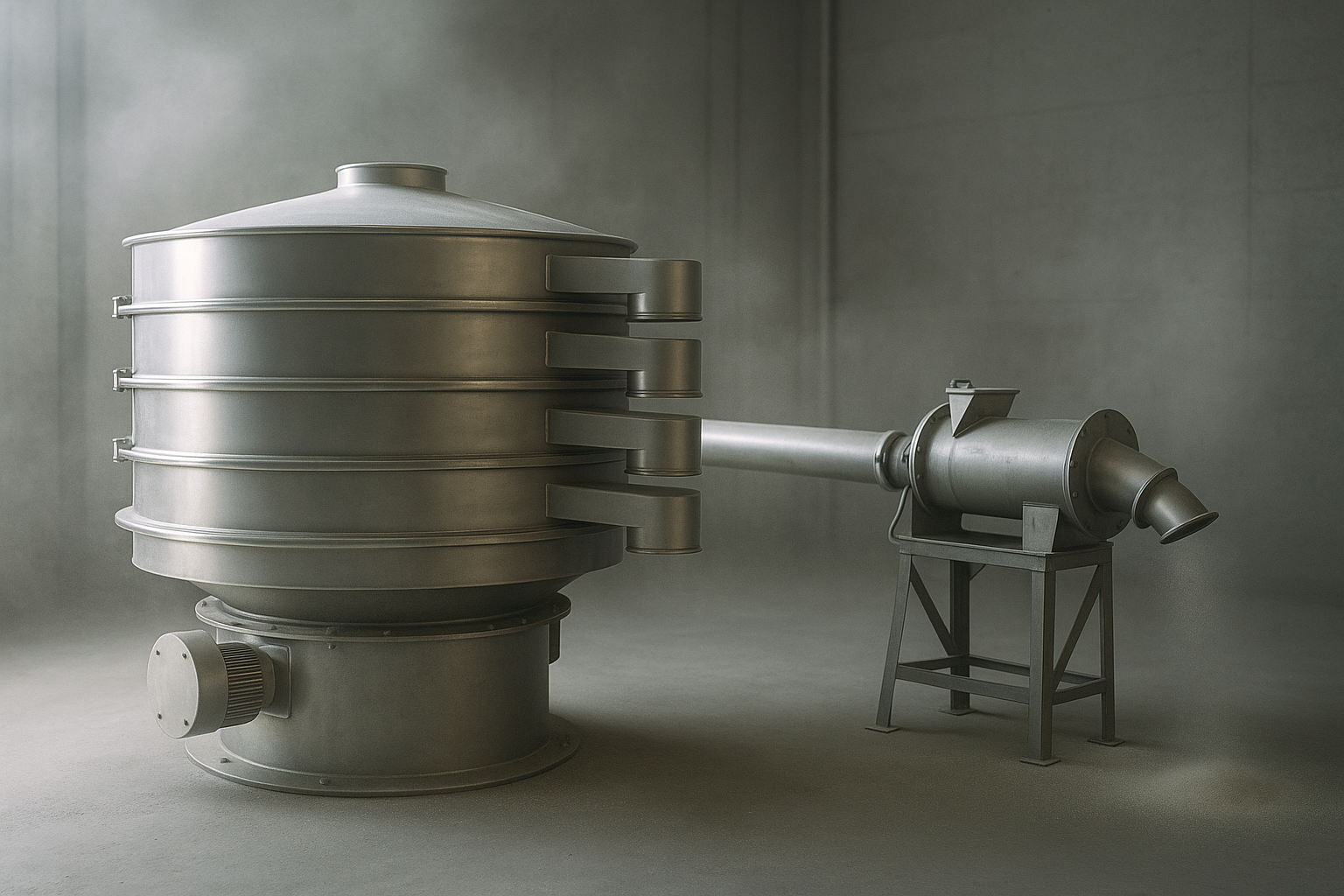
Size reduction changes the particle size distribution through impact, compression, attrition or cutting. Screening then separates material by size. A reliable circuit is selected from breakage behavior, feed variability, target distribution, capacity, energy, wear and the handling of oversize and fines.

Industrial powder size reduction and screening equipment with dust controlled connections
Photorealistic industrial process installation representing Deagglomerators and Nibblers.

Specialist Technology

Deagglomerators & Nibblers

A deagglomerator breaks weak lumps formed during storage, drying or transfer without necessarily grinding every particle.

Rotating elements force agglomerates through a controlled gap or screen.

Explore
Photorealistic industrial process installation representing Impact Crushers.

Specialist Technology

Impact Crushers

An impact crusher reduces particle size by accelerating feed against breaker surfaces or striking it with moving elements.

Product size depends on feed distribution, material fracture behavior, rotor speed, impact geometry, clearances and recirculation.

Explore

Technology Cluster

Storage & Transportation

Storage and transportation systems hold and move bulk solids between production, inventory and dispatch. Sound design preserves material flow and product quality while controlling dust, segregation, weather exposure and the interfaces with loading and reclaim equipment.

Bulk solids storage and transportation facility with silos, loading station and tanker
Photorealistic industrial process installation representing Vacuum Conveying.

Specialist Technology

Bulk Loading & Unloading

Bulk loading and unloading systems transfer dry solids between storage, process equipment and mobile containers while controlling flow, displaced air, dust and vehicle interaction.

The correct arrangement depends on material behavior, required rate, receiving geometry, containment target, weighing method and the way operators connect, position and clean the system.

Explore
Photorealistic industrial process installation representing Level Measurement.

Specialist Technology

Silo Reclaim Systems

A silo reclaim system withdraws bulk solids from storage at a controlled rate and with a defined flow pattern.

Reliable reclaim starts with measured material flow properties and compatible hopper and feeder geometry; adding a stronger drive rarely fixes an outlet that was designed against the wrong flow regime.

Explore

Specialist Technology

Bulk Bag Unloading Systems

A bulk bag unloading system supports a filled flexible intermediate bulk container, controls the outlet spout, promotes reliable discharge and contains dust while transferring powder or granules into the next process.

Selection starts with the material flow behaviour, bag geometry, required discharge rate, dust and explosion hazards, operator tasks, downstream pressure conditions and the evidence needed at commissioning.

Explore
Photorealistic industrial process installation representing Dust Suppression Hoppers.

Specialist Technology

Dust Suppression Hoppers

A dust suppression hopper controls the way free flowing bulk material leaves a loading point so the stream remains compact and entrains less air.

Independent field research shows that the approach can reduce respirable dust in suitable duties.

Explore
Photorealistic industrial process installation representing Loading Spouts.

Specialist Technology

Loading Spouts

A loading spout guides dry bulk material into a truck, railcar, ship, container or stockpile while limiting free fall and providing a controlled route for displaced air.

Selection depends on material, rate, target geometry, required movement, level tracking, dust control and the consequences of overfilling or vehicle movement.

Explore

Technology Cluster

Valves, Gates & Airlocks

Valves, gates and airlocks perform different duties in bulk solids systems. A gate normally opens or isolates a gravity flow path. A diverter selects a route. A rotary airlock transfers material across a pressure difference with controlled leakage. Correct selection starts by defining the required function instead of treating these devices as interchangeable.

Industrial rotary airlock, diverter valve and slide gate beneath powder hoppers
Photorealistic industrial process installation representing Diverter Valves.

Specialist Technology

Diverter Valves

A bulk solids diverter directs material or a pneumatic conveying stream between two or more routes.

Selection depends on whether diversion occurs under gravity, pressure or vacuum, whether switching happens with flow present, and how completely routes must be isolated from leakage or cross contamination.

Explore
Photorealistic industrial process installation representing Rotary Valves.

Specialist Technology

Rotary Valves

A rotary valve meters bulk solids through a rotating pocketed rotor and can limit gas flow between regions of different pressure.

It is not perfectly gas tight.

Explore
Photorealistic industrial process installation representing Slide Gates.

Specialist Technology

Slide Gates

A slide gate opens or closes a bulk solids flow path by moving a blade across an outlet.

It is primarily an isolation or shutoff device, not a precise feeder.

Explore

Partner with powderbulkvideos.com

Put your technical expertise in front of engineers who are already researching.

Build a connected company, video and technology presence with clearly labelled partner visibility and measurable placement performance.