
Application
Feeder Refill from Pneumatic Conveying
Answer in brief
Refill a loss-in-weight feeder from a vacuum receiver mounted above it: level sensors trigger a defined charge, the discharge valve isolates conveying vacuum from the weighed hopper, and the conveying cycle rebuilds the buffer while the feeder returns to gravimetric control. Fast, repeatable, gentle refills within a narrow level band are what keep the feeder's accuracy claim true in production.
Reviewed August 14, 2026 · Updated October 14, 2026
The problem
Desired outcome
Process approach
Selection factors
Common failure modes
- Refill charges too large for the hopper band, so density and the volumetric bridge drift.
- Conveying vacuum reaches the weighed hopper and corrupts the load-cell signal.
- The receiver empties into a still-dosing feeder in one violent, aerating drop.
- Buffer volume too small, so the conveying system cannot keep up at peak rates.
- Displaced air during the drop has no vent path and blows dust into the room.
- Filter cleaning pulses shake the structure during fine dosing.
Partner with powderbulkvideos.com
Put a relevant technical solution in this decision path.
Connect your company and video evidence with clearly labelled visibility where engineers evaluate this material, application, industry or product.
Frequently asked questions
Why does refill design decide loss-in-weight accuracy?
Because the feeder is blind during every refill: it doses volumetrically on learned behavior until the weight signal stabilizes. Slow, irregular or aerating refills stretch that blind window and change the density the bridge assumes — which is where accuracy is actually lost.
How big should the vacuum receiver above a feeder be?
Large enough to hold at least one full refill charge plus the material conveyed during a cycle, small enough that product does not sit and segregate. The working rule: the receiver refills the feeder in seconds, and the conveying system refills the receiver in the pauses.
How is conveying vacuum kept away from the weighing system?
With a discharge valve that seals the receiver from the feeder hopper except during the drop, and venting that lets displaced air escape without a pressure path into the weighed volume. Vacuum reaching the load cells reads as phantom weight change.
Does dense phase conveying help with feeder refill?
For fragile, abrasive or blend-sensitive products, yes: lower velocities reduce breakage, segregation and aeration in the receiver, so the refill drops denser, calmer material — exactly what the volumetric bridge wants.
Related content
Continue exploring
Move from this page to the companies, videos and technical topics that add useful context.
Companies


Videos

VAC-U-MAX
VAC-U-MAX: 10 Critical Design Factors to Consider When Designing Vacuum Conveying Systems
VAC-U-MAX presents ten design factors for vacuum conveying, including pickup, material behavior, route, receiver, filtration, discharge and controls.
Total reach: 11,000
Coperion
Coperion Loss-in-Weight Feeder Animation
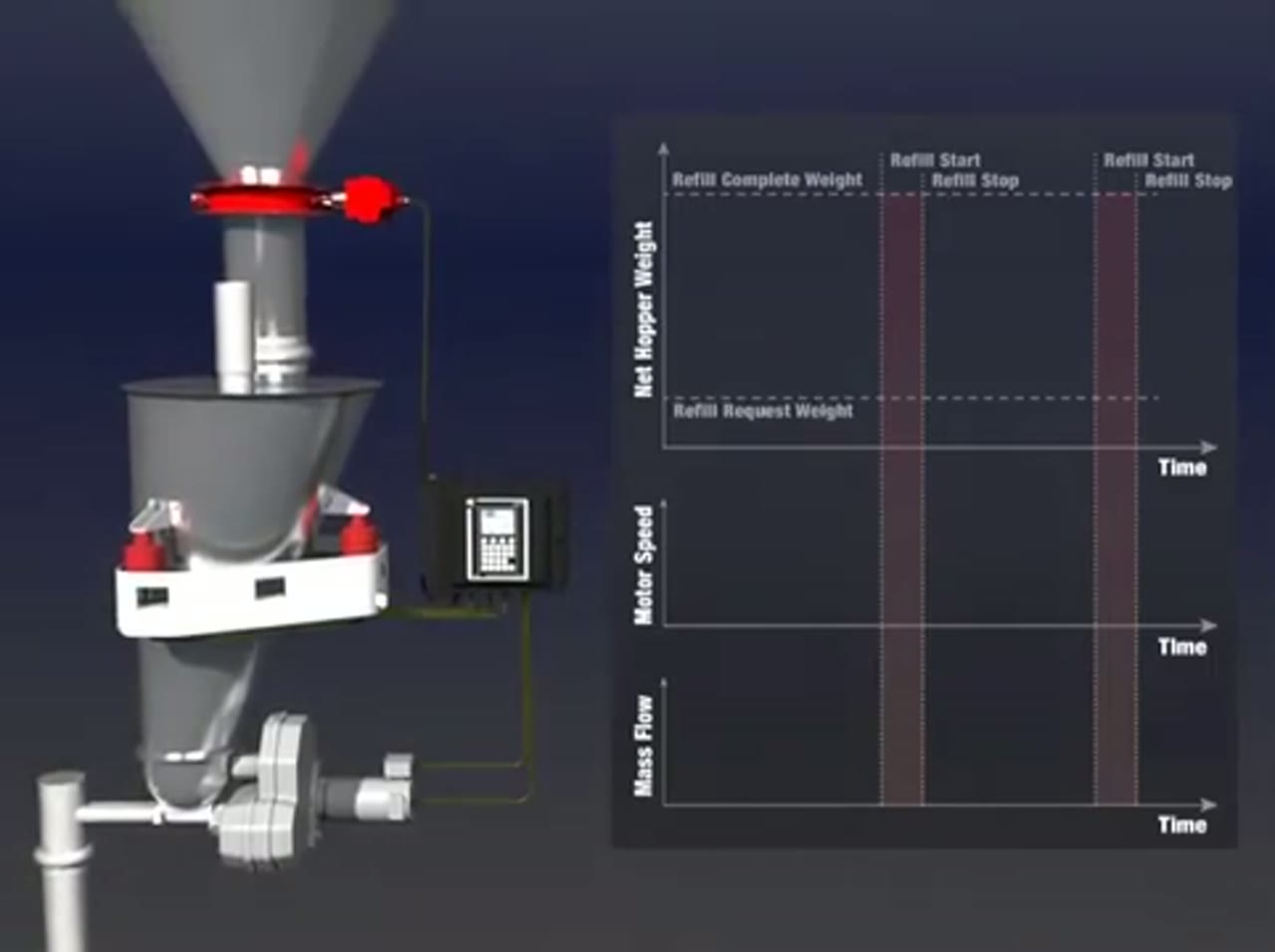
The Coperion K-Tron animation shows a controller observing the decrease in combined hopper, feeder and material weight, comparing the measured rate with the setpoint and adjusting feeder output.
Total reach: 43,080

Volkmann GmbH
Suction lance for powder feeding
The Volkmann video shows powder being introduced from a drum or container through a suction lance into a vacuum conveying line. It shows the pickup boundary and the need to admit material and conveying air in a controlled way. Capacity and suitability depend on the powder and need a conveying trial with the actual material.
Total reach: 1,792