
Application
Dense Phase Conveying in Chemical Production
Answer in brief
In chemical production dense phase is chosen for containment as much as for the product.
Less air means a smaller filter, a smaller vent and a smaller release if something fails, and a closed loop with nitrogen becomes affordable at dense phase air volumes.
- Use the low air volume; it is what makes containment and inerting practical.
- Check compatibility along the whole line, including the valves.
- Design the changeover between campaigns into the line.
Reviewed October 21, 2026
The problem
A chemical plant conveying a powder has three problems at once: the product may be harmful, it may be reactive with oxygen or moisture, and the line is shared between campaigns.
Dilute phase conveying makes all three harder because of the air. A large air volume needs a large filter, a large vent and a large extraction, and every one of those is a place where product can escape and air can enter. Inerting a dilute phase line with nitrogen is possible and expensive.
Dense phase changes the arithmetic. The air volume is a fraction of the dilute phase figure, which makes a closed loop with an inert gas practical, shrinks the receiving filter and reduces the vent.
What it does not solve is compatibility and carryover. The pipeline, the bends, the valves, the vessel and the seals all see the product and the cleaning agent, and a line that carries three campaign products has to be emptied and cleaned between them in a way somebody can state as a number.
Desired outcome
A conveying system sized so the air or inert gas volume is small enough to make containment, filtration and inerting proportionate.
Compatibility verified along the whole line, including bends, valves, flexible sections and seals, against every product and cleaning agent in the campaign plan.
A line that can be emptied and cleaned between campaigns, with the residual quantity measured rather than assumed.
A feed and grain plant measures the result rather than the route: pellet durability taken at the press and never after the conveying line hides what the bends did.
Process approach
The material is characterised first: permeability, de aeration behaviour and the pressure needed for the duty. For chemical powders this often has to be done per product, because a campaign plan may include materials with very different conveying behaviour on the same line.
Where the product is oxygen or moisture sensitive, a closed loop is designed rather than an open one: the conveying gas is recirculated, cooled and filtered, with make up and oxygen monitoring. Dense phase is what makes the gas inventory affordable.
Containment is then designed at the ends. The feeding vessel and the receiver are where product meets the plant, so those are the containment boundaries; the pipeline itself is usually the easy part. Filter change, vessel entry and the drain at a low point are the operations to design for.
Changeover is designed in. Drain points at low spots, an emptying sequence, an accessible route for cleaning and a measured residual quantity give a carryover figure that a quality question can be answered with.
- Each campaign product characterised separately for conveying behaviour.
- Closed loop with inert gas where oxygen or moisture sensitivity requires it, with oxygen monitoring.
- Containment designed at the feeding vessel and the receiver, which are the real boundaries.
- Compatibility verified for pipeline, bends, valves, flexible sections and seals, including cleaning agents.
- Drain points and an emptying sequence for changeover between campaigns.
- Residual quantity measured so the carryover figure is a number.
Selection factors
- Exposure limit of the products, which decides how much the reduced air volume is worth.
- Oxygen or moisture sensitivity, which decides between an open system and a closed inert loop.
- Conveying behaviour per product, measured, since a campaign plan can span very different materials.
- Compatibility of every wetted component with products and cleaning agents.
- Carryover permitted between campaigns and how it will be measured.
- Area classification, which applies to the vessel, the valves and the instruments.
Common failure modes
- Dilute phase retained for a harmful product, so the filter and the vent are larger than they need to be
- Inert loop designed with no oxygen monitoring, so loss of inerting is invisible
- Compatibility checked for the pipeline but not for the valve seals and flexible sections
- No drain at a low point, so the line cannot be emptied between campaigns
- Carryover between products estimated rather than measured as a residual quantity
- One conveying characterisation applied to a campaign plan with very different materials
Partner with powderbulkvideos.com
Put a relevant technical solution in this decision path.
Connect your company and video evidence with clearly labelled visibility where engineers evaluate this material, application, industry or product.
Frequently asked questions
Why does dense phase help with containment?
Because it uses far less air. A smaller air volume means a smaller filter, a smaller vent and a smaller potential release, and it makes recirculating an inert gas affordable rather than theoretical.
Where are the real containment boundaries?
At the feeding vessel and the receiver. The pipeline is welded and usually straightforward; the operations that matter are filter changes, vessel access and draining at a low point.
How is carryover between campaigns established?
By measuring what is left after the emptying sequence. A residual quantity measured on the installed line is something a quality question can be answered with; an estimate is not.
Related content
Continue exploring
Move from this page to the companies, videos and technical topics that add useful context.
Companies

Videos
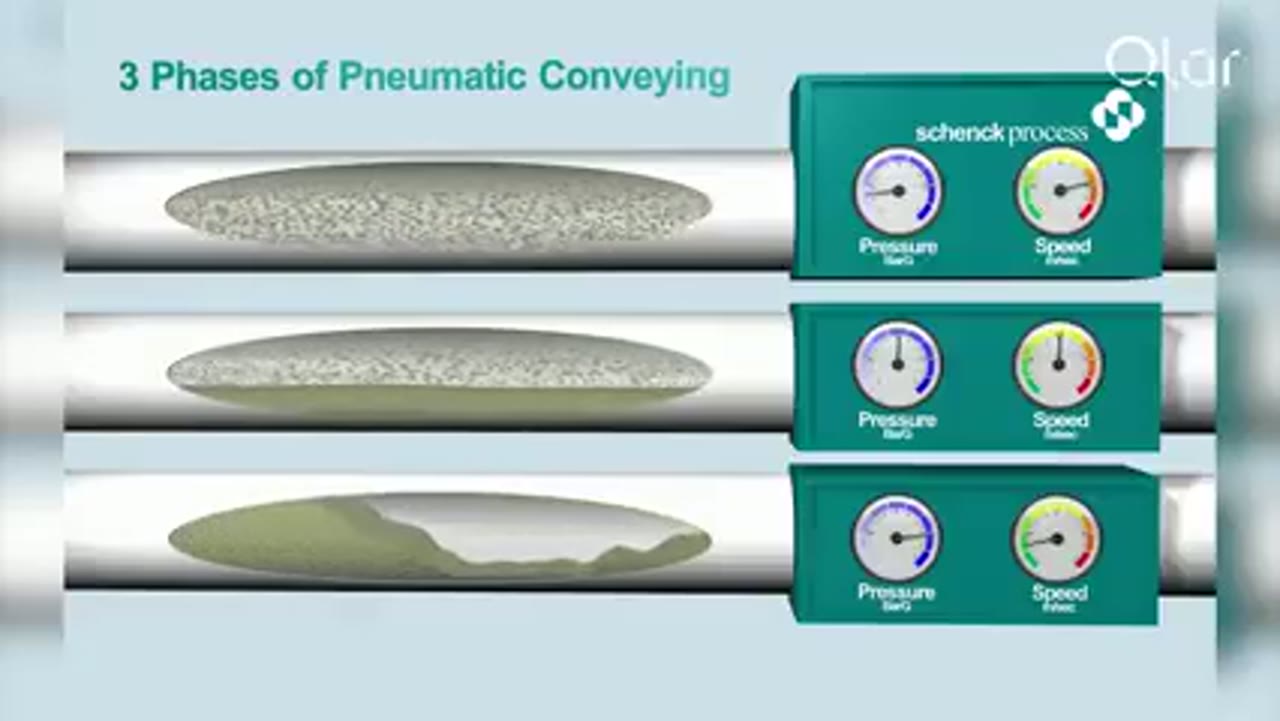
Qlar
Pneumatic Conveying Explained: The 3 Key Phases of Dense Phase Conveying
Qlar explains the three phases of dense phase pneumatic conveying and where each one fits when powders, granules and bulk solids have to move without being damaged.
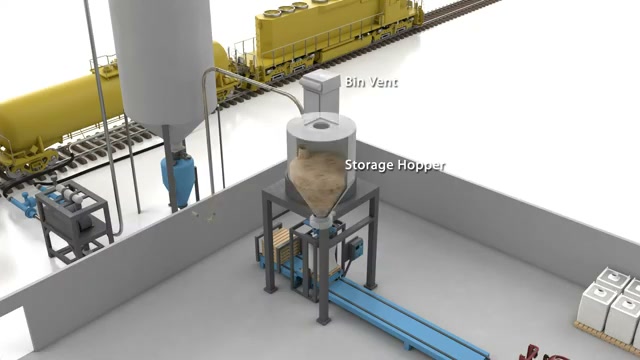
Magnum Systems
Dense Phase Conveying Process Flow Animation
Magnum Systems shows in a short animation how material travels through a dense phase line in slugs rather than as a continuous stream.
Total reach: 1,747
Coperion
E-finity Continuous Dense Phase Conveying
Coperion presents E-finity, a continuous dense phase conveying system for fragile granular and pelleted materials that monitors pressure and corrects the airflow during the run.
Total reach: 1,905