
Guide
Dust Collection Systems: Selection and Design Guide
Answer in brief
Dust collection design starts at the emission points, not at the collector: define every capture point with its airflow, design duct velocities that keep dust moving, then size the collector by air-to-cloth ratio for the dust — and engineer the explosion-protection concept in from day one for combustible dusts.
By Editorial Team · Published August 14, 2026 · Updated October 13, 2026
Sponsored visibility
Featured videos for this topic
Paid placements are clearly marked and remain separate from the editorial related-video selection.
A dust collection system is really three systems in series: capture at the source, transport through ductwork, and separation in the collector. Most underperforming installations fail in the first two stages — hoods that never captured properly, or ducts where dust settles — while attention went to the filter alone.
Capture: where the system is won or lost
Every transfer point, bag dump, screen and packer that emits dust is a capture point with a required airflow. Enclosing the source beats blasting air at it: a hood that surrounds the emission needs a fraction of the airflow of an open canopy.
The classic engineering reference for hood design and capture velocities is the ACGIH Industrial Ventilation manual; its hood-specific airflow recommendations are the honest basis for the system total.
Ductwork
Duct design balances two failure modes: too slow, and dust settles into plugs and fire load; unnecessarily fast, and abrasion plus pressure loss soar.
Systems are laid out branch by branch to hold the design velocity through every operating combination, with balancing by design (duct sizing) preferred over throttling dampers that operators later re-adjust. Long-radius bends and gradual junctions cost less over a plant life than the elbows they replace.
Choosing the collector
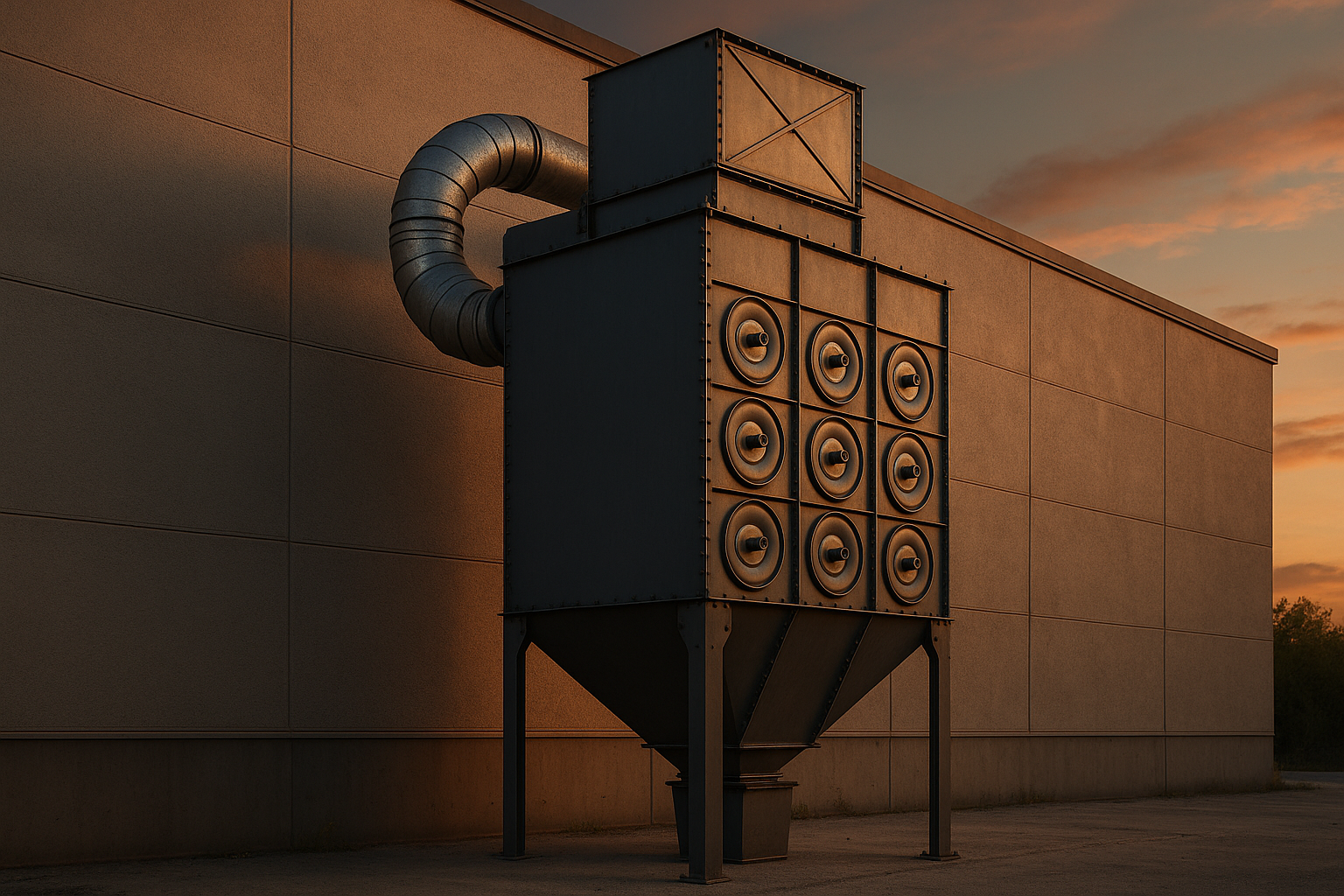
For most process dusts, the choice is between baghouse (fabric filter) and cartridge collectors. Cartridges pack more media into less space and suit fine, dry, free-releasing dusts at moderate loads; bags remain the robust choice for heavy loads, fibrous or sticky dusts, and high-temperature service.
Cyclones survive as pre-separators for coarse loads and spark reduction. The sizing discipline is the air-to-cloth ratio (filtration velocity): conservative ratios cost filter area up front and repay it in emission stability, pressure drop and media life.
Partner with powderbulkvideos.com
Put your expertise beside the decisions engineers are making.
Connect a relevant company profile and technical video portfolio with clearly labelled visibility on this topic.
Cleaning and discharge
Pulse-jet cleaning dominates: rows of media are cleaned by compressed-air pulses while the collector stays online. Cleaning that is too aggressive or too frequent shortens media life and pushes fines through; cleaning on differential pressure rather than fixed timers keeps the cake — and the filtration efficiency it provides — intact.
The hopper is not a storage bin: collected dust must discharge continuously through a rotary valve or double-flap gate into a closed disposal or recyrecyclingh.
Combustible dust: protection is part of the design
If the dust is explosible, the collector is a protected vessel, not an accessory: deflagration venting sized to the dust and vessel (directed to a safe area or through flameless venting indoors), isolation on the inlet duct so a deflagration cannot propagate back into the plant, and rotary-valve discharge acting as an isolation barrier.
Spark sources upstream — mills, dryers — may justify spark detection and extinguishing in the duct. The NFPA 652 framework ties dust testing, hazard analysis and these protections together; OSHA enforcement follows the same logic.
Design checklist
- Every emission point listed with hood type and design airflow?
- Duct velocities held in every branch across all operating combinations?
- Air-to-cloth ratio chosen conservatively for the dust class?
- Cleaning controlled on differential pressure, not timers alone?
- Hopper discharge continuous and closed — no dust storage in the collector?
- Dust explosibility tested; venting, isolation and discharge barriers engineered accordingly?
- Fan sized for the dirty-filter operating point, with margin for future capture points?
Frequently asked questions
Baghouse or cartridge collector — which is better?
Cartridges pack more filter media into a smaller housing and suit fine, dry, easily released dusts at moderate loads. Baghouses handle heavy dust loads, fibrous, sticky or abrasive dusts and higher temperatures more robustly. The dust decides — not the footprint alone.
What is the air-to-cloth ratio?
The filtration velocity: total airflow divided by installed filter area. Conservative (lower) ratios mean more filter area, lower pressure drop, longer media life and more stable emissions — usually the cheapest choice over the system lifetime.
Why does my dust collector need explosion venting?
Because a collector concentrates fine, dispersed dust and ignition risks in one vessel. For explosible dusts the NFPA 652 framework leads to deflagration venting or suppression on the vessel, isolation on the inlet duct and a discharge device that acts as a barrier — engineered from dust-test data, not assumptions.
How is collected dust discharged safely?
Continuously, through a rotary valve or double-flap gate into a closed bin, bag or recycling line. Letting dust accumulate in the collector hopper creates bridging, fire load and — for combustible dusts — an unnecessary explosion volume.
Related content
Continue exploring
Move from this page to the companies, videos and technical topics that add useful context.
Companies


Videos

DSH Systems
DSH Systems: Before & After DSH7 Truck Loading Limestone Sand
Side-by-side comparison of truck loading operations before and after installing the DSH 7 Corten-steel Dust Suppression Hopper, loading limestone sand at up to 950 metric tons per hour with almost no airborne dust.
Total reach: 24,929

DSH Systems
DSH Systems: Installation Profile – Phu My Port in Vietnam
DSH Systems documents a dust-suppression hopper installation for dry granular material transfer at Phu My Port in Vietnam.
Total reach: 23,687

DSH Systems
DSH Systems: Introduction Dust Suppression Hopper
DSH Systems introduces its dust-suppression hopper for controlling dust fallout during dry-bulk loading.
Total reach: 24,748

HS Umformtechnik GmbH
HS Umformtechnik Company Video
HS Umformtechnik presents large-radius pipe bends, pipe couplings and branch pipes for pneumatic conveying systems.
Total reach: 6,272

VAC-U-MAX
VAC-U-MAX: Model 1050 Continuous-Duty Industrial Vacuum Cleaner
This VAC U MAX video explains the Model 1050 portable continuous duty vacuum system for dense material recovery. It helps define the system boundary and major components. Capacity, filtration, pressure loss, discharge and combustible dust suitability depend on the material and complete installation.
Total reach: 46,346

Imperial Systems
CMAXX Dust and Fume Collector Install Video
Imperial Systems demonstrates installation steps and site interfaces for a CMAXX dust and fume collector.
Total reach: 1,889

Camfil APC
Overview of Gold Series Industrial Dust Collectors
Camfil APC provides an official overview of its Gold Series industrial dust collector platform and the role of cartridge collection in industrial dust-control systems.
Total reach: 3,238