
Application
Bulk Bag Discharge in Food Production
Answer in brief
A bulk bag station in a food plant is a hygiene boundary as much as a flow device.
The bag liner, the untying step and the spout connection are all places where the product meets the room, and the room is not clean enough for it.
- Enclose the untying and seal the spout.
- Sieve after discharge; the bag is the most likely source of foreign bodies.
- Include the station in the allergen cleaning plan.
Reviewed October 21, 2026
The problem
A bulk bag holds a tonne of powder above an open process, and everything that makes it convenient also makes it difficult.
The bag is soft, so it deforms as it empties and the spout moves. The powder bridges inside the liner, which stops the flow with the bag still half full. And the moment of untying the spout is the moment dust is released at the operator's face.
In a food plant two more constraints arrive: the station has to be cleanable to the plant standard, and where allergens are involved the liner and the station have to be segregated or verifiably cleaned between products.
Desired outcome
A station that empties the bag completely, without the operator reaching into the flow and without a dust cloud at the connection.
In practice that means three things: the bag is supported so it collapses inwards as it empties, the spout is connected before it is opened, and the station can be cleaned in the time the plant has between products.
Sieving after the station as a routine step, because the bag and its liner are the most likely source of foreign material in the plant and a shed fragment reaches the process intact.
In mineral processing the governing figure is the respirable silica fraction, which is invisible: capture judged by appearance passes while the dangerous part is still airborne.
Process approach
The bag arrives on a pallet and is lifted into a frame, either by hoist or by forklift depending on the building.
The spout passes through a seal into the receiving hopper and is clamped before it is untied. That order matters: a spout untied outside the seal releases dust that the extraction then has to chase.
Extraction at the connection point keeps the operator's breathing zone clear while the bag is open. The volume is set by the opening and the face velocity needed to hold the dust in, not by the size of the station.
As the bag empties, it needs help. Massaging paddles or a vibrating frame work the powder down the walls of the liner, and a bag that is supported at the corners collapses inwards instead of forming a bridge across the spout.
Bag variation is the detail that defeats otherwise good stations. Liner type, spout length and bag dimensions differ between suppliers and between deliveries, and a frame built around one supplier's bag means that a change of supplier becomes a change of procedure, usually an improvised one at the station.
- Connect first, open second.
- Extract at the opening, not at the room.
- Support the bag so it collapses inwards.
- Leave the last of the powder a path to the outlet.
- Sieving after the station, since the bag and liner are the main foreign body route.
- Frame and spout arrangement able to take the full range of bags in the supply.
- Changeover time measured against the allergen plan rather than estimated.
Selection factors
- Flow behaviour of the powder, measured rather than assumed: it decides whether massaging is optional or essential.
- Hygienic standard required, which decides the surface finish, the seal design and whether the station can be wet cleaned.
- Allergen matrix: shared stations need either verified cleaning or dedicated contact parts.
- Headroom in the building, which decides between hoist and forklift loading more often than preference does.
- Bag variation: liner type, spout length and bag dimensions differ between suppliers and the frame has to take all of them.
- Explosion characteristics of the powder, which decide whether the station and its extraction need protection.
- Sieve position and mesh, chosen for liner fragments as well as for product lumps.
Common failure modes
- Spout untied before it is sealed into the hopper, which releases the dust the extraction was meant to prevent
- No massaging or vibration, so the bag bridges with a third of the product still inside
- Extraction sized for the station rather than for the opening, so capture velocity is too low where it matters
- Station cannot be cleaned in the available changeover time, so it is cleaned less often than the allergen plan assumes
- Frame designed for one supplier's bag dimensions, so a changed supplier means a changed procedure
- No sieve after the station, so liner fragments reach the process intact
- Massaging paddles working the whole bag rather than the lower third, which does the resisting
Partner with powderbulkvideos.com
Put a relevant technical solution in this decision path.
Connect your company and video evidence with clearly labelled visibility where engineers evaluate this material, application, industry or product.
Frequently asked questions
Why does a bulk bag stop flowing when it is half empty?
The powder bridges inside the liner. The bag is soft, so it cannot break the bridge itself, and without massaging or vibration the flow stops with a large part of the product still inside.
When should the spout be opened?
After it is clamped into the seal, never before. A spout untied outside the seal releases a dust cloud that the extraction then has to chase instead of preventing.
What decides the extraction volume?
The open area at the connection and the face velocity needed to hold the dust in. The size of the station is not the driver, and a larger fan does not fix a badly placed opening.
Why sieve after a bulk bag station in a food plant?
Because the bag is the most likely foreign body source in the plant and the liner itself sheds. A fragment that arrives intact is not removed by anything else downstream.
Related content
Continue exploring
Move from this page to the companies, videos and technical topics that add useful context.
Companies
Videos
Flexicon
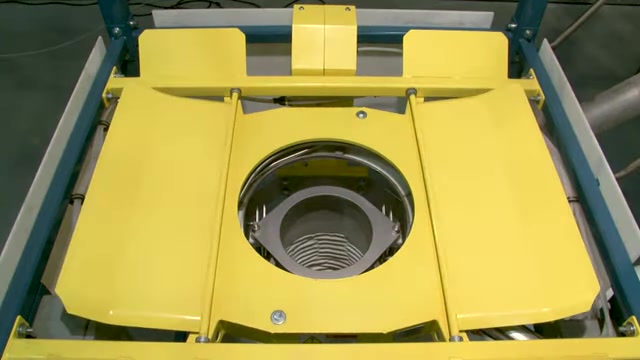
Flexicon BULK-OUT Bulk Bag Dischargers
Flexicon presents its BULK-OUT bulk bag discharger range: forklift-loaded BFF frames, hoist-and-trolley BFC frames, split and half frames, and accessories for dust-free untying, retying and flow promotion.
Total reach: 73,122
Hapman
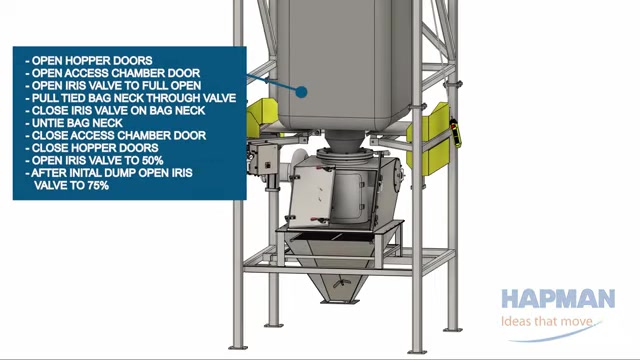
Hapman Bulk Bag Hoist Unloader with Dust Collection
Hapman shows a hoist-loaded bulk bag unloader with a round access chamber and integrated dust collection for dust-free discharge.
Total reach: 2,978
Palamatic Process
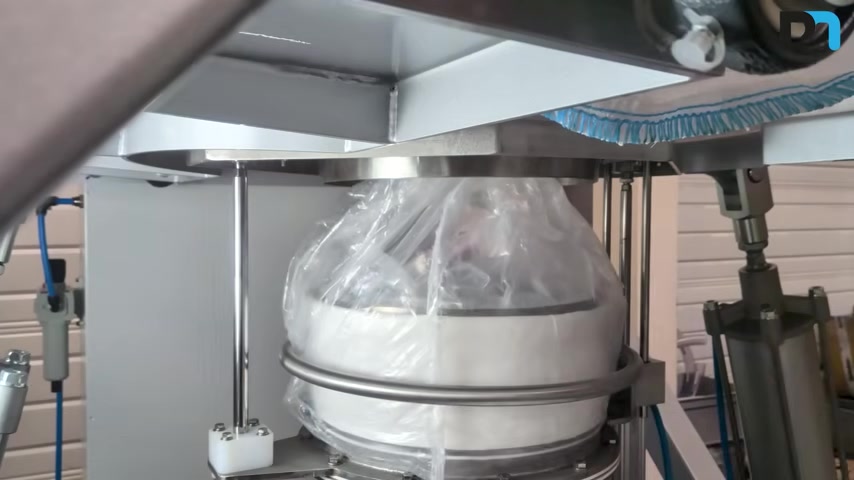
Palamatic Process: Emptying Big Bags of Sensitive Powders with OEB Containment
A Palamatic Process engineer explains the OEB big bag discharge station for toxic, CMR and ultra-fine powders, including the sleeve tie-off that keeps containment through a bag change.
Total reach: 18,760
Technologies
- Bulk Bag Unloading Systems
- Bulk Bag Unloading Systems: Selection and Design
- Dust Collection & Air Pollution Control
- Dust Collection & Air Pollution Control Technology Guide
- Feeding & Dosing Control
- Feeding & Dosing Control
- Screening & Sieving Systems
- Screening & Sieving Systems for Powder and Bulk Solids
- Vacuum Conveying
- Vacuum Conveying Systems