
Application
Bulk Bag Discharge in Chemical Batching
Answer in brief
In chemical batching the bulk bag station is the single largest exposure point in most plants.
It is also where the batch weight is established, so dust control and accuracy have to be solved together.
- Specify a sealed connection with extraction, not a cuff.
- Add flow aids for the cohesive products on the list.
- Weigh below the station, not inside it.
Reviewed October 21, 2026
The problem
In chemical batching the bulk bag station feeds a recipe, so the accuracy of what leaves it matters as much as the fact that it leaves.
The materials vary widely between campaigns, from free-flowing granules to cohesive hygroscopic powders, and the same station has to handle all of them. Many are corrosive, irritant or incompatible with each other, which makes cross-contamination a safety question rather than a quality one.
Desired outcome
A station that empties any of the plant's materials completely, meters the required quantity within the recipe tolerance, and can be cleaned between products with confidence.
Weighing arranged below the station rather than inside it, so the batch figure is not affected by the hoist, the massaging paddles or the mass of a bag that is still partly supported by its own liner.
A documented answer for every incompatible pair on the material list: dedicated contact parts, a verified cleaning procedure, or a campaign sequence that keeps them apart. With incompatible chemistry that is a safety decision, not a quality preference.
A food plant adds the hygiene boundary: the spout is clamped into the seal before it is untied, and the station has to be cleanable inside the changeover the plant actually has.
Process approach
The bag is lifted into the frame and the spout sealed into the hopper before opening.
Below the hopper, the metering device does the work that distinguishes batching from simple discharge: usually a screw or rotary valve under gravimetric control, so the quantity is weighed rather than assumed. Where the addition is small relative to the batch, a loss-in-weight arrangement holds the tolerance that a volumetric device cannot.
Material compatibility decides the contact parts. A station that handles both an acid and an alkaline powder needs either dedicated parts or a verified cleaning procedure, and the choice is usually cheaper to make at the design stage.
Flow aids are specified from measured properties rather than added after commissioning. A hygroscopic powder that has absorbed moisture in storage behaves nothing like the sample that was tested dry, and the station has to handle the condition the material arrives in.
The connection itself is where the exposure is. A cuff over an open hopper is not a seal; a clamped spout inside a sealed inlet with extraction at the opening is, and the extraction volume follows from the open area and the capture velocity rather than from the size of the station.
- Seal, open, discharge under weight control.
- Contact parts chosen for the whole material list, not the first one.
- Cleaning procedure defined before the second product arrives.
- Weighing below the station, isolated from the hoist and the massaging mechanism.
- Flow aids specified from measured properties in the as received condition.
- Extraction volume derived from the open area at the connection, then verified by sampling.
Selection factors
- The full material list, not the easiest member of it: flow, corrosivity and compatibility all come from the worst case.
- Recipe tolerance, which decides volumetric against gravimetric metering.
- Changeover frequency, which decides whether cleaning time or dedicated parts is cheaper.
- Area classification, which may require inerting or specific equipment ratings.
- Operator exposure to irritant or corrosive powders at the connection.
- Weighing arrangement, since a load path through the hoist or the paddles corrupts the batch figure.
- As received material condition, including moisture pickup in storage.
- Cleaning agent compatibility with the contact parts, often harsher than the products.
Common failure modes
- Station specified for the first material and then used for the whole list
- Volumetric metering where the recipe tolerance is tighter than the density variation
- Shared contact parts between incompatible products without a verified cleaning procedure
- Area classification considered after the equipment was selected
- Hopper outlet sized for a free-flowing granule and used for a cohesive powder
- Weighing taken at the station, so the hoist and the massaging paddles appear in the batch figure
- Flow aids added after commissioning because the design used a dry laboratory sample
- Cuff over an open hopper described as a sealed connection
Partner with powderbulkvideos.com
Put a relevant technical solution in this decision path.
Connect your company and video evidence with clearly labelled visibility where engineers evaluate this material, application, industry or product.
Frequently asked questions
Volumetric or gravimetric metering under the bag?
Gravimetric wherever the recipe tolerance is tighter than the bulk density variation of the materials. In a plant with a varied material list, that is usually the case.
How should cross-contamination be handled?
Either dedicated contact parts or a verified cleaning procedure, decided at the design stage. With incompatible chemicals it is a safety question, not only a quality one.
What should the station be designed for?
The most difficult material on the list, not the most common one. Flow behaviour, corrosivity and compatibility all come from the worst case.
Where should the weighing be?
Below the station, mechanically isolated from the hoist and the massaging mechanism. Anything that applies force to the weighed assembly appears as mass, and a partly supported bag is the hardest version of that problem.
Related content
Continue exploring
Move from this page to the companies, videos and technical topics that add useful context.
Companies
Videos
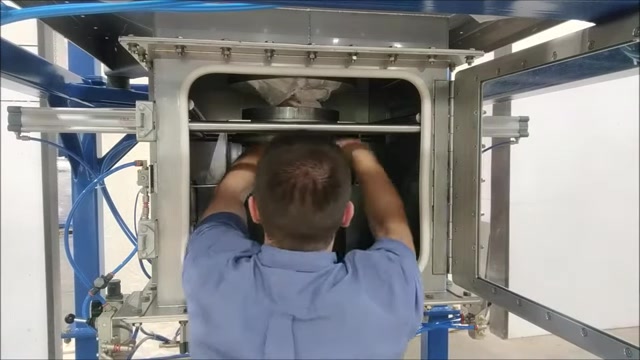
Carolina Conveying
Carolina Conveying Bulk Bag Unloader: Clamping Down on Dust
Carolina Conveying shows how its bulk bag discharge station contains dust: the spout is untied inside a sealed access module and clamped pneumatically to a feed tube.
Total reach: 18,065
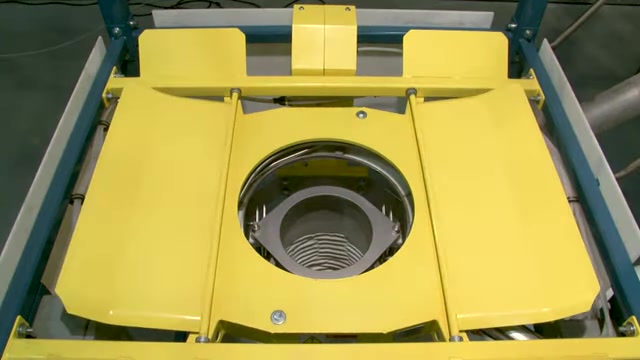
Flexicon
Flexicon BULK-OUT Bulk Bag Dischargers
Flexicon presents its BULK-OUT bulk bag discharger range: forklift-loaded BFF frames, hoist-and-trolley BFC frames, split and half frames, and accessories for dust-free untying, retying and flow promotion.
Total reach: 73,122
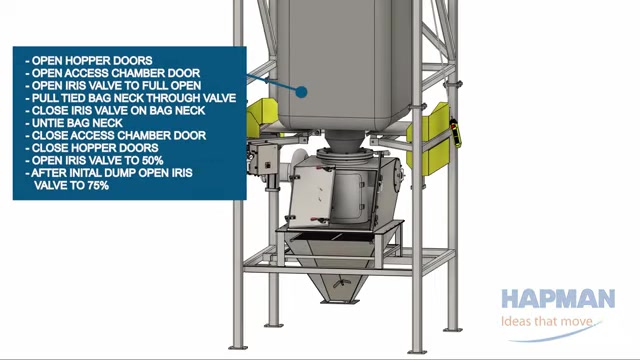
Hapman
Hapman Bulk Bag Hoist Unloader with Dust Collection
Hapman shows a hoist-loaded bulk bag unloader with a round access chamber and integrated dust collection for dust-free discharge.
Total reach: 2,978