
Material
Fly Ash
Answer in brief
Fly ash behaves like a liquid when aerated and like concrete when it is not.
That switch is what breaks feeders: an ash that floods through a rotary valve in the morning can arch over the same outlet after a weekend of consolidation.
- Control aeration deliberately instead of letting it happen by accident.
- Design the silo outlet for the consolidated state.
- Expect abrasive wear despite the small particle size.
Reviewed October 21, 2026 · Updated November 10, 2026
Handling challenges
Fly ash is the classic example of a powder with two completely different personalities, and the plant usually meets both in the same week.
Aeration and flooding
Freshly conveyed ash retains air for a long time because the particles are fine and spherical.
In that state it flows through valves and feeders uncontrolled, overfills the next vessel and defeats gravimetric feeding.
Deaeration volume above the feeder, a controlled fill sequence and rotary valves with the right clearance class are the usual answers.
Consolidation and ratholing
Left to stand, the same ash consolidates and forms a stable rathole over the outlet, with the stored inventory sitting untouched around it.
- Size outlets from measured flow properties for the time-consolidated condition.
- Prefer mass flow geometry where the silo duty allows it.
- Use aeration pads as a flow aid with care, since over-aeration swings the material back to flooding.
Wear
Fine does not mean gentle: fly ash contains hard, angular particles and erodes bends, valve seats and feeder housings quickly.
Long-radius bends, wear-resistant inserts at impact points and a defined inspection interval are cheaper than an unplanned outage.
Moisture and set
Ash with free lime reacts with water and sets hard, which turns a small leak into a solid block inside a silo or a truck.
Weatherproofing, dry venting air and prompt removal of any wetted material are practical rather than theoretical requirements.
Health and emissions
Respirable fractions include crystalline silica, so dust control at loading, filter maintenance and operator protection are regulated matters rather than housekeeping.
What to establish before buying equipment
- Flow properties in both the aerated and time-consolidated states.
- Free lime content, which predicts set behavior on contact with water.
- Particle hardness and the expected wear rate at design velocity.
- Peak loading rate and the dust control method at the truck or railcar.
Storage and conditioning
Fly ash is the clearest example of a powder that behaves like two different materials.
Freshly filled and aerated, it flows like water and will run through any opening. Left to settle, it consolidates hard and arches over an outlet that worked an hour earlier. The same silo, the same ash, two opposite problems.
- Design for both: a deaeration volume for the fluid state and an outlet sized for the consolidated state.
- Keep it dry. Class C ash in particular reacts with water and sets, and a leak turns a silo into a repair job.
- Fluidising pads need dry, oil-free air, or they create the crust they are meant to prevent.
What this means for equipment
The equipment has to handle the fluid state without flooding and the settled state without arching.
Dense phase conveying is the usual answer over distance: low velocity keeps the abrasive fines from eating bends, and the vessel handles the aerated material in a controlled way. Rotary valves need to be specified for the flooding case, because a standard valve passes aerated ash as if the pocket were open.
- Dense phase for continuous duty; dilute phase only for short transfers.
- A deaeration volume before any feeder, and gravimetric feeding where the rate matters.
- Isolation that closes against a flowing column.
Safety and regulatory
Fly ash is not combustible, and the controls are respiratory and chemical.
It is alkaline enough to irritate skin and eyes, and the respirable fraction can contain crystalline silica depending on the fuel and the plant. Both make capture at the source the practical control rather than personal protection alone.
- Capture at every transfer, and closed handling of collected dust.
- Eye and skin protection where the material is handled open, especially where it may be damp.
- Confined space discipline at silos: aerated ash can behave like a liquid and will not support a person.
Material behavior
- Flowability
- Flooding when aerated, poor when consolidated
- Abrasiveness
- High despite fine particle size
- Cohesiveness
- Moderate; consolidates in storage
- Moisture behavior
- Moisture causes hard set, especially with high free lime
- Contamination risk
- Respirable dust with crystalline silica content
Partner with powderbulkvideos.com
Put a relevant technical solution in this decision path.
Connect your company and video evidence with clearly labelled visibility where engineers evaluate this material, application, industry or product.
Frequently asked questions
Why does fly ash flood and arch in the same silo?
Because it has two states. Aerated it behaves almost like a liquid; consolidated it gains enough strength to span the outlet. The design has to cover both, not pick one.
What happens if fly ash gets wet?
It can react and set, particularly higher calcium grades. A wet patch in a silo becomes a solid that has to be removed mechanically.
Is dense phase really necessary?
For continuous lines, usually yes. Fly ash is abrasive and the wear rises steeply with velocity, so a dilute phase line can need new bends within months.
Related content
Continue exploring
Move from this page to the companies, videos and technical topics that add useful context.
Companies


Videos

Laidig Systems
Laidig Systems: Applications – Powder and Bulk Solids
Laidig Systems designs and builds custom storage and reclaim systems that automate the unloading of dry bulk materials. The company focuses on materials with poor flow characteristics and delivers reclaimers for flat- and cone-bottom structures in industries such as food processing, biomass, power, cement, and mining.
Total reach: 24,494
Qlar
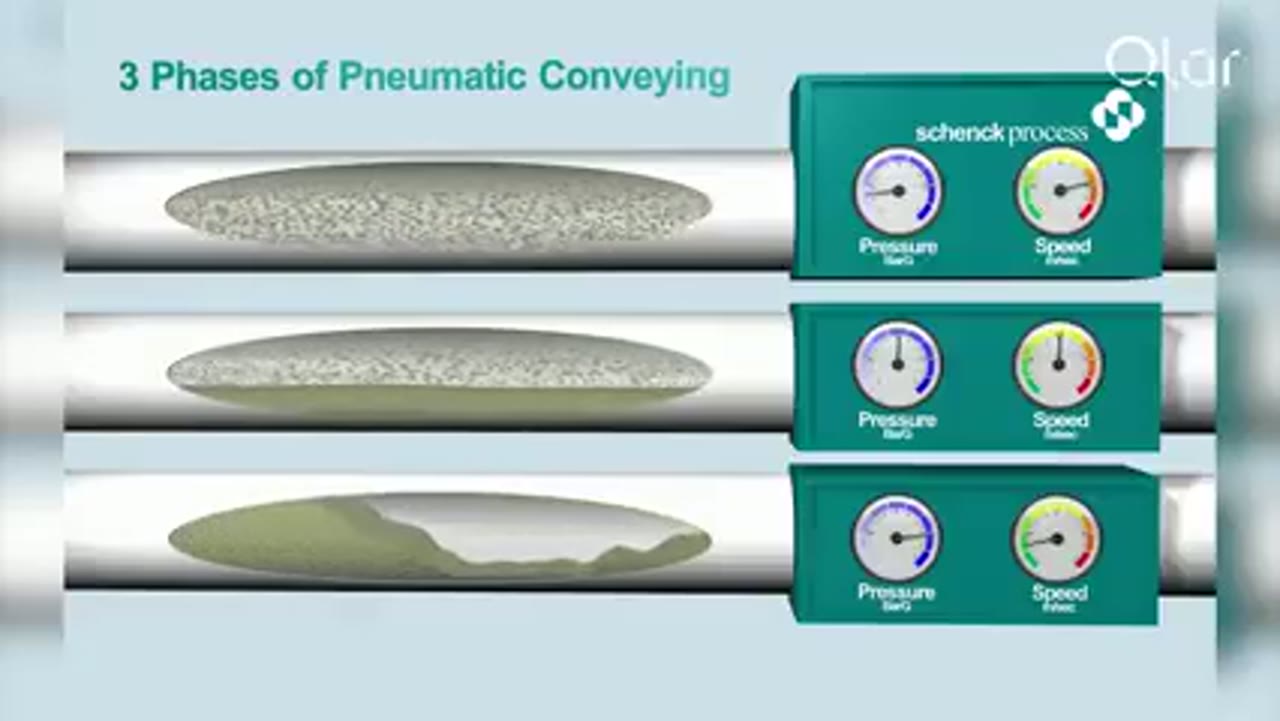
Pneumatic Conveying Explained: The 3 Key Phases of Dense Phase Conveying
Qlar explains the three phases of dense phase pneumatic conveying and where each one fits when powders, granules and bulk solids have to move without being damaged.
Technologies
- Bulk Loading & Unloading
- Dense Phase Conveying
- Dense Phase Conveying
- Dust Collection & Air Pollution Control
- Dust Collection & Air Pollution Control Technology Guide
- Feeding & Dosing Control
- Feeding & Dosing Control
- Pneumatic Conveying
- Pneumatic Conveying Technology Guide
- Rotary Valves
- Rotary Valves for Powder and Bulk Solids
- Silo Reclaim Systems
- Storage & Transportation
Applications
- Bulk Truck Loading
- Dense Phase Conveying for Abrasive Materials
- Dense Phase Conveying in Building Materials Plants
- Pneumatic Conveying in Building Materials Plants
- Routing Powder to Multiple Destinations in Building Materials
- Routing Powder to Multiple Destinations in Energy & Power
- Shut-off and Isolation in Fuel and Ash Bins
- Shut-off and Isolation under Cement and Lime Silos
- Valve and Airlock Selection for Building Materials Plants
- Valve and Airlock Selection for Power and Energy Plants