
Application
Valve and Airlock Selection for Building Materials Plants
Answer in brief
In a building materials plant the valve has to survive abrasion and then survive moisture.
Dry cement erodes a seat; damp cement sets on it. The same device has to cope with both, at throughputs where a leak is tonnes rather than kilos.
- Line the wear points and list the liners as consumables.
- Design against set up, not just against wear.
- Keep devices reachable, because they will need attention.
Reviewed October 21, 2026
The problem
Cement, lime, fly ash and crushed aggregate are among the hardest materials a valve handles, and they are handled in very large quantities. Erosion of seats, blades and rotor tips is continuous, and because the pressure differentials are modest the first symptom of wear is usually a leak that nobody notices until a silo level does not match a delivery.
The second mechanism is the opposite of wear. Cement and lime react with water, and a device that has been washed, rained on or exposed to humid air through a vent has a hard deposit on it. A blade that erodes slowly can be defeated in a weekend by a set up deposit, and a gate that is stuck closed is as much of a production problem as one that will not seal.
Hot service adds a third case. Clinker and kiln dust handling and fly ash from the firing side run well above ambient, and the clearances have to allow for thermal growth.
Everything is also physically large and often at height, which makes the question of who can reach the device as important as the device itself.
Desired outcome
A valve with wear concentrated in liners and blades that are listed, stocked and changed on a measured interval, so the seal condition is known rather than inferred.
Protection against set up as a design feature: no stagnant pockets, no path for water to the sealing surfaces, and a geometry that a deposit does not lock.
Clearances appropriate to the service temperature, and access that lets the wear parts be changed from a platform.
In a chemical powder line the same valve is judged on seal compatibility and inward tightness instead of wear life, so a liner specification carries no weight there.
Process approach
Duty by duty, the plant divides into silo discharge, conveying boundaries, filter discharge and chute diversion, and each one wears differently. Knife and roller gates under silos take the sliding wear and the material head; rotary valves at pneumatic boundaries take the tip wear; diverters take impingement at the junction.
Liner selection follows the mechanism rather than the material. Where particles strike a surface, a ceramic or hard faced plate lasts; where they slide, a compliant liner often lasts longer than a harder one. Applying one answer everywhere guarantees a short life somewhere.
Set up is then designed out. Vents are arranged so humid air does not sit against a sealing face, drains are provided where washing is unavoidable, and the geometry avoids pockets where a damp deposit can key itself in. On an outdoor installation this matters more than the wear specification.
Temperature is checked for the hot positions, with the cold clearance derived from thermal growth rather than from the catalogue, and the resulting leakage used in the conveying design.
- Duties divided by wear mechanism, with liners chosen for impingement or sliding.
- Liners, blades and tips listed as consumables with measured intervals.
- Set up designed out: no stagnant pockets, no water path to the seal, drains where needed.
- Clearances derived from thermal growth in hot positions.
- Leak condition monitored, since a worn seal shows up as a mass balance error.
- Access from a platform for every device whose wear parts are scheduled.
Selection factors
- Abrasiveness and wear mechanism at the specific position, which decides the liner more than the material name does.
- Exposure to moisture, including rain, washing and humid vent air, which decides the set up risk.
- Material head above a gate, which sets closing force and frame stiffness.
- Service temperature in clinker, kiln dust and fly ash positions.
- Throughput, because at these rates a small leak is a large tonnage.
- Access at height, which decides whether scheduled wear parts are actually changed.
Common failure modes
- One liner specification used for impingement and sliding positions alike
- Damp cement setting on a sealing face, locking a gate that wear alone would not have stopped
- Clearance set cold in a hot fly ash position, so the valve binds in service
- Worn seal found through a silo mass balance error rather than through inspection
- Gate frame sized without the material head, so the blade deflects and never seals
- Wear parts scheduled on a device that cannot be reached without scaffolding
Partner with powderbulkvideos.com
Put a relevant technical solution in this decision path.
Connect your company and video evidence with clearly labelled visibility where engineers evaluate this material, application, industry or product.
Frequently asked questions
What ends a valve life faster here, wear or set up?
Both, and set up is the quicker of the two. Erosion takes months; a damp cement deposit can lock a sealing face over a weekend, which is why water paths and stagnant pockets belong in the specification.
How is a worn seal usually detected?
Too often through a mass balance: a silo level that does not match deliveries. A measured wear interval and a scheduled inspection are what turn that into something found before it costs tonnage.
Does one liner material work across the plant?
No. Where particles strike a surface a hard ceramic lasts longest; where they slide, a compliant rubber often outlasts a harder liner. Using one answer everywhere guarantees a short life somewhere.
Related content
Continue exploring
Move from this page to the companies, videos and technical topics that add useful context.
Companies
Videos
ACS Valves
ACS Quick Clean Rotary Valve Demonstration
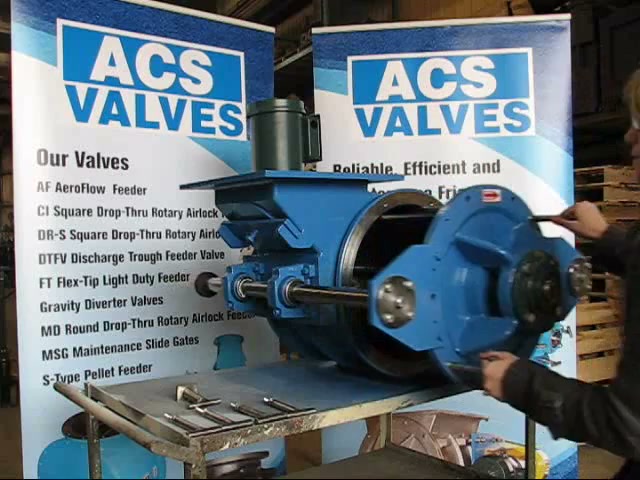
In this 65-second ACS Valves clip, a presenter opens a Quick-Clean rotary valve without tools: handles release, the rotor and endplate slide out on RotorRail supports, and a locating key guides reassembly. What the demo establishes is physical access to the product-contact zone — cleaning validation and sanitary certification still depend on the supplied model and the site's procedure.

Coperion
Coperion ZRD Rotary Valve for Powder Applications
Coperion presents the ZRD rotary valve and the design choices that adapt it to powder discharge, metering and pneumatic-conveying service.
Total reach: 10,524

Vortex – Solids & Bulk Handling Components
Vortex®: Orifice Slide Gate Valve
Vortex's video presents the Orifice Slide Gate Valve: a linear blade carries a machined orifice that moves into or out of alignment with the process connection to isolate or regulate dry-bulk flow.
Total reach: 68,292