
Comparison
Slide Gate vs Diverter Valve
Answer in brief
They do different jobs, and most selection mistakes come from using a gate where a route change is needed.
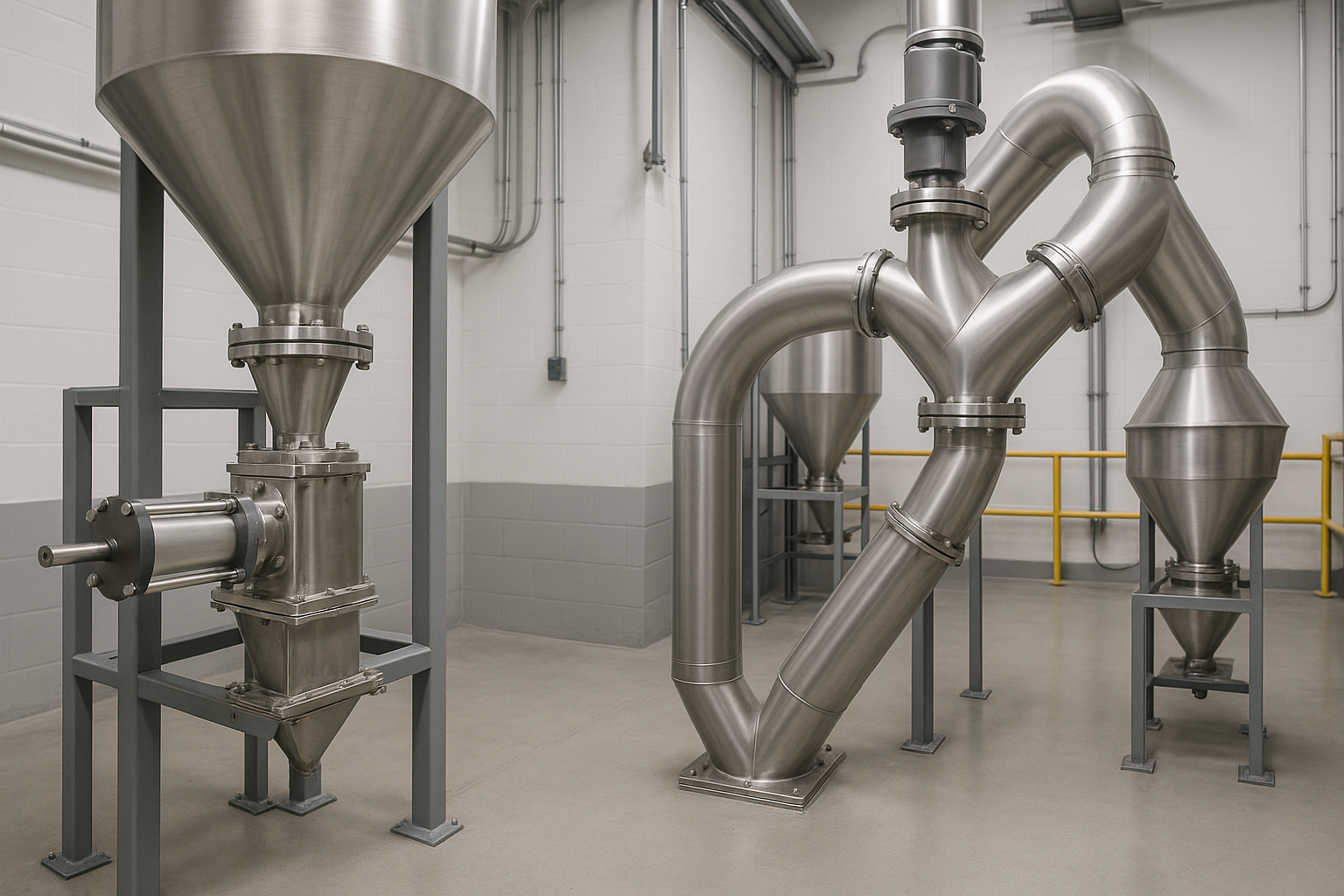
A slide gate opens or closes one path. A diverter valve sends one incoming stream into one of two or more outgoing paths.
- Shut off a silo outlet or isolate a vessel: slide gate.
- Feed two destinations from one line: diverter.
- Pressure sealing, abrasion and cleanability then narrow the choice within each family.
By Editorial Team · Published October 21, 2026 · Updated October 21, 2026
What actually differs
A slide gate moves a blade across the flow path and either passes or blocks it.
A diverter valve keeps the flow open and changes where it goes, using a moving tube, a pivoting chute, a flap or a plug.
The consequence is mechanical: a gate has to seal against a full material column, while a diverter has to seal between two paths without trapping material at the junction.
Decision criteria
| Criterion | Slide gate | Diverter valve |
|---|---|---|
| Function | Open or close one path | Route to one of several paths |
| Typical position | Silo outlet, vessel isolation | Branch in a conveying line |
| Pressure capability | From dust tight to pressure rated | Depends heavily on type |
| Dead volume | Blade pocket | Junction area, type dependent |
| Wear point | Blade edge and seat | Tube or flap seal and the junction |
| Cleanability | Good with the right design | Flex tube types clean best |
Where the slide gate is the right choice
- Isolating a silo or hopper for maintenance.
- Closing a feed line so that downstream equipment can be opened safely.
- Dosing by time in simple duties, where accuracy is not critical.
Within the family the decision is between blade styles: orifice gates for clean shut-off under a column, roller or knife designs for abrasive service and clear-action designs where no material may be trapped in the seat.
Partner with powderbulkvideos.com
Put your expertise beside the decisions engineers are making.
Connect a relevant company profile and technical video portfolio with clearly labelled visibility on this topic.
Where the diverter valve is the right choice
- One source feeding two or more silos, packers or process lines.
- Switching between a process route and a reject or sampling route.
- Dilute and dense phase lines that must not be broken for route changes.
Flex tube types suit hygienic and gentle duties, pivoting chutes suit gravity flow, and plug or seal tite designs suit pressure conveying where leakage across the junction matters.
Where neither fits
Neither device is a feeder. Using a gate to control rate gives a flow that varies with head and material condition.
Neither is automatically an explosion isolation device, and neither should be assumed gas tight unless it is specified and tested as such.
What to measure before deciding
- Duty: shut-off, routing or both.
- Line pressure and the leakage that is acceptable across the closed position.
- Material abrasiveness and particle size, which set the wear expectation.
- Cleaning requirement, especially where products change.
Frequently asked questions
Can a diverter valve also shut off the flow?
Some designs can close both outlets, but that is a secondary feature. Where reliable isolation is required, a dedicated gate is the safer selection.
Which valve suits abrasive materials?
Within gates, designs that keep the blade out of the flow path when open last longest. Within diverters, the wear concentrates at the junction, so the geometry and liner material matter more than the actuation type.
Are these valves suitable for pressure conveying?
Only the types rated for it. Both families include dust tight designs that are not pressure tight, and the difference matters in a pressure line.
Related content
Continue exploring
Move from this page to the companies, videos and technical topics that add useful context.
Companies
Videos

Vortex – Solids & Bulk Handling Components
Vortex®: Orifice Slide Gate Valve
Vortex's video presents the Orifice Slide Gate Valve: a linear blade carries a machined orifice that moves into or out of alignment with the process connection to isolate or regulate dry-bulk flow.
Total reach: 68,011

Vortex – Solids & Bulk Handling Components
Vortex®: Seal Tite Diverter Valve
Vortex presents a diverter valve that changes a dry-material route while sealing the inactive branch.
Total reach: 33,861

Vortex – Solids & Bulk Handling Components
Vortex®: Clear Action Gate™
Vortex presents a clear opening slide gate arrangement used to start or stop gravity flow. The video is useful for understanding the internal flow path and moving components. Pressure, leakage, wear, material compatibility and cleaning still require verification for the actual duty.
Total reach: 14,255

Vortex – Solids & Bulk Handling Components
Vortex®: Roller Slide Gate Valve™
Vortex video of the Roller Slide Gate Valve, a roller-supported slide gate for isolating or controlling dry-bulk material flow at gravity-flow points such as hopper and bin outlets.
Total reach: 73,457