
Application
Valve and Airlock Selection for Pet Food Plants
Answer in brief
Pet food asks a valve to handle something sticky, fragile and frequently changed.
Fat coated kibble builds on every surface it slides over, the pieces break if they are sheared, and the line switches between species and life stage recipes several times a day.
- Specify against fat build up, which is the real failure mode.
- Protect the kibble: a broken piece is a reject.
- Count the changeovers before choosing a cleaning concept.
Reviewed October 21, 2026
The problem
The difficult material in a pet food plant is not the meal; it is the finished kibble after coating. Fat and palatant make it adhesive, and every sliding surface, seal face and pocket collects a layer. The layer builds until a gate blade no longer seats, and the symptom is not a mechanical alarm but recipe carryover.
Carryover matters here more than people outside the industry expect. A poultry free diet, a prescription product or a single protein line has claims on the bag, and the valve that leaked between recipes is where those claims fail.
At the same time the product is fragile. Extruded kibble breaks under shear, and broken kibble is screened out as fines. A rotary valve with a tight clearance turns a percentage of good product into a by product, and on a line running tonnes an hour that percentage is money.
Meal handling upstream brings its own version of the problem: fine, fibrous and often containing fat already, so the same build up appears in the dosing valves at the mixer.
Desired outcome
Valves that stay closed when the product is fatty, with sealing surfaces that wipe rather than collect, and with inspection points that make the state of the seal visible without dismantling.
Gentle handling of finished product, with gates preferred to rotating clearances wherever no air boundary is required.
Cleaning that fits the number of changeovers the plant actually runs, which is usually more than the specification assumed.
For pharmaceutical powder handling the deciding document is measured containment data for that valve size, and a valve chosen on cleanability alone will not produce it.
Process approach
The duties are separated first. In the meal and premix area the valve is a dosing or shut off device under a bin; after the coater it is a transfer device handling finished product; under filters it is a dust discharge. Those three want different hardware, and plants that buy one type for all of them get build up in the first, breakage in the second and over specification in the third.
For finished product the preference is to avoid shear entirely. Slide gates, chutes and drag conveyors move kibble without a rotating clearance, and a rotary valve is used only where a genuine pressure boundary exists. Where one is needed, a large slow valve with bevelled tips passes kibble with far less damage than a correctly sized small one.
Build up is addressed with geometry and access. A blade that wipes its seat on every stroke keeps itself clean; a seal that can be inspected through a hatch gets inspected. Both are cheaper than discovering carryover in a finished goods test.
Changeover is then counted honestly. A line running six recipes a shift needs quick release end plates and tool free seal removal, because anything slower will be skipped.
- Duties separated: meal dosing, finished product transfer and filter discharge.
- Rotating clearances avoided in finished product unless a pressure boundary requires one.
- Large slow valves with bevelled tips where an airlock is unavoidable.
- Sealing surfaces designed to wipe, with inspection access to see their condition.
- Cleaning concept matched to the real number of changeovers per shift.
- Recipe carryover treated as a product claim risk, with the valve named in the changeover procedure.
Selection factors
- Fat and palatant content of the stream, which decides the sealing geometry and the inspection interval.
- Kibble fragility, measured on the actual product, since breakage goes straight to the fines screen.
- Changeover count per shift and the time allowed for each.
- Claim sensitivity of the recipes sharing the line, including single protein and prescription diets.
- Pressure duty, which is the only justification for a rotating clearance in finished product.
- Cleaning method, dry or wet, and whether the valve survives it.
Common failure modes
- One valve type bought for meal dosing, finished product and filter discharge alike
- Fat build up preventing a blade from seating, with recipe carryover as the only symptom
- Correctly sized small rotary valve breaking kibble that a larger slow one would have passed
- Seal condition invisible without dismantling, so it is checked only after a failure
- Cleaning procedure longer than the changeover window, so it is shortened in practice
- Valve left out of the changeover procedure, so nobody owns the carryover risk
Partner with powderbulkvideos.com
Put a relevant technical solution in this decision path.
Connect your company and video evidence with clearly labelled visibility where engineers evaluate this material, application, industry or product.
Frequently asked questions
What is the main failure mode in pet food valves?
Build up from fat and palatant on sealing surfaces. The blade stops seating, and because nothing breaks there is no alarm: the first sign is carryover between recipes.
How much kibble does a rotary valve break?
Enough to matter at line rates, and it depends mostly on clearance and tip speed. A larger valve turning slower with bevelled tips reduces it considerably, at the cost of more air leakage.
Why is carryover more serious here than general cleanliness?
Because the bag carries claims. A single protein, poultry free or prescription diet depends on the previous recipe not being present, and a valve that no longer seals is where that claim quietly fails.
Related content
Continue exploring
Move from this page to the companies, videos and technical topics that add useful context.
Companies
Videos
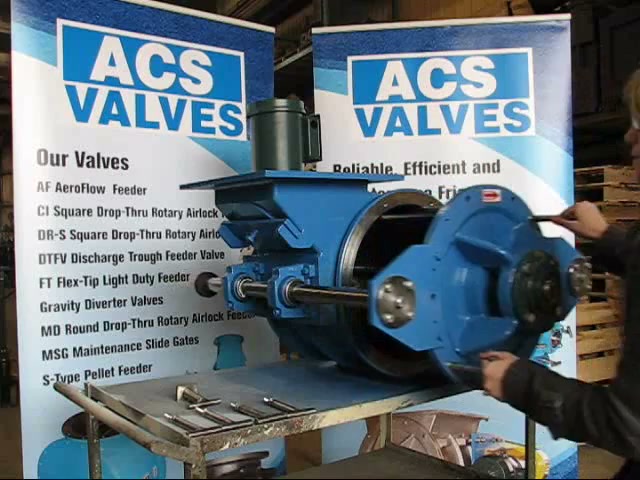
ACS Valves
ACS Quick Clean Rotary Valve Demonstration
In this 65-second ACS Valves clip, a presenter opens a Quick-Clean rotary valve without tools: handles release, the rotor and endplate slide out on RotorRail supports, and a locating key guides reassembly. What the demo establishes is physical access to the product-contact zone — cleaning validation and sanitary certification still depend on the supplied model and the site's procedure.
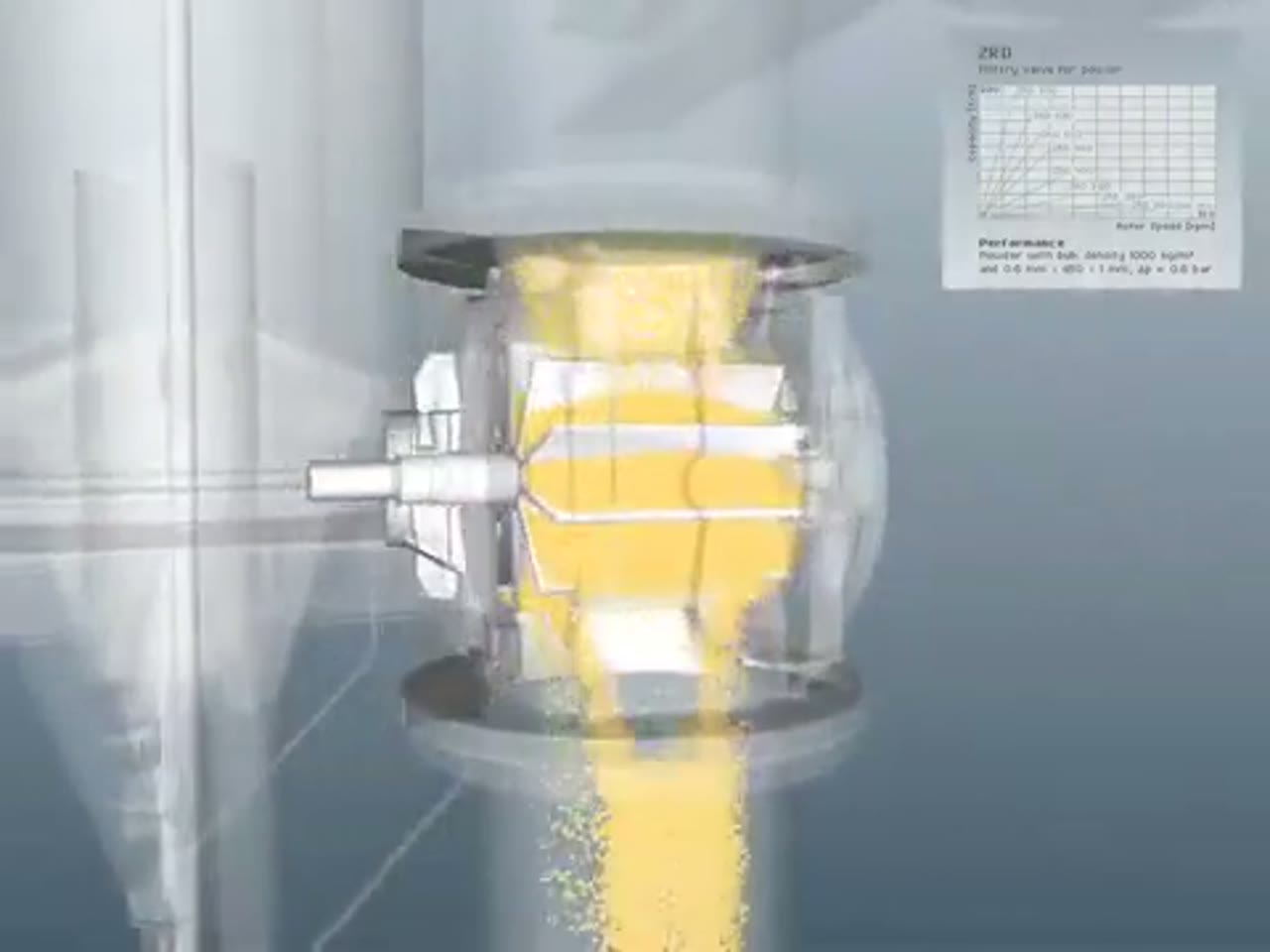
Coperion
Coperion ZRD Rotary Valve for Powder Applications
Coperion presents the ZRD rotary valve and the design choices that adapt it to powder discharge, metering and pneumatic-conveying service.
Total reach: 10,524

Vortex – Solids & Bulk Handling Components
Vortex®: Orifice Slide Gate Valve
Vortex's video presents the Orifice Slide Gate Valve: a linear blade carries a machined orifice that moves into or out of alignment with the process connection to isolate or regulate dry-bulk flow.
Total reach: 68,292