
Comparison
Belt Conveyor vs Bucket Elevator
Answer in brief
Height and floor space decide this more than anything else.
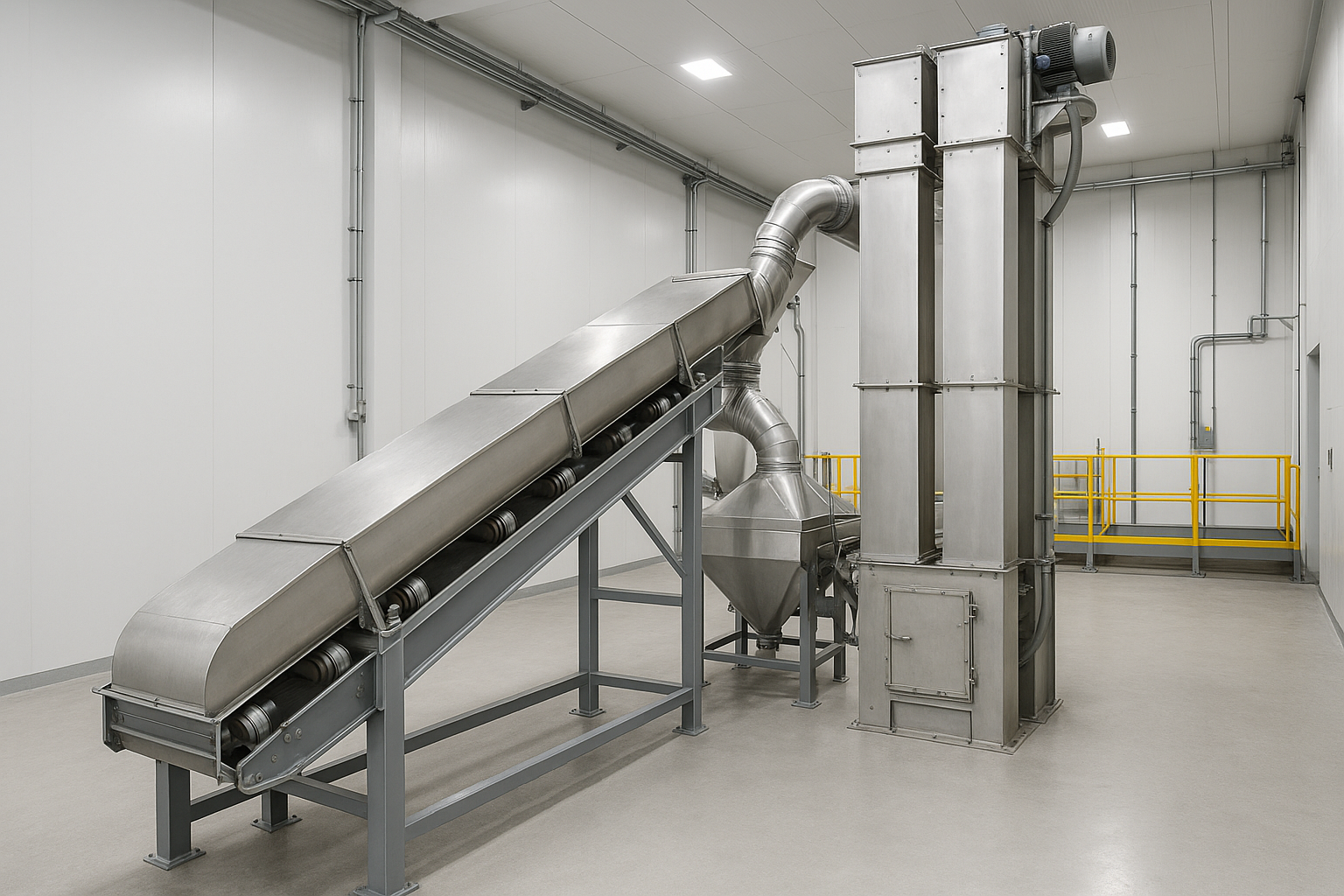
A belt conveyor is gentle and simple but needs a long run to gain height, because material slips back above roughly 18 to 20 degrees for free-flowing solids.
- Plenty of horizontal space, fragile product: inclined belt.
- Height in a small footprint: bucket elevator.
- High angle sandwich belts cover the middle ground where neither fits comfortably.
By Editorial Team · Published October 21, 2026 · Updated October 21, 2026
Sponsored visibility
Featured videos for this topic
Paid placements are clearly marked and remain separate from the editorial related-video selection.
What actually differs
A belt conveyor carries material on an open surface, and the maximum incline is set by the friction between material and belt.
A bucket elevator carries material in buckets on a belt or chain inside a casing, so the angle is irrelevant and the height is limited by mechanical design rather than by the material.
The practical consequences are footprint, product damage and how the equipment fails.
Decision criteria
| Criterion | Belt conveyor | Bucket elevator |
|---|---|---|
| Height gain | Limited by incline, long runs | Vertical, small footprint |
| Product damage | Low | At loading and discharge |
| Dust containment | Needs covers and skirting | Enclosed by design |
| Explosion risk | Lower, open structure | Classic risk, enclosed with ignition sources |
| Maintenance access | Good | Poor, inside the casing |
| Typical failure | Belt wear, spillage at transfers | Belt slip, bucket loss, boot blockage |
Where the belt conveyor is the better choice
- Long horizontal distances with a moderate rise.
- Fragile products where bucket loading and discharge would cause breakage.
- Duties where access for cleaning and inspection matters.
Where the incline needed exceeds what a plain belt can hold, high angle sandwich belt designs grip the material between two belts and raise the possible angle substantially without changing the gentle handling.
Partner with powderbulkvideos.com
Put your expertise beside the decisions engineers are making.
Connect a relevant company profile and technical video portfolio with clearly labelled visibility on this topic.
Where the bucket elevator is the better choice
- Large height gain in a building or silo plant with no space for a long incline.
- Free-flowing, non-fragile materials such as grain, pellets and minerals.
- Duties where full enclosure of the product is an advantage.
The enclosure is also the hazard: an elevator leg contains dust, movement and potential ignition sources, which is why it is one of the most commonly protected pieces of equipment in grain and food plants.
Where neither fits
Neither suits a duty that needs an accurately controlled rate; both are transport devices, and metering belongs to a feeder.
Very cohesive materials that stick in buckets or build up on belts need a different principle, often a screw or a pneumatic system.
What to measure before deciding
- Height to be gained and the horizontal space available.
- Material friction angle and flow behavior on the belt surface.
- Fragility and the acceptable fines increase.
- Dust explosion characteristics, which determine the protection of an enclosed elevator.
Frequently asked questions
How steep can a plain belt conveyor run?
For free-flowing bulk solids the practical limit is usually between 15 and 20 degrees. Material properties, belt surface and loading conditions move the figure, and testing is the only reliable answer.
Why are bucket elevators a dust explosion concern?
They combine an enclosed volume, suspended dust and moving parts that can misalign and generate friction heat. Protection usually combines venting, isolation and monitoring of belt alignment and speed.
What is a high angle sandwich belt conveyor?
Two belts hold the material between them, which prevents rollback and allows far steeper angles than a single belt while keeping the gentle handling characteristics.
Related content
Continue exploring
Move from this page to the companies, videos and technical topics that add useful context.
Companies


Videos

Dos Santos International
Dos Santos International: History of Sandwich Belt High Angle Conveyor
Dos Santos International describes the development context for sandwich-belt high-angle conveying of coarse bulk materials on steep routes.
Total reach: 21,039

ScrapeTec International GmbH
AirScrape: New conveyor skirting for your transfer points
The footage presents the AirScrape contact-free conveyor skirting concept at a belt transfer zone. It shows the position above the belt edge, the angled lamella arrangement and the intended inward direction of air and material.
Total reach: 10,400

AViTEQ Vibrationstechnik GmbH
AViTEQ: Trough Conveyor
AViTEQ presents a vibrating trough conveyor for handling free-flowing bulk materials.
Total reach: 15,243

HAZEMAG & EPR GmbH
HAZEMAG | Cement | Aggregates
HAZEMAG presents its crushing and processing technology for the cement and aggregates industries. Founded in 1946 with the invention of the world's first impact crusher for cement and aggregates, the company reports an installed base of more than 75,000 machines worldwide.
Total reach: 7,449

HAZEMAG & EPR GmbH
HAZEMAG | Recycling | C&D Waste | 1946 – today
HAZEMAG & EPR GmbH designs, manufactures, installs and commissions plants for the cement & aggregate, minerals processing and recycling industries, combining equipment optimization expertise with beneficiation experience across the processing chain.
Total reach: 6,472

Laidig Systems
Laidig Systems: Applications – Powder and Bulk Solids
Laidig Systems designs and builds custom storage and reclaim systems that automate the unloading of dry bulk materials. The company focuses on materials with poor flow characteristics and delivers reclaimers for flat- and cone-bottom structures in industries such as food processing, biomass, power, cement, and mining.
Total reach: 24,452

Netter Vibration
Netter Vibration: Efficient packaging – cost reduction and quality improvement with vibrating tables
NetterVibration presents low-profile vibrating tables for package settling and compaction where installation height is constrained.
Total reach: 102,960

Gericke AG
Nibbler and Deagglomerator Gericke GNB
Gericke's video explains the operating and cleaning concept of the GNB coarse grinder and deagglomerator: a low-speed paddle-and-screen arrangement works lumps down to size, and the unit opens for inspection. Particle size, capacity, heat input and wear still require representative material testing.
Total reach: 3,220