
Material
Potash
Answer in brief
Potash is a salt, and it behaves like one: it takes up moisture, cakes hard and corrodes the building around it.
Terminal operators measure success in whether the pile can still be reclaimed after a humid month.
- Control humidity in storage, since the cake forms during cycles rather than at a fixed level.
- Select corrosion-resistant materials for everything in contact.
- Expect segregation when grades are blended.
Reviewed October 21, 2026 · Updated November 10, 2026
Handling challenges
Potash terminals are built around humidity rather than around tonnage.
Caking
Moisture dissolves crystal surfaces and drying recrystallises them, bonding grains into a solid mass.
- Controlled or dehumidified warehouse ventilation.
- Anti-caking treatment where the specification allows it.
- Limited pile height and storage time for fine grades.
Breaking a caked pile is done with mobile equipment, and it damages both the product and the building.
Corrosion
Damp potash attacks carbon steel structures, fasteners and conveyor components.
Coatings, stainless or polymer components in contact areas and regular washdown extend the life of the terminal.
Segregation in blends
Bulk blends separate by particle size during every transfer, which changes the nutrient ratio delivered to the field.
Matching particle size across the blend is more effective than improving the blender.
Dust at loading
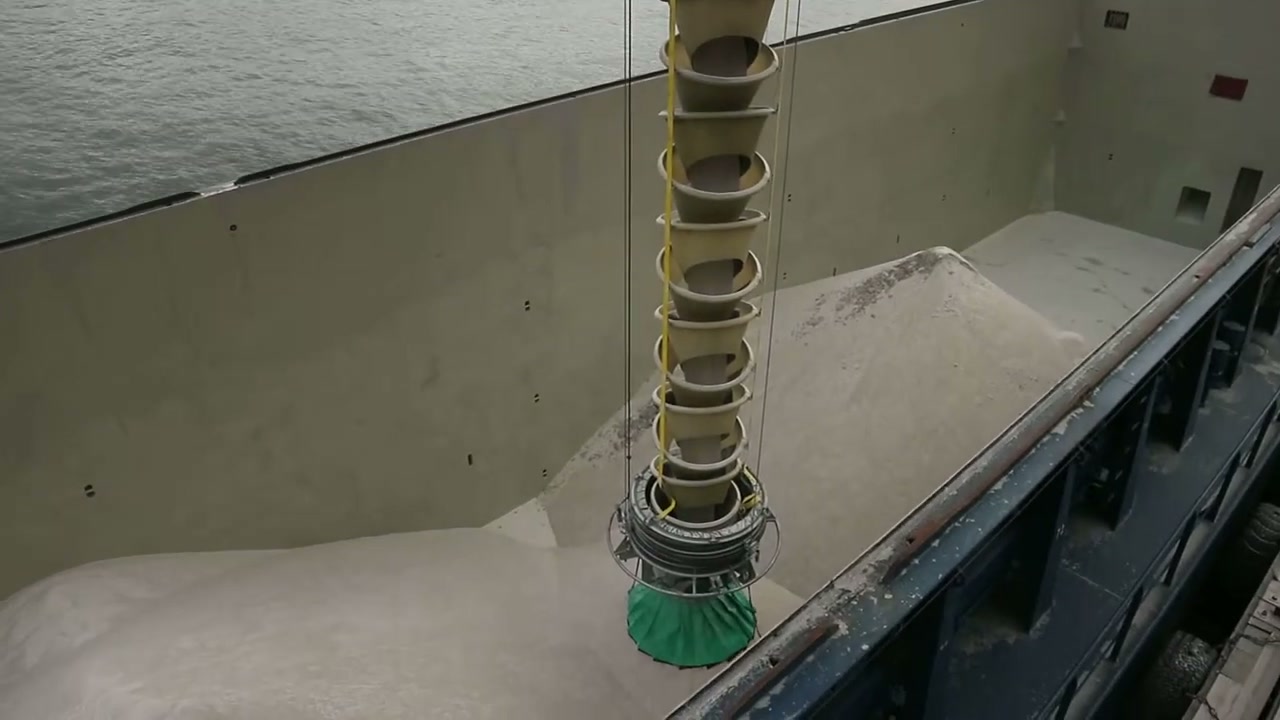
Ship and truck loading produce visible plumes; cascade chutes and telescopic spouts with extraction contain the column.
What to establish before buying equipment
- Grade, particle size and anti-caking treatment on receipt.
- Humidity profile inside the storage across the year.
- Materials of construction for all contact and structural parts.
- Loading rate and dust control method.
Storage and conditioning
Potash is hygroscopic and corrosive, and storage is where both show.
It takes up moisture, cakes and then sets, and the resulting brine attacks ordinary steel. An outdoor store without a sealed roof is a repair schedule.
- Seal and condition; moisture control is the whole game.
- Choose materials for brine, not for dry salt.
- Expect strong time consolidation and size the outlet for the stood condition.
What this means for equipment
Corrosion and caking drive the design, and abrasion adds a third demand.
Granular potash is hard enough to wear chutes and screw flights, so the equipment has to be both corrosion resistant and wear resistant, which narrows the material choice.
- Stainless or lined surfaces, including fasteners.
- Ledge-free geometry so a crust has nowhere to start.
- Gentle handling to limit fines, which cake faster than granules.
Safety and regulatory
Potash is not combustible and the hazards are irritation and corrosion.
- Dust capture at transfer points.
- Eye protection where handled open.
- Structural inspection where salt-laden dust settles on steelwork.
The long game is corrosion of the building, which progresses quietly for years before anyone looks.
Material behavior
- Flowability
- Free flowing when dry
- Abrasiveness
- Moderate
- Cohesiveness
- Low when dry, hard caking after humidity cycling
- Moisture behavior
- Hygroscopic; critical relative humidity varies with grade and temperature
- Contamination risk
- Corrosion products and dust emission in ports
Partner with powderbulkvideos.com
Put a relevant technical solution in this decision path.
Connect your company and video evidence with clearly labelled visibility where engineers evaluate this material, application, industry or product.
Frequently asked questions
Why does potash cake so readily?
It is hygroscopic. Absorbed moisture dissolves the surface and recrystallises into bridges between particles, and each humid cycle adds another layer.
What material should chutes be?
Both corrosion and wear resistant, which narrows the choice. Granular potash is hard enough to abrade, and the brine from any moisture attacks ordinary steel.
Why do fines matter?
They cake faster than granules and they are what corrodes the surrounding structure once they settle. Gentle handling limits both.
Related content
Continue exploring
Move from this page to the companies, videos and technical topics that add useful context.
Companies
Videos
Cleveland Cascades
Cascade Chute Loading at 500 Tonnes per Hour
Cleveland Cascades shows a cascade chute loading material at 500 tonnes per hour, with the falling stream held together inside the chute.

Vortex – Solids & Bulk Handling Components
Vortex®: Telescoping Loading Spout
Vortex presents a telescoping spout for guiding dry bulk material into a truck, railcar, vessel or stockpile. The video is useful for understanding the internal flow path and moving components. Pressure, leakage, wear, material compatibility and cleaning still require verification for the actual duty.
Total reach: 77,189