
Application
Dust-free Loading in Mineral Terminals
Answer in brief
At a mineral terminal the dust that leaves the loading point leaves the site.
Wind, drop height and fines content decide the plume, and the control has to work in the open rather than in a building.
- Slow the material and keep the outlet near the surface.
- Use water only within the product specification.
- Measure the respirable fraction, not just the visible plume.
Reviewed October 21, 2026
The problem
Mineral loading happens outdoors at high rates, which removes most of the control options other industries use. There is no building to extract, the equipment moves, and the wind does whatever it wants.
The physics is simple. Material falling a long way entrains air and arrives with energy; both lift fines. The further the drop and the finer the material, the larger the plume. And because the operation is at a site boundary, the plume is visible to people who are not employees, which turns it into a regulatory matter quickly.
Water is available but limited. Many minerals have a moisture specification, and some buyers reject material above it, so the amount of water available for dust control is a contractual question rather than an engineering one.
And the respirable fraction matters independently of the plume. Crystalline silica exposure applies to the operators, and it is invisible, so the visible dust and the health risk are not the same measurement.
The equipment is the same as in any bulk loading installation. What differs is that the fines content and the moisture specification pull in opposite directions.
Desired outcome
A loading arrangement that reduces the drop and the entrained air, with cascade chutes or telescopic arrangements keeping the discharge close to the surface of the pile or hold.
Moisture used within the product specification and applied where it addresses the actual mechanism, with freezing considered where the terminal operates in winter.
Respirable exposure measured on operators, and boundary emissions assessed against the limits that apply rather than against appearance.
For truck and ship loading in building materials the spout has to retract as the vehicle fills, because an enclosed spout that stays extended leaves the last metre open.
Process approach
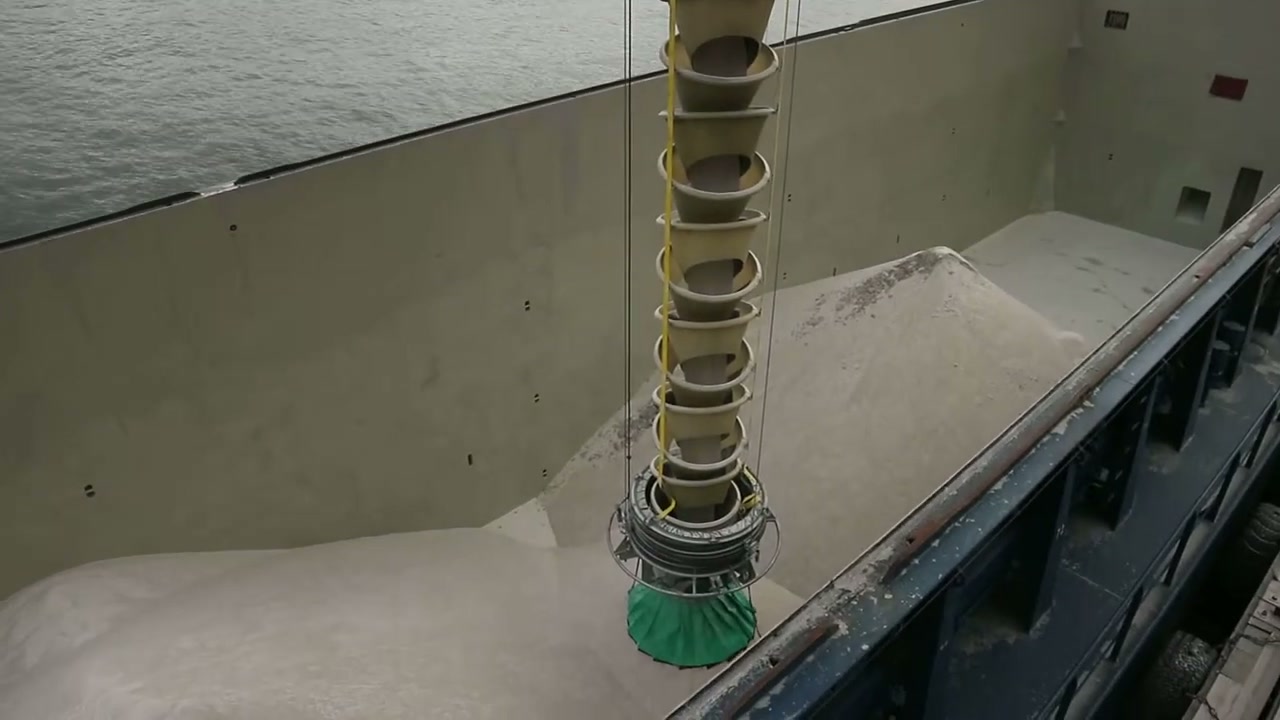
Geometry first. A cascade chute decelerates the stream in stages, which removes most of the energy available to loft fines; a telescopic arrangement keeps the outlet close to the surface as the pile or hold fills, so the final drop stays short. Together these are the main control at high rates, and they cost no moisture.
Water is then applied where it helps. Fog addresses dust that is already airborne with very little added moisture; sprays wet the material and use much more. The choice follows the mechanism and the specification, and in a freezing climate the system needs drainage and protection or it will not be available when it is needed.
Wind is designed around where the layout allows: orientation, screens and the timing of operations in high wind. Some terminals suspend loading above a wind speed, which is a control like any other.
Exposure monitoring then runs alongside the emission monitoring, because the respirable fraction and the visible plume are different things and only one of them has an occupational limit.
- Cascade or staged deceleration to remove the energy that lofts fines.
- Telescopic arrangement keeping the outlet close to the surface as the hold or pile fills.
- Fog for airborne dust, sprays for wetting, chosen for the mechanism and the specification.
- Water system drained and protected where the terminal operates in freezing conditions.
- Operational controls for high wind, including suspension above a defined speed.
- Respirable exposure measured on operators alongside boundary emission monitoring.
Selection factors
- Loading rate, which decides how much can be achieved by extraction versus deceleration.
- Fines content of the material, which determines how much there is to lose.
- Moisture specification of the product, which caps the water available.
- Wind exposure and the operational controls available at the site.
- Crystalline silica content and the operator exposure limit.
- Boundary proximity and the emission limits that apply there.
Common failure modes
- Long free fall left in place while water is added to control the result
- Telescopic outlet not retracted as the hold fills, so the final drop stays long
- Spray system used where the dust is already airborne, wasting both water and specification margin
- Moisture addition exceeding the product specification and causing rejection
- Water system with no freeze protection at a terminal that operates through winter
- Compliance judged by the visible plume while the respirable exposure is unmeasured
Partner with powderbulkvideos.com
Put a relevant technical solution in this decision path.
Connect your company and video evidence with clearly labelled visibility where engineers evaluate this material, application, industry or product.
Frequently asked questions
What is the main control at high loading rates?
Reducing the energy in the stream. A cascade chute decelerates the material in stages and a telescopic outlet keeps the final drop short, and neither costs any moisture.
How much water can be used?
Only what the product moisture specification allows, which is often a contractual limit rather than an engineering one. That is why geometry comes before water.
Is the visible plume the right measurement?
Only for emissions. The respirable fraction that carries the occupational exposure limit is invisible, so operator exposure has to be sampled separately.
Related content
Continue exploring
Move from this page to the companies, videos and technical topics that add useful context.
Companies

Videos

DSH Systems
DSH Systems: Installation Profile – Phu My Port in Vietnam
DSH Systems documents a dust-suppression hopper installation for dry granular material transfer at Phu My Port in Vietnam.
Total reach: 23,755
Cleveland Cascades
Cascade Chute Loading at 500 Tonnes per Hour
Cleveland Cascades shows a cascade chute loading material at 500 tonnes per hour, with the falling stream held together inside the chute.

Vortex – Solids & Bulk Handling Components
Vortex®: Telescoping Loading Spout
Vortex presents a telescoping spout for guiding dry bulk material into a truck, railcar, vessel or stockpile. The video is useful for understanding the internal flow path and moving components. Pressure, leakage, wear, material compatibility and cleaning still require verification for the actual duty.
Total reach: 77,198