
Application
Dust-free Truck and Ship Loading in Building Materials
Answer in brief
At a loading point the dust comes from the air the material drags with it, not only from the material.
Enclosing the falling column and extracting the displaced air removes most of the plume; filtering the yard afterwards does not.
- Enclose the column and extract what it displaces.
- Retract the spout as the vehicle fills.
- Keep water away from cement at every point.
Reviewed October 21, 2026
The problem
Loading is where a building materials plant becomes visible to its neighbours. A plume at a truck bay or a ship loader crosses the boundary, it is photographed, and it attracts the kind of regulatory attention that no internal dust problem does.
The mechanism is often misunderstood. Most of the dust is not blown off the material; it is carried out by air. The falling column entrains air on the way down, and the vehicle or hold displaces its own volume of air as it fills. Both have to leave, and they leave with the fines.
That is why enclosure plus extraction works and yard level measures do not. Once the air has left with the dust in it, there is nothing cost effective to be done.
Cement adds the water constraint. Hydration makes any wet suppression unusable on the powder side, and a spout with a damp deposit inside it blocks. Aggregate is the opposite and tolerates water readily, which is why one loading point handling both needs two approaches.
Desired outcome
An enclosed falling column with a skirt and a seal at the vehicle, and extraction sized from the displaced plus entrained air so the plume does not form.
A spout that retracts as the level rises, keeping the final drop short, with level sensing rather than operator judgement.
A dry powder side with no water path at all, and the extraction filter protected and discharging back into the product where that is acceptable.
At a food and ingredient terminal the coupling and the hose are product contact parts, and storing them outdoors between loads undoes the hygiene standard the terminal claims.
Process approach
For powders the arrangement is a telescopic spout with an outer dust skirt and integrated extraction. The spout follows the level, the skirt contains the displaced air, and the extraction takes it to a filter whose recovered material can usually go straight back into the load.
Level sensing is what makes it work. A spout that is not retracted as the vehicle fills leaves a long drop at exactly the moment the hold or tank is most full of dusty air, and that is when most of the plume is produced.
For coarse aggregate at high rates the principle changes to deceleration: a cascade chute removes the energy from the stream, which is the practical control where the air volumes make extraction impossible.
Then the water question is settled by position. Sprays and suppression belong on the aggregate side only, with drainage, washdown and spray drift all arranged so nothing reaches a cement or lime spout.
- Telescopic spout with dust skirt and integrated extraction for powders.
- Extraction volume calculated from displaced plus entrained air.
- Level sensing to retract the spout, keeping the final drop short as the vehicle fills.
- Cascade chutes for coarse aggregate at rates where extraction is impractical.
- Recovered dust returned to the load where that is acceptable.
- Water, drainage, washdown and spray drift kept entirely away from cement and lime spouts.
Selection factors
- Material, since powders need enclosure and aggregates need deceleration.
- Loading rate, which decides whether extraction is feasible.
- Vehicle or hold type and whether a skirt or seal can work reliably.
- Boundary proximity and the visibility of a plume to neighbours.
- Moisture intolerance of cement and lime, which excludes water entirely.
- Level sensing, which is what makes a telescopic spout effective rather than decorative.
Common failure modes
- Spout enclosed but not retracted as the vehicle fills, leaving a long drop at the worst moment
- Extraction volume estimated rather than calculated from displaced and entrained air
- Yard level measures used after the dusty air has already escaped
- Water or spray drift reaching a cement spout and setting inside it
- Skirt or seal omitted, so the enclosure vents into the bay
- One approach specified for a bay that loads both powder and aggregate
Partner with powderbulkvideos.com
Put a relevant technical solution in this decision path.
Connect your company and video evidence with clearly labelled visibility where engineers evaluate this material, application, industry or product.
Frequently asked questions
Where does the dust in a loading plume come from?
Mostly from air. The falling column entrains air and the vehicle displaces its own air as it fills, and both leave carrying fines. Enclosing the column and extracting that air is what removes the plume.
Why does the spout need level sensing?
Because the final drop has to stay short. A spout left extended as the vehicle fills produces most of the plume at the end of the load, when the hold is fullest of dusty air.
Can the recovered dust go back into the load?
Usually yes, and it is the simplest answer: it is the same material, and returning it avoids both a disposal route and a loss of product.
Related content
Continue exploring
Move from this page to the companies, videos and technical topics that add useful context.
Companies

Videos

DSH Systems
DSH Systems: Installation Profile – Phu My Port in Vietnam
DSH Systems documents a dust-suppression hopper installation for dry granular material transfer at Phu My Port in Vietnam.
Total reach: 23,755
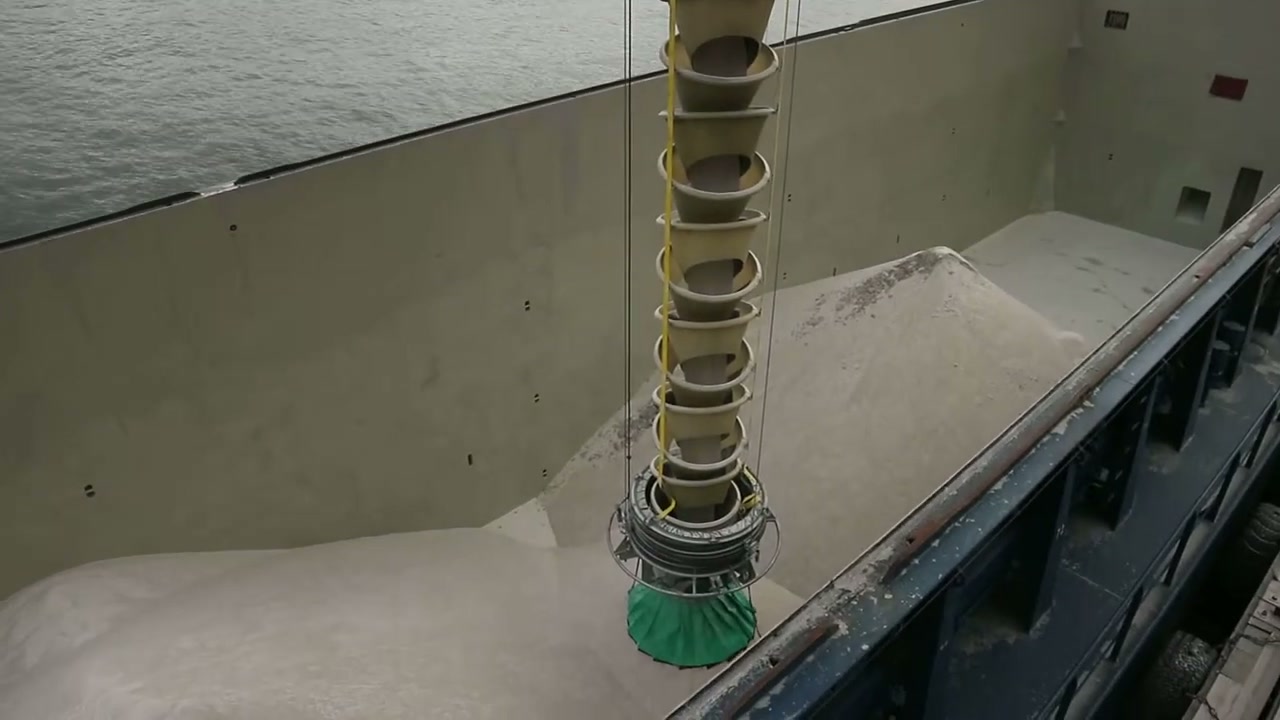
Cleveland Cascades
Cascade Chute Loading at 500 Tonnes per Hour
Cleveland Cascades shows a cascade chute loading material at 500 tonnes per hour, with the falling stream held together inside the chute.

Vortex – Solids & Bulk Handling Components
Vortex®: Telescoping Loading Spout
Vortex presents a telescoping spout for guiding dry bulk material into a truck, railcar, vessel or stockpile. The video is useful for understanding the internal flow path and moving components. Pressure, leakage, wear, material compatibility and cleaning still require verification for the actual duty.
Total reach: 77,198