
Material
Sulfur
Answer in brief
Sulfur dust ignites more easily than most people expect, and it is produced by the handling itself.
Prills and granules abrade against each other at every transfer, and the fine fraction that results is both the explosion hazard and the corrosion source.
- Design transfers to reduce attrition rather than to capture its consequences.
- Control static and ignition sources wherever the dust can form a cloud.
- Keep the material dry, because wet sulfur dust is corrosive to steel.
Reviewed October 21, 2026 · Updated November 10, 2026
Handling challenges
Solid sulfur is handled in very large tonnages, and the engineering problem is that the product generates its own hazard as it moves.
Attrition creates the hazard
Every drop and every belt transfer knocks fines off the prill surface.
That dust has a low minimum ignition energy, which means ordinary static discharge is a credible ignition source rather than a theoretical one.
- Reduce free fall height and use cascade or spiral chutes at loading.
- Avoid conveying routes with repeated direction changes.
- Bond and ground all conductive components, including loading spouts and truck or ship interfaces.
Ignition and fire behavior
Burning sulfur produces sulfur dioxide, which turns a small fire into an evacuation event very quickly.
Hot work controls, spark detection and clear rules for welding near sulfur storage matter more here than in most dry bulk operations.
Corrosion
Dry sulfur is relatively benign to steel, but sulfur dust with moisture forms acidic conditions that attack carbon steel structures and fasteners.
Housekeeping on structures, drainage that removes water rather than ponding it and coatings selected for the condition all extend asset life.
Loading and shipping
Ship and truck loading is where the dust plume is most visible and most regulated.
Telescopic chutes with skirting and integrated extraction keep the material column enclosed down to the pile, which controls both emission and the air entrained with the product.
What to establish before buying equipment
- Fines content at the loading point, measured after transport rather than at production.
- Minimum ignition energy and explosion characteristics of the actual dust.
- Peak loading rate and the trajectory at the chute outlet.
- Humidity exposure along the route, which drives the corrosion case.
Storage and conditioning
Sulfur is stored as prills or granules and behaves well while it stays dry and cool.
It softens well below the temperatures a dark silo reaches in summer sun, and softened prills cake into a block. Moisture adds the second problem: wet sulfur forms acid, which attacks the steel around it.
- Shade or ventilate outdoor storage; solar gain alone can reach the softening range.
- Keep water out, and choose materials for the acid that appears when it gets in anyway.
- Expect fines: prills abrade against each other and the fines are the explosible fraction.
What this means for equipment
Gentle handling and material choice drive the design.
Prills break easily, and every broken prill becomes dust that is both a hazard and a loss. Low drop heights, low velocities and generous chute geometry are worth more here than capacity.
- Belt or gentle mechanical conveying rather than high-velocity pneumatic.
- Corrosion-resistant materials where moisture can reach the product.
- Dust collection designed for an explosible dust, not as an afterthought.
Safety and regulatory
Sulfur dust is explosible and sulfur itself burns readily, producing sulfur dioxide.
The combination of a low ignition energy and a toxic combustion product makes this one of the materials where protection has to be designed rather than retrofitted.
- Earthing and bonding throughout; static is a credible ignition source.
- Explosion protection and isolation on collectors and silos.
- A fire plan that accounts for sulfur dioxide, agreed before it is needed.
Material behavior
- Flowability
- Free flowing as prills and granules
- Abrasiveness
- Moderate, self-abrading
- Cohesiveness
- Low when dry
- Moisture behavior
- Moisture plus sulfur dust is corrosive to carbon steel
- Contamination risk
- Not applicable; corrosion of adjacent equipment is the practical concern
Partner with powderbulkvideos.com
Put a relevant technical solution in this decision path.
Connect your company and video evidence with clearly labelled visibility where engineers evaluate this material, application, industry or product.
Frequently asked questions
Why does sulfur cake in an outdoor silo?
Solar gain. Sulfur softens well below the temperature a dark silo reaches in summer, and softened prills fuse into a block.
What does wet sulfur do to equipment?
It forms acid, which attacks ordinary steel. Where moisture can reach the product, the material choice has to account for it.
Why does prill breakage matter?
Every broken prill becomes dust, and sulfur dust is explosible with a low ignition energy. Gentle handling is a safety measure, not just a quality one.
Related content
Continue exploring
Move from this page to the companies, videos and technical topics that add useful context.
Companies
Videos
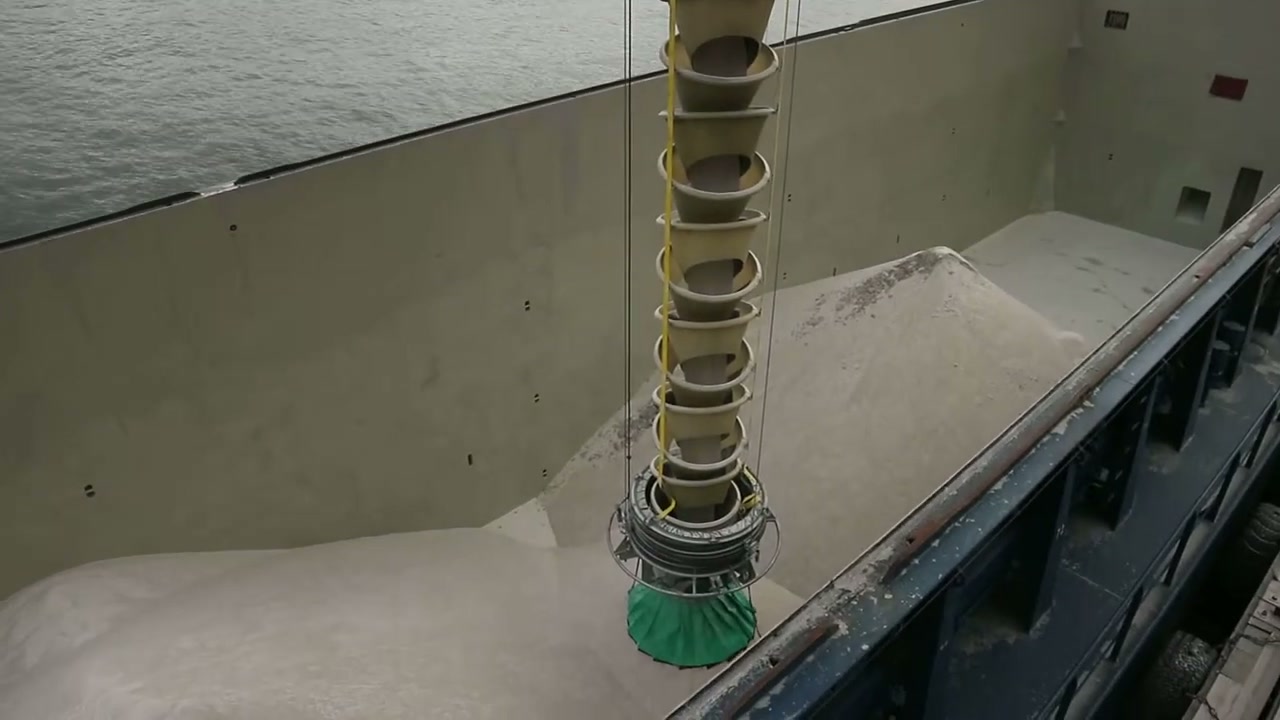
Cleveland Cascades
Cascade Chute Loading at 500 Tonnes per Hour
Cleveland Cascades shows a cascade chute loading material at 500 tonnes per hour, with the falling stream held together inside the chute.
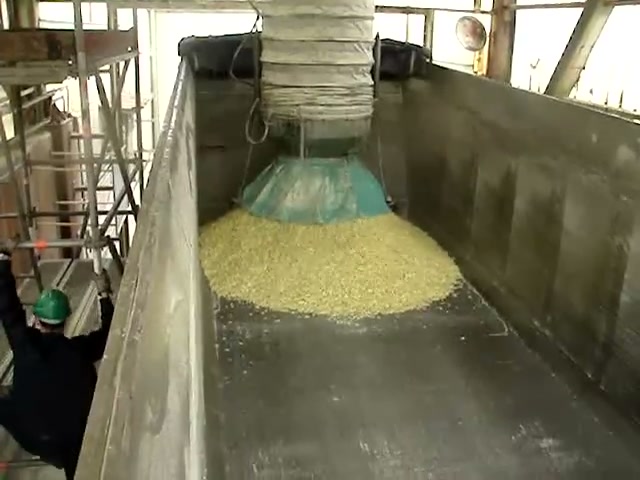
Cleveland Cascades
Road Loading Chute Handling Sulphur
Cleveland Cascades shows a road loading chute handling sulphur at 150 tonnes per hour at a site in La Coruña, Spain.
Total reach: 2,551