
Application
Dust Suppression at Transfer Points in Grain Handling
Answer in brief
Not every transfer point can have a filter and a fan, and that is where passive suppression earns its place.
A suppression hopper slows the material and lets the induced air escape through the product rather than carrying dust with it.
- Use it where extraction cannot follow the equipment.
- Understand what it does: it reduces generation, it does not capture.
- Keep it clean, because it is a place dust can accumulate.
Reviewed October 21, 2026
The problem
A grain plant has transfer points that a ducted system cannot serve. Truck loading in a yard, a mobile conveyor, stockpiling, a railcar spout, a loading point on a barge: the equipment moves, or there is nowhere to put a filter, or the duty is occasional enough that a fan and a filter cannot be justified.
Dust is still generated at every one of them, and it still becomes both an emission and a settled layer. In a plant where the layer is the explosion hazard, a transfer point that nobody can extract is not a transfer point that can be ignored.
Passive suppression is the answer, and it works on a different principle from extraction. Falling grain entrains air; the air escapes at the bottom of the fall and takes the fines with it. A suppression hopper slows the stream in a series of stages so the entrained air separates gradually and leaves through the material, which keeps the dust with the grain.
What it does not do is capture. The dust stays in the product rather than being removed, which is usually what the plant wants but is worth being explicit about.
Desired outcome
Suppression hoppers at the transfer points that cannot be ducted, sized and configured for the material and the flow rate, so dust generation is reduced at the point of fall.
A clear understanding of what has been installed: generation reduced, nothing captured, and the dust still in the product.
A cleaning and inspection routine, because a device full of stagnant grain dust is itself part of the layer problem it was installed to reduce.
At a cement and aggregate loading bay the product mix is the deciding factor: one dust control system specified for a bay that handles both a fine powder and a coarse aggregate suits neither.
Process approach
The selection starts from the flow rate and the material, because the device works by slowing the stream, and a hopper sized for a lower rate will choke or will let the stream pass through without the staged deceleration that does the work.
Position matters as much as size. The device belongs at the end of the fall, where the air is about to escape, and the arrangement below it has to let the material leave freely; a suppression hopper discharging into a restriction stops working.
Where some capture is also needed, the two approaches combine: a suppression hopper reduces the dust generated and a modest local extraction removes what remains, which is a far smaller duty than extraction alone would have been.
Then the device enters the cleaning routine. It has internal surfaces, it holds material, and in a grain plant anything that holds material and dust is inspected and cleaned on a schedule.
- Device sized for the flow rate and the material, since staged deceleration is what does the work.
- Positioned at the end of the fall, with a free discharge below it.
- Combined with modest local extraction where capture as well as reduction is needed.
- Included in the cleaning and inspection routine, since it holds material and dust.
- Explosion hazard considered, because the device is an enclosed volume holding grain dust.
- Expectation set clearly: generation reduced, dust retained in the product, nothing captured.
Selection factors
- Flow rate and material, which decide the size and the internal arrangement.
- Whether extraction is genuinely impossible, since capture is better where it can be had.
- Fall height, which determines how much air is entrained in the first place.
- Mobility of the equipment, which is usually the reason for choosing a passive device.
- Cleaning access, because the device accumulates dust internally.
- Dust explosion context, since it is an enclosed volume in a grain plant.
Common failure modes
- Device sized for a lower flow rate, so the stream passes through without being decelerated
- Suppression hopper discharging into a restriction, which stops it working
- Installed in a position where a ducted extraction was perfectly possible and better
- Treated as capture, so the plant believes dust has been removed when it is in the product
- Left out of the cleaning routine, so it becomes an accumulation of grain dust in an enclosed volume
- Fall height left unchanged, so a large volume of air is entrained before the device sees it
Partner with powderbulkvideos.com
Put a relevant technical solution in this decision path.
Connect your company and video evidence with clearly labelled visibility where engineers evaluate this material, application, industry or product.
Frequently asked questions
How does a suppression hopper work?
It slows the falling stream in stages so the entrained air separates gradually and escapes through the material. The fines stay with the grain instead of being carried out with the air.
Does it capture dust?
No. It reduces how much dust becomes airborne, and the dust stays in the product. That is usually what a grain plant wants, but it is a different outcome from extraction.
When is extraction better?
Whenever it is practical. Capture removes the dust rather than retaining it, so a passive device is for the points where a fan and a filter genuinely cannot follow the equipment.
Related content
Continue exploring
Move from this page to the companies, videos and technical topics that add useful context.
Companies

Videos

DSH Systems
DSH Systems: Installation Profile – Phu My Port in Vietnam
DSH Systems documents a dust-suppression hopper installation for dry granular material transfer at Phu My Port in Vietnam.
Total reach: 23,755

DSH Systems
DSH Systems: Introduction Dust Suppression Hopper
DSH Systems introduces its dust-suppression hopper for controlling dust fallout during dry-bulk loading.
Total reach: 24,866
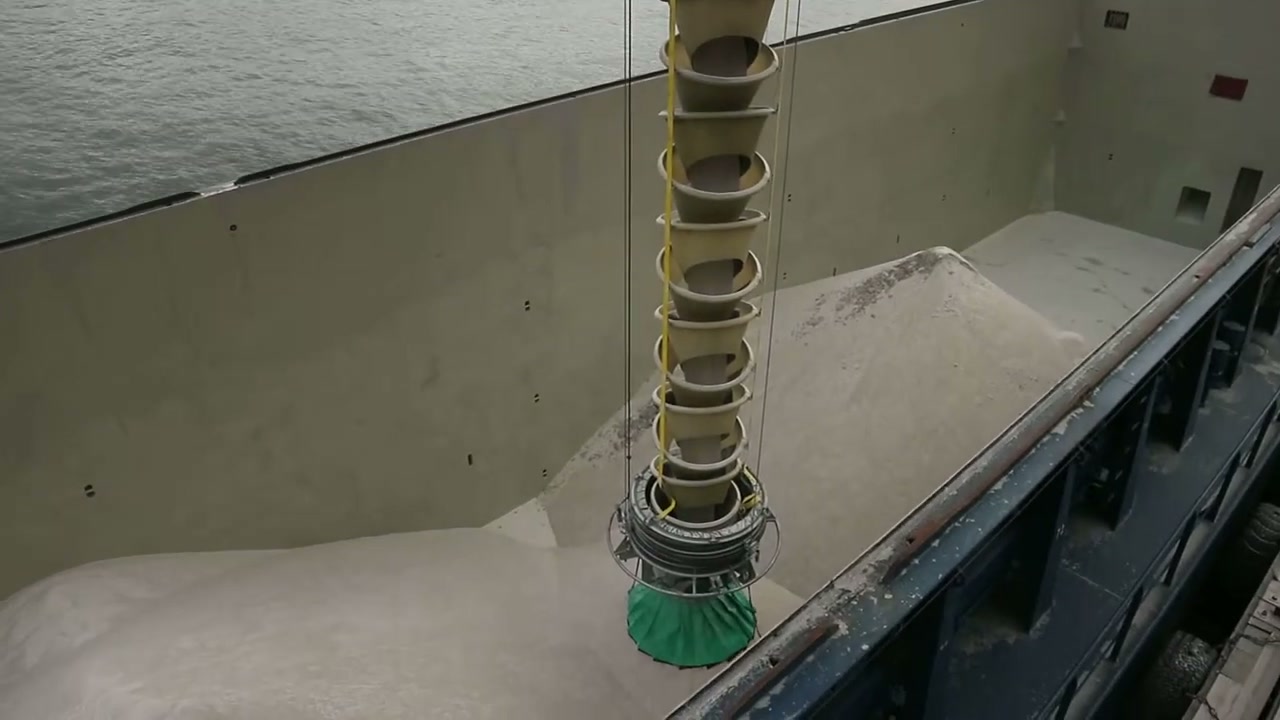
Cleveland Cascades
Cascade Chute Loading at 500 Tonnes per Hour
Cleveland Cascades shows a cascade chute loading material at 500 tonnes per hour, with the falling stream held together inside the chute.