
Application
Dust-free Loading in Grain and Feed Terminals
Answer in brief
At a grain terminal the loading point generates both the emission and the dust layer that makes the plant dangerous.
What escapes into the air settles on structures, and that layer is the fuel for a secondary explosion.
- Contain the column; the dust you never release costs nothing to clean.
- Slow the stream at high rates rather than trying to extract them.
- Protect the extraction filter, because it holds the worst dust on site.
Reviewed October 21, 2026
The problem
Loading is the largest single dust release on most grain terminals, for a simple reason: the rates are enormous and the fall is long. A ship loading spout moving thousands of tonnes an hour entrains a great deal of air, and all of it escapes at the hold with the fines in it.
The dust that escapes does not go away. It settles on the gantry, the conveyor structures, the quay and the equipment, and in this industry that layer is the mechanism behind the serious incidents. A terminal that cannot keep its structures clean has a hazard independent of any individual vessel.
Rate changes the available solutions. At truck and railcar rates a telescopic spout with extraction is the standard and works well. At ship loading rates the air volume to extract becomes impractical, and the answer shifts to reducing the generation rather than capturing the result.
And the extraction filter, where there is one, holds the finest grain dust on the site, which makes it a vessel that needs protection and isolation.
Desired outcome
Loading arrangements matched to the rate: enclosed spouts with extraction at truck and railcar rates, cascade or slowing arrangements at ship loading rates.
A filter protected and isolated on the basis of the collected dust, with the vessel strength verified.
Housekeeping designed in: access to the surfaces that collect, a cleaning method that removes rather than redistributes, and an interval that reflects what the loading actually releases.
At a mineral terminal the fines content and the moisture specification decide, and a long free fall left in place while water is added controls nothing.
Process approach
Rate decides the principle. Telescopic spouts with an outer skirt and integrated extraction suit trucks and railcars: the spout follows the fill level, the skirt contains the displaced air, and a modest extraction takes it to a filter.
At ship loading rates cascade chutes do the work instead. The material is decelerated in stages so it arrives with far less entrained air and far less energy to loft fines, which is the only practical control at those volumes.
Where extraction is used, the volume is calculated from the displaced air plus the entrained air rather than estimated, and the filter is then protected: explosion data from the collected dust, vessel strength verified, venting where the location allows it, and isolation in the inlet duct.
Housekeeping is then designed rather than assumed. The structures that collect dust are identified, access is provided, and the method is vacuum rather than compressed air, because compressed air moves the layer instead of removing it.
- Telescopic spout with skirt and extraction at truck and railcar rates.
- Cascade or staged deceleration at ship loading rates, where extraction is impractical.
- Extraction volume calculated from displaced plus entrained air.
- Filter protected on collected dust data, with vessel strength verified and inlet isolation.
- Housekeeping access designed for the structures that actually collect dust.
- Vacuum cleaning rather than compressed air, which redistributes the layer.
Selection factors
- Loading rate, which decides between extraction and staged deceleration.
- Vehicle or vessel type and whether a seal or skirt can be made to work.
- Dust explosion characteristics of the collected dust.
- Filter location, which decides whether conventional venting is available.
- Housekeeping access to gantries, structures and quay surfaces.
- Emission limits at the site boundary, where a terminal is close to neighbours.
Common failure modes
- Extraction specified at ship loading rates, where the air volume is impractical
- Extraction volume estimated rather than calculated from displaced and entrained air
- Filter unprotected or unisolated although it holds the finest dust on the site
- Skirt or seal omitted, so an enclosed spout vents to the quay anyway
- Housekeeping access never designed, so the structures that collect dust cannot be cleaned
- Compressed air used for cleaning, lifting the layer rather than removing it
Partner with powderbulkvideos.com
Put a relevant technical solution in this decision path.
Connect your company and video evidence with clearly labelled visibility where engineers evaluate this material, application, industry or product.
Frequently asked questions
Why does loading rate change the solution?
Because the air volume to extract scales with it. At truck rates extraction is straightforward; at ship loading rates it becomes impractical, and the control has to reduce generation instead.
What does a cascade chute do?
It decelerates the stream in stages, so the material arrives with much less entrained air and much less energy to loft fines. That is the main control available at very high rates.
Why protect the loading filter?
Because it holds the finest and most reactive grain dust on the site, and it is connected by duct to the loading equipment. Protection and isolation keep one event from becoming two.
Related content
Continue exploring
Move from this page to the companies, videos and technical topics that add useful context.
Companies

Videos

DSH Systems
DSH Systems: Installation Profile – Phu My Port in Vietnam
DSH Systems documents a dust-suppression hopper installation for dry granular material transfer at Phu My Port in Vietnam.
Total reach: 23,755
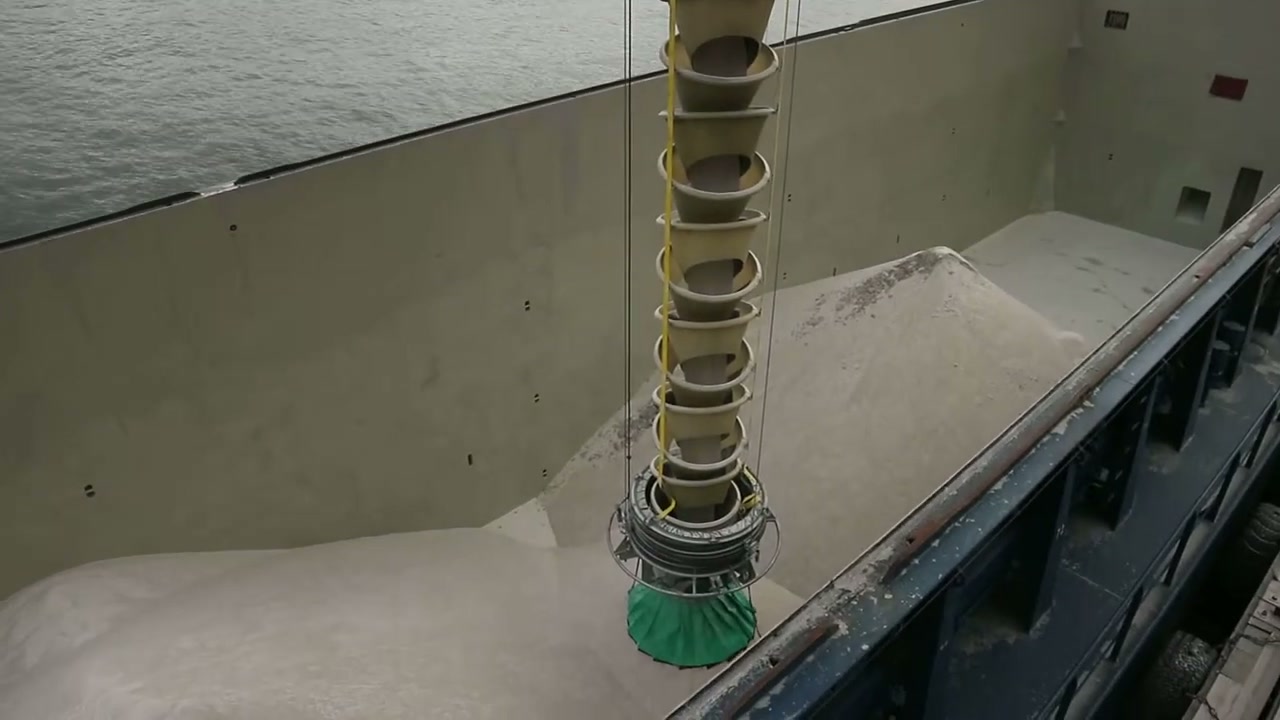
Cleveland Cascades
Cascade Chute Loading at 500 Tonnes per Hour
Cleveland Cascades shows a cascade chute loading material at 500 tonnes per hour, with the falling stream held together inside the chute.

Vortex – Solids & Bulk Handling Components
Vortex®: Telescoping Loading Spout
Vortex presents a telescoping spout for guiding dry bulk material into a truck, railcar, vessel or stockpile. The video is useful for understanding the internal flow path and moving components. Pressure, leakage, wear, material compatibility and cleaning still require verification for the actual duty.
Total reach: 77,198