
Independent industry shortlist for Slide Gates
Best Slide Gate Valve Companies for Bulk Solids 2026
Answer in brief
Vortex, WAMGROUP, and Polimak make up this 2026 shortlist of slide gate valve suppliers for dry bulk solids.
Vortex builds a dedicated gate for each duty, from gravity roller gates to orifice gates for 15 psig conveying lines and abrasion-resistant steel gates for sand and clinker.
WAMGROUP offers standardized dust-tight VL valves from 150 to 400 mm with polymer-coated frames, and Polimak configures low-profile gates in Hardox, stainless, and high-temperature versions.
The blade concept is the same everywhere; what differs is the pressure the gate seals against, the seal and wear materials, the actuation, and how the body fits silos, conveyors, and loading points.
By Editorial Team · Published August 27, 2026 · Updated October 27, 2026
How we selected these companies
ShowHide
We compared slide gate suppliers on five technical areas that decide whether a gate matches the duty at its installation point.
- Gate range (30%) looks at the gate types a supplier builds, the cross sections and sizes, and the conditions each type is rated for: gravity flow, dilute-phase or dense-phase conveying pressure, and material temperature.
- Application range (25%) looks at the installation points and products the gates are built for, from silo outlets and conveyor inlets to loading points, and at worked duties with stated size, pressure, and temperature.
- Wear and contact materials (20%) covers body and blade materials, hardened and stainless steels, engineering polymers, liners, and the seal materials offered.
- Actuation and integration (15%) covers manual, pneumatic, and electric drives, position switches and positioning control, and how the gate ties into hoppers, conveyors, and spouts.
- Mechanical design and connections (10%) covers the blade and seal mechanism, body height, flange patterns, and access for seal replacement.
Gate range carries the most weight because a gate that is not rated for the line pressure or product temperature cannot be made to work by any option; application range follows because the same gate behaves very differently on plastic pellets and on hot clinker.
Gate range 30%
Gate types, cross sections, sizes, and the pressure and temperature each type is rated for.
Application range 25%
Installation points and products the gates are built for, from silo outlets to loading points, with worked duties.
Wear and contact materials 20%
Body, blade, liner, and seal materials: hardened and stainless steels, engineering polymers, and high-temperature versions.
Actuation and integration 15%
Manual, pneumatic, and electric actuation, position feedback, and how the gate ties into hoppers, conveyors, and spouts.
Mechanical design and connections 10%
Blade and seal mechanism, body height, flange standards, and access for seal replacement.
Last reviewed October 7, 2026
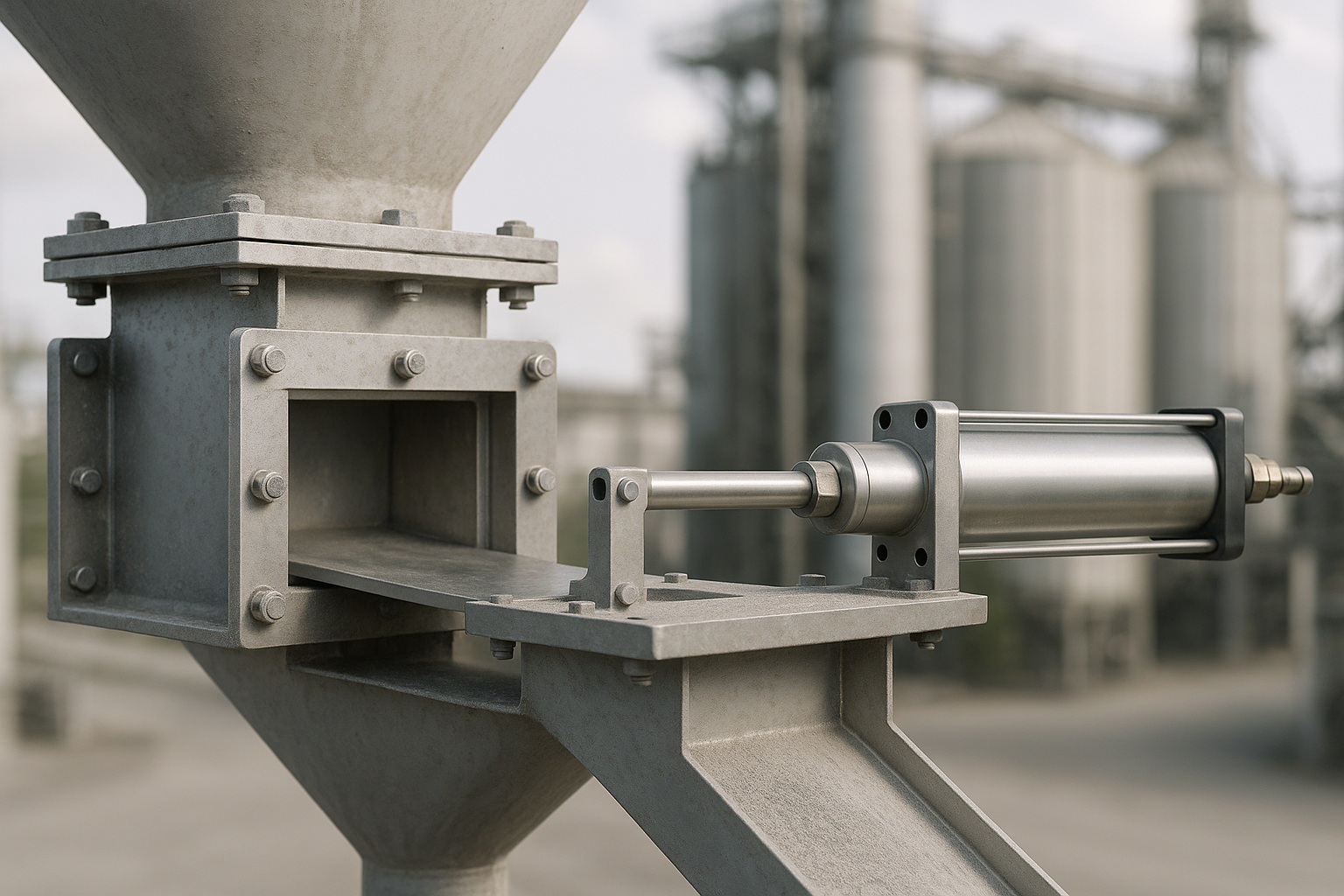
A slide gate is the simplest valve in a bulk plant — a blade that crosses a flow channel — and simultaneously one of the most abused: it closes through a standing column of product, sees every abrasive particle the process moves, and is expected to seal dust-tight for years. The difference between suppliers shows up not in the concept but in the details that survive that duty.
What slide gates do — and what they must not be asked to do
Slide gates shut off gravity or conveying flow at hopper outlets, silo discharges, conveyor inlets and loading spouts. Closed, they isolate equipment for maintenance and stop flow between batches; open, they present a full free cross section that neither meters nor throttles.
Asking a plain slide gate to regulate rate is the classic misapplication: partially open blades wear at the edge, product packs the bonnet, and the gate neither seals nor meters well afterward. Flow-control variants with profiled openings exist for exactly that duty — they are a deliberate selection, not an accident.
Where the engineering actually sits
Three details separate industrial slide gates. First, the seal system: the blade must run product-tight against dust that infiltrates every clearance, with seals that can be inspected and replaced without cutting the gate out of the line.
Second, materials: abrasive products grind standard steels; engineering polymers, replaceable liners, hardened and stainless executions decide service life, and food duties add sanitary construction and compatible gasket materials. Third, the closing event itself: a gate that must close through a standing product column needs blade geometry and actuator sizing chosen for it — closing force rises sharply when the blade has to shear through packed material.
Actuation and integration
Manual handwheel and chainwheel gates serve infrequent isolation duties; pneumatic cylinders dominate automated batch and loading cycles; electric actuators appear where compressed air is scarce or position feedback matters.
Integration decides the rest: flange patterns matched to hoppers and conveyors, low-profile bodies where headroom is tight, position switches for interlocks, and — in combustible-dust plants — the gate's role in the isolation concept, where a closed slide gate is a physical barrier but not automatically a certified explosion isolation device.
How we ranked the suppliers
The ranking weighs five technical properties. Gate range carries the largest weight because gate families, cross sections, and duty variants determine whether a supplier can match the valve to the task. Application range, wear and contact materials, actuation and integration, and mechanical design and connections complete the picture.
The three suppliers cover different parts of that range. Vortex builds a separate gate for each duty: the Roller Gate for gravity flow in 6 to 30 in sizes, the Orifice Gate for dilute-phase and vacuum lines up to 15 psig, the HDP Gate for dense-phase lines up to 75 psig, and the Titan Slide Gate in 400 BHN abrasion-resistant steel.
WAMGROUP offers a standardized program of square, round, and rectangular slide valves from 150 to 400 mm with polymer-coated frames and interchangeable handwheel, pneumatic, and gear motor actuators. Polimak supplies low-profile gates in cast steel, cast aluminium, welded steel, stainless steel, and Hardox, with high-temperature models up to 200°C.
Sealing: where slide gates earn or lose their reputation
Dust-tightness is the promise a slide gate makes to the plant around it, and it is kept — or broken — at the blade seals. Powders infiltrate every clearance the design leaves open: fines migrate along the blade, pack into the bonnet cavity and either jam the stroke or trickle out as fugitive dust that housekeeping then chases across the floor.
Good designs answer with defined seal systems around the full blade perimeter, hard or resilient seats matched to the product, purge or relief provisions where fines accumulate, and above all with seals that maintenance can actually reach: a gate whose seals can be inspected and swapped in place gets maintained, a gate that must be unbolted from the line gets ignored until it leaks. In hygienic duties the same geometry decides cleanability — crevice-free seats and gasket materials with food-contact compliance are what separate a sanitary gate from a painted industrial one.
What to ask a gate supplier for
Catalog pages show valve bodies; duty experience shows in the details around them. Ask for closing-force data or actuator sizing guidance for closing through product, wear-material options with named materials rather than vague hardening claims, dimensioned drawings that let you check the retrofit into existing headroom, and photographs of the gate on real installations rather than renderings.
Installation details that pay rent for years
Mounting orientation, support of the actuator weight, accessibility of the bonnet and the position of limit switches all look like minor drawings notes and decide daily operation for a decade.
A gate installed with its actuator unsupported fatigues its own mounting; one installed against the maintenance aisle direction turns every seal change into scaffolding work. Walking the installation position with the drawing before ordering costs an hour and prevents most of the complaints that later get blamed on the valve itself.
Specifying your own gate
- Duty defined: isolation, batch shut-off, or genuine flow control (different valve!)?
- Closing case honest: empty channel, flowing product, or standing column?
- Product abrasiveness and the matching blade, liner and seal materials?
- Cross section and flange pattern matched to the outlet — not adapted afterward?
- Actuation, position feedback and interlocks specified with the controls team?
- Seal inspection and replacement possible in place?
- Role in the combustible-dust isolation concept clarified — barrier or certified isolation device?
Partner with powderbulkvideos.com
Show your equipment where buyers compare suppliers.
Booked places and Featured Listings are limited to 40 percent of a Top List, clearly labelled and separate from the editorial ranking.
Selected companies
-
Best for: A dedicated gate for each duty: gravity, dilute phase to 15 psig, dense phase to 75 psig, and abrasive service in 400 BHN steel
Vortex builds a separate gate for each duty.
- The Roller Gate handles gravity flow in 6 to 30 in sizes with a 3 to 4 in overall height and no metal-on-metal blade contact.
- The Orifice Gate seals dilute-phase and vacuum lines up to 15 psig in 2 to 16 in sizes with live-loaded hard polymer seals.
- The HDP Gate takes dense-phase lines up to 75 psig, and the Titan Slide Gate uses 400 BHN abrasion-resistant steel for abrasive duties such as sand, slag, and clinker.
- Bodies come in aluminum, 304 or 316L stainless, and carbon steel; seals in nylon, PET, UHMW-PE, and glass-filled PTFE.
- Standard gates run to 180 or 250°F, modified versions to 400°F.
- Actuation is by air cylinder, hand wheel, chain wheel, or electric actuator.
View related CompanyTechnical score breakdown
- Gate range
- 5/5 · Roller Gate and Titan Slide Gate in 6 to 30 in for gravity flow, Orifice Gate in 2 to 16 in to 15 psig, HDP Gate in 4 to 14 in to 75 psig, and a Maintenance Gate in 6 to 20 in.
- Application range
- 5/5 · Duties from a 6 in gate on sorbitol to 28 in gates on clinker at 400°F, a 14 in gate on a 45 psig cement line, and rail car loading of sand with variable blade positioning.
- Wear and contact materials
- 5/5 · 400 BHN abrasion-resistant steel blades and inlet liners, 304 and 316L stainless contact parts, and live-loaded seals in nylon, PET, UHMW-PE, or 25% glass-filled PTFE; gates modified for up to 400°F.
- Actuation and integration
- 4.5/5 · Double-acting air cylinder, hand wheel, chain wheel, or electric actuator; reed, proximity, or mechanical limit switches; a positioning controller that takes a 4 to 20 mA or 0 to 10 V signal.
- Mechanical design and connections
- 5/5 · Overall height of 2 to 3 in on the Orifice Gate and 3 to 4 in on the Roller Gate, ANSI #125/150 and DIN PN10 flanges on the HDP Gate, and side-frame access slots for seal replacement in place.
-
2Best for: Standardized dust-tight slide valves from 150 to 400 mm with SINT polymer-coated frames and interchangeable actuators
WAMGROUP
WAMGROUP
WAMGROUP's VL slide valves are a standardized program: square VLQ and round VLC valves in six sizes from 150 to 400 mm, rectangular VLR valves, and the VLS with a pneumatic cylinder inside the frame.
- The two-piece carbon or 304 stainless steel frame is coated with SINT engineering polymer, which forms the dust seal without flange gaskets; blades are SINT, carbon steel, or 304 stainless.
- Handwheel, pneumatic cylinder, and gear motor actuators are interchangeable on the same frame.
- The valves are dust-tight but not pressure-tight and take material up to 60°C in continuous service.
- VG valves in carbon or stainless steel extend the range to 1,000 x 1,000 mm for abrasive products, and the VIB low-profile valve measures 75 mm flange to flange.
View related CompanyTechnical score breakdown
- Gate range
- 4/5 · VLQ and VLC in six sizes from 150 to 400 mm, VLR in four rectangular sizes, VLS with integrated cylinder, VG up to 1,000 x 1,000 mm, and low-profile VIB; all for gravity flow up to 60°C.
- Application range
- 3.5/5 · Hopper and silo outlets, inlets and outlets of mechanical conveyors, and loading spout inlets; VG valves for sand, gravel, coal, and whole grain.
- Wear and contact materials
- 4/5 · Frames coated in SINT MC or food-grade SINT AL polymer, blades in SINT, carbon steel, or 304 stainless, and two replaceable abrasion-resistant seals on VG valves.
- Actuation and integration
- 4.5/5 · Three interchangeable actuators on one frame: handwheel, pneumatic cylinder of 63, 80, or 100 mm, and gear motor; VLS with the cylinder inside the frame.
- Mechanical design and connections
- 4.5/5 · Body height of 113 to 125 mm and weights of 14 to 46 kg on VLQ and VLC, 75 mm flange to flange on VIB, and a polymer seal lip that replaces flange gaskets.
-
3Best for: Low-profile gates in Hardox, stainless, and 200°C versions, supplied with silos, big bag stations, and loading bellows
Polimak
Polimak
Polimak's slide gate valves are a configurable line with a low-profile body that keeps flange-to-flange height to a minimum.
- Bodies are cast steel, cast aluminium, or welded steel, with stainless steel versions for food and sanitary duty and Hardox versions for abrasive bulk solids.
- Rectangular and circular inlets and outlets take DIN or ANSI flanges.
- Replaceable polyurethane, gland packing, and silicone seals keep product in, high-temperature models run up to 200°C, and ATEX versions are available.
- Actuation is by pneumatic piston, electric drive, handwheel, or chainwheel, with limit switches and position indicators built in; a position controller sets the blade for flow rate.
- The gates fit Polimak's own silos, big bag stations, and loading bellows.
View related CompanyTechnical score breakdown
- Gate range
- 3.5/5 · One configurable gate line in cast steel, cast aluminium, and welded steel with rectangular and circular openings, high-temperature models to 200°C, ATEX versions, and a separate drum-type flow control gate.
- Application range
- 3.5/5 · Outlets of silos, bins, hoppers, chutes, and mechanical conveyors, and below the discharge hopper of big bag stations, with manual or pneumatic operation.
- Wear and contact materials
- 4/5 · Hardox steel for abrasive bulk solids, stainless steel for food and sanitary duty, and replaceable polyurethane, gland packing, and silicone seals.
- Actuation and integration
- 4.5/5 · Pneumatic piston, electric drive, handwheel, or chainwheel, with built-in limit switches, position indicators, and a position controller for the blade; supplied within Polimak silo discharge and loading systems.
- Mechanical design and connections
- 3.5/5 · Low-profile body with minimum flange-to-flange height and rectangular or circular flanges to DIN or ANSI.

Listed here? Link to this list.
Companies on this list may use the badge on their website and share the list. The badge links back here, so readers can check the criteria and the full ranking themselves.
Frequently asked questions
What is a slide gate valve used for in bulk handling?
It shuts off the flow of powders and granular materials at hopper outlets, silo discharges, conveyor connections, and loading points, for maintenance isolation and batch stops. Open, it presents a full free cross section. It is a shut-off device, not a metering valve.
Can a slide gate valve regulate flow rate?
A plain slide gate should not be used that way: a partially open blade wears at the edge and packs product into the bonnet, and the gate neither seals nor meters well afterward. For regulating duty, choose a gate with a positioning controller that sets the blade from a 4 to 20 mA signal, or a dedicated flow control gate.
Can a slide gate be installed in a pneumatic conveying line?
Only a gate built for it. Gravity gates are dust-tight but not pressure-tight, so line pressure drives fines past the blade. Orifice-type gates with live-loaded polymer seals handle dilute-phase and vacuum lines up to 15 psig, and heavy-duty pressure gates are rated for dense-phase lines up to 75 psig, depending on size.
Which slide gate materials suit abrasive products?
Hardened steels such as 400 BHN abrasion-resistant plate or Hardox for blade and inlet liners, and engineering-polymer contact surfaces and seals that compensate for wear. The wear materials offered for blade, liner, and seals matter more for service life than the base valve. For food duties, stainless construction and compatible seal materials come first.
Is a closed slide gate an explosion isolation device?
Not automatically. A closed gate is a physical barrier, but certified explosion isolation requires devices tested for flame and pressure propagation. In combustible-dust plants the gate's role in the isolation concept has to be defined explicitly.
How is the order of this list decided?
The ranked positions follow the five technical criteria: gate range, application range, wear and contact materials, actuation and integration, and mechanical design and connections, weighted 30, 25, 20, 15, and 10 percent. Booked and Featured places are labeled as such and carry no rank.
Sources and further reading
- Combustible Dust, U.S. Occupational Safety and Health Administration
- DSS162: Can The Fan Be Used As An Explosion Isolation Device?, Dust Safety Science
- EHEDG Guidelines Overview, European Hygienic Engineering & Design Group
- How to Properly Select Slide Gates, Powder & Bulk Solids
- Industrial slide valve for heavy-duty applications, making.com
- NFPA 652 – Standard on the Fundamentals of Combustible Dust, National Fire Protection Association
- NFPA 69: Standard on Explosion Prevention Systems, National Fire Protection Association (NFPA)
- Slide Valves VL, Plant Automation Technology
- What Is a Slide Gate Valve?, Projectmaterials
Related content
Continue exploring
Move from this page to the companies, videos and technical topics that add useful context.
Videos

Vortex – Solids & Bulk Handling Components
Vortex®: Clear Action Gate™
Vortex presents a clear opening slide gate arrangement used to start or stop gravity flow. The video is useful for understanding the internal flow path and moving components. Pressure, leakage, wear, material compatibility and cleaning still require verification for the actual duty.
Total reach: 14,293

Vortex – Solids & Bulk Handling Components
Vortex®: Orifice Slide Gate Valve
Vortex's video presents the Orifice Slide Gate Valve: a linear blade carries a machined orifice that moves into or out of alignment with the process connection to isolate or regulate dry-bulk flow.
Total reach: 68,090

Vortex – Solids & Bulk Handling Components
Vortex®: Roller Slide Gate Valve™
Vortex video of the Roller Slide Gate Valve, a roller-supported slide gate for isolating or controlling dry-bulk material flow at gravity-flow points such as hopper and bin outlets.
Total reach: 73,616
Technologies
Applications
- Contained Shut-off in Battery Material Plants
- Hygienic Shut-off at Bin Outlets in Food Plants
- Intake Pit and Bin Gates in Grain Handling
- Shut-off and Isolation in Fuel and Ash Bins
- Shut-off and Isolation in Plastics Silos
- Shut-off and Isolation under Cement and Lime Silos
- Shut-off and Isolation under Mineral Silos
- Shut-off at Mixer and Coater Outlets in Pet Food Plants