
Application
Valve and Airlock Selection for Grain and Feed Plants
Answer in brief
A grain plant runs hundreds of gates and valves, so the decision is about the fleet, not the device.
What matters is a small number of types, parts that are interchangeable, actuators that can be swapped by the site team, and tolerance of the stones, bolts and lumps that arrive with the crop.
- Standardise on few types, keep the spares shallow.
- Size the opening for foreign bodies, not for grain.
- Keep every device reachable, because there are too many to crane.
Reviewed October 21, 2026
The problem
The difficulty in a grain or feed plant is arithmetic. A mill has gates at the intake pit, under every silo, at every distributor, before and after every scale and at every bin in the dosing station, and the number runs into the hundreds. A device that is five percent better and a different type from everything else makes the plant worse, because it doubles a spares list and halves the chance that the night shift can fix it.
Then the material arrives as it comes. Grain carries stones, soil, string, insects and whatever fell off the last truck, and feed carries pellets, fibrous meals and fat coated material that sticks. A blade clearance sized for wheat is a jam waiting for a bolt.
Fat is the quiet problem in feed. Coated meals build on sliding surfaces, a gate blade stops seating, and the leak shows up as cross contamination between recipes rather than as a mechanical fault.
Desired outcome
A small catalogue of gate and valve types covering the whole plant, with common blades, seals and actuators, and a spares holding that is shallow and useful rather than deep and specific.
Openings and clearances that pass the foreign bodies the crop actually contains, and devices that stay closed when the product is fatty or damp.
Maintenance that the site team can do from a platform, because a plant with hundreds of devices cannot hire a crane for each one.
In a mineral plant the same gate is sized against particle angularity and the head of a loaded bin, and the actuator rather than the seal sets the limit.
Process approach
Standardisation is the first design step and it is a deliberate one. The duties are grouped, a type is chosen for each group, and the number of groups is kept small even where that means a slightly oversized device in some positions.
Sizing then starts from the contamination, not from the grain. The intake pit and the first gates after it see everything, so they are sized and built for it; further into the plant, after cleaning and magnets, the duty narrows and lighter devices become reasonable. That split is where most of the cost saving sits, and it only works if the cleaning equipment is reliable.
For feed lines the sealing surfaces are chosen against build up. A blade that wipes rather than slides, a seal that can be replaced from outside, and an accessible inspection point make the difference between a device that seals for a season and one that leaks after a month of fat coated meal.
Where a device sits in a dust explosion hazard area, which in a grain plant is most of them, the actuator, the limit switches and any position sensor are specified for it, and the gate itself is checked against whether it is being relied on as an explosion barrier. Usually it is not, and that should be written down rather than assumed in either direction.
- Duties grouped and a deliberately small set of device types chosen.
- Heavy duty devices at the intake and lighter ones after cleaning and magnets.
- Blades, seals and actuators made interchangeable across positions.
- Sealing surfaces specified against fat and moisture build up in feed lines.
- Actuators and switches rated for the dust hazard area.
- Whether a gate is an explosion barrier stated explicitly, in either direction.
Selection factors
- Number of installed devices, which makes commonality worth more than per unit optimisation.
- Foreign body content at each position, which differs greatly before and after cleaning.
- Throughput and flow rate, since grain gates are often sized by chute geometry rather than by the valve.
- Fat and moisture content in feed, which decides the sealing surface and the inspection interval.
- Cross contamination requirement between recipes, including medicated feed where it applies.
- Access at height, which decides whether a device will be maintained or just replaced when it fails.
Common failure modes
- Each project specifying a different gate, so the plant carries six spares lists for one duty
- Light duty gates installed before the cleaning equipment, where everything in the truck still passes
- Blade clearance sized for grain and jammed by the first bolt
- Fat build up stopping a blade from seating, so recipes cross contaminate without any mechanical alarm
- Actuator or limit switch not rated for the dust hazard area it stands in
- Device installed where it cannot be reached, so it is run to failure
Partner with powderbulkvideos.com
Put a relevant technical solution in this decision path.
Connect your company and video evidence with clearly labelled visibility where engineers evaluate this material, application, industry or product.
Frequently asked questions
Why does standardisation matter more here than elsewhere?
Because of the count. A plant with hundreds of gates gains more from one interchangeable type than from a better device in each position, and the night shift can only fix what it has seen before.
Where should heavy duty gates be used?
At the intake pit and in the first positions after it, where stones, bolts and string still pass. After cleaning and magnet separation the duty is much lighter, and that is where lighter devices are justified.
What causes gates to leak in feed plants?
Fat coated meal building on the sealing surface until the blade no longer seats. There is no mechanical symptom, so it shows up as cross contamination between recipes rather than as a fault.
Related content
Continue exploring
Move from this page to the companies, videos and technical topics that add useful context.
Companies
Videos
Coperion
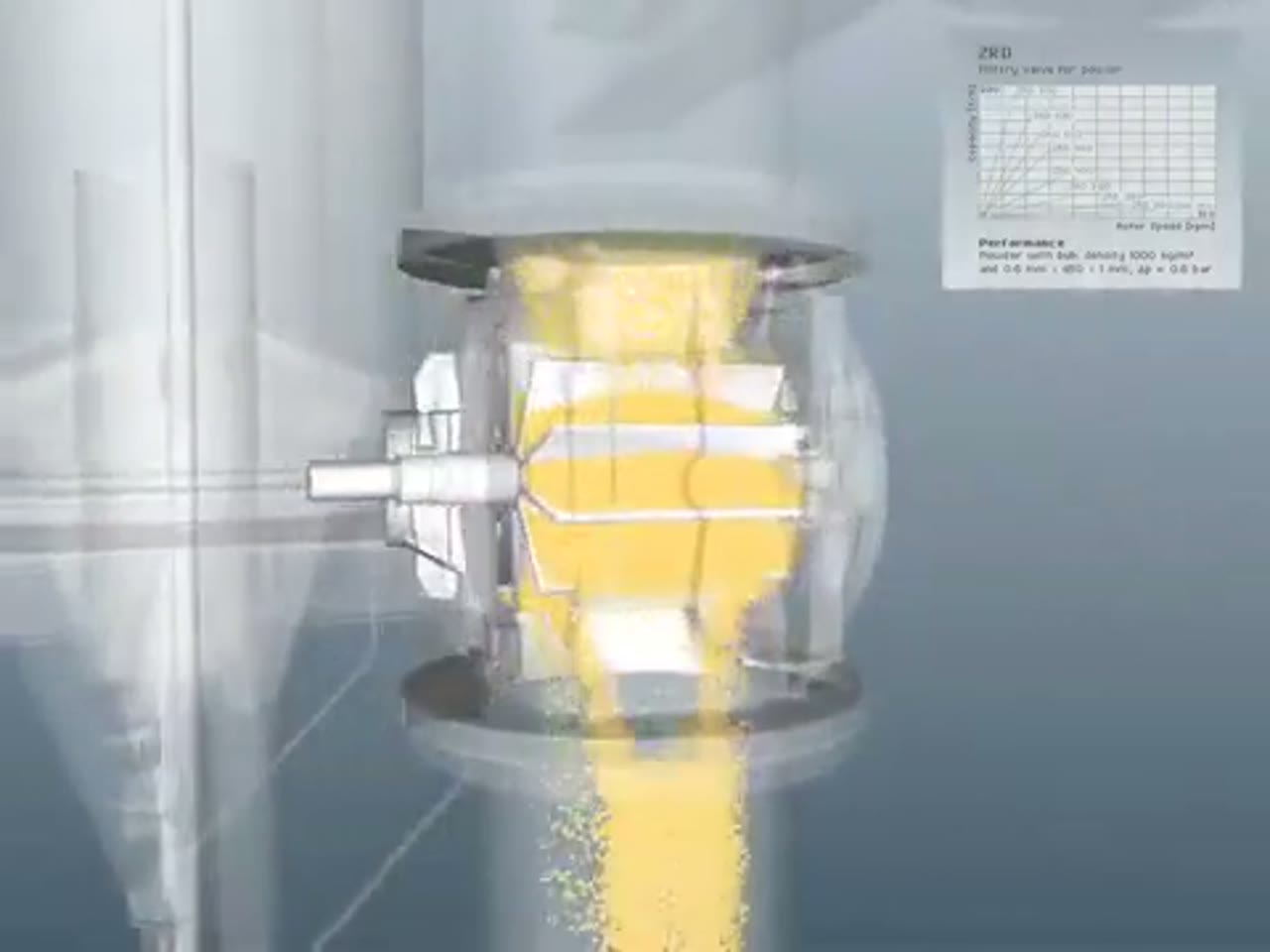
Coperion ZRD Rotary Valve for Powder Applications
Coperion presents the ZRD rotary valve and the design choices that adapt it to powder discharge, metering and pneumatic-conveying service.
Total reach: 10,524

Kice Industries
Kice VJX Airlock Installation
Kice Industries demonstrates installation considerations for its VJX airlock at a dry-bulk process interface.

Vortex – Solids & Bulk Handling Components
Vortex®: Orifice Slide Gate Valve
Vortex's video presents the Orifice Slide Gate Valve: a linear blade carries a machined orifice that moves into or out of alignment with the process connection to isolate or regulate dry-bulk flow.
Total reach: 68,292