
Comparison
Chemical vs Mechanical Explosion Isolation
Answer in brief
Isolation is the measure most often missing, and the choice between chemical and mechanical comes down to detection time, duct geometry and what the duct carries.
A chemical barrier injects suppressant into the duct on detection and works in either flow direction. A mechanical device closes or blocks the duct, either passively through the pressure wave or actively on a signal.
- Short ducts, bends close to the vessel, bidirectional risk: chemical.
- Simple straight inlet duct with sufficient distance: passive flap or active valve.
- No isolation at all: the event travels into the next vessel.
By Editorial Team · Published October 21, 2026 · Updated October 21, 2026
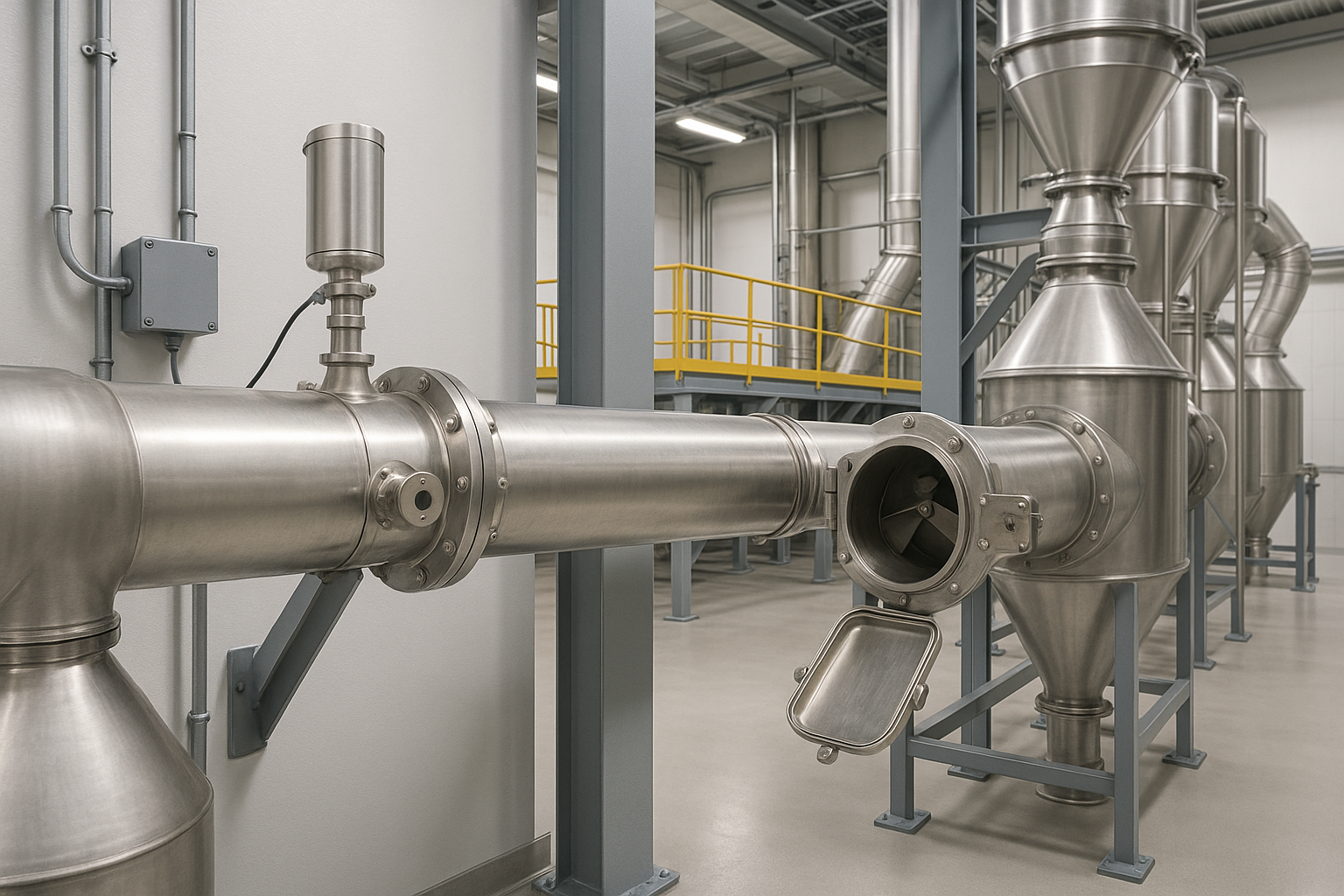
What actually differs
Both approaches have the same job: stop flame and pressure from reaching the connected vessel.
They achieve it in completely different ways, and the installation constraints follow from that.
Chemical isolation: pressure or optical detectors trigger a suppressant cartridge that fills a section of duct with powder, extinguishing the flame front.
Mechanical isolation: a flap closes under the pressure wave, or a fast-acting valve closes on a signal, physically blocking the duct.
Chemical barriers need a minimum distance for the suppressant to establish. Mechanical devices need a minimum distance for the closing movement to complete, and passive flaps additionally need a flow direction they are designed for.
Decision criteria
| Criterion | Chemical barrier | Mechanical device |
|---|---|---|
| Trigger | Detector and control unit | Pressure wave, or detector for active types |
| Flow direction | Either | Passive flaps in one direction only |
| Duct contamination | Suppressant enters the product stream | None |
| Minimum distance | Required, from the manufacturer's test data | Required, longer for slow closing devices |
| After an event | Recharge cartridges, clean the duct | Inspect, reset or replace |
| Routine maintenance | Detector checks, cartridge life | Flap seat and hinge condition |
Where chemical isolation is the better choice
- Ducts where a passive flap cannot be installed with the required straight length.
- Installations where flame could travel in either direction.
- Vessels connected by ducts that bend soon after the outlet.
The trade-off is that suppressant enters the process, which matters for food, pharmaceutical and high-purity materials.
Partner with powderbulkvideos.com
Put your expertise beside the decisions engineers are making.
Connect a relevant company profile and technical video portfolio with clearly labelled visibility on this topic.
Where mechanical isolation is the better choice
- A straight inlet duct with enough distance for the device to act.
- Product streams that must not be contaminated by suppressant.
- Plants that prefer a device with no detection electronics to maintain.
Passive flap valves are attractive because they need no power or detection, but they only work in the direction they were tested for, and a fouled or worn seat is a silent failure.
Where neither fits
Isolation does not replace venting or suppression on the vessel itself.
It also cannot compensate for a duct that is too short for any device to act in, which is a layout problem to be solved on the drawing rather than with hardware.
What to measure before deciding
- Duct length, diameter and the position of the first bend.
- Normal flow direction and whether reverse flow is credible.
- Dust explosion characteristics, which set the device data required.
- Product sensitivity to suppressant contamination.
Frequently asked questions
Is isolation really necessary if the vessel is vented?
Yes. Venting protects the vessel it is fitted to. A deflagration travels along connected ducting and can start a second, more violent event in the adjoining vessel.
Do passive flap valves work in both directions?
No. A passive flap is tested and certified for one direction, and installing it against a possible reverse flow leaves the duct unprotected.
Does a rotary valve isolate an explosion?
Only if it is specifically designed, tested and certified for that duty, with defined clearances and the right number of pockets. An ordinary process rotary valve is not an isolation device.
Related content
Continue exploring
Move from this page to the companies, videos and technical topics that add useful context.
Companies

Videos

REMBE® GmbH Safety+Control
REMBE®: Explosion Isolation – REMBE® EXKOP®
This REMBE video explains an active explosion isolation system intended to stop propagation through connected ductwork. The shown equipment is part of explosion mitigation, not a substitute for ignition prevention. Selection requires representative dust test data, a hazard assessment and a coordinated venting, suppression and isolation strategy.
Total reach: 23,426
BS&B Safety Systems
BS&B Industrial Explosion Protection Devices
BS&B Safety Systems presents its range of industrial explosion protection devices: explosion vents, flameless venting, and chemical explosion suppression and isolation systems.
Total reach: 2,066

REMBE® GmbH Safety+Control
REMBE®: Safety_Campus® – unboxed – EXKOP® Maintenance
In this Safety Campus 'unboxed' video, REMBE explains inspection and maintenance tasks for the EXKOP active explosion-isolation system, focusing on service access, component condition and the checks that return an isolation device to a known state.
Total reach: 6,235