
Comparison
Flameless Venting vs Conventional Explosion Venting
Answer in brief
The question is almost always about where the vessel stands.
A conventional vent panel is the cheaper and simpler device, but it needs a safe outdoor discharge area that no person or structure occupies. A flameless device lets the same vessel stand indoors by retaining the flame and cooling the vented gases.
- Outdoors with a clear discharge path: conventional panel.
- Indoors, or outdoors with no safe path: flameless device.
- Ducting a panel to the outside is a third option with its own penalties.
By Editorial Team · Published October 21, 2026 · Updated October 21, 2026
What actually differs
Both approaches start with the same vent area calculation, because both are deflagration venting.
The difference is what happens after the panel opens.
Conventional venting: flame, pressure and burning dust leave the vessel and travel several metres as a fireball, with a pressure wave and a reaction force on the vessel.
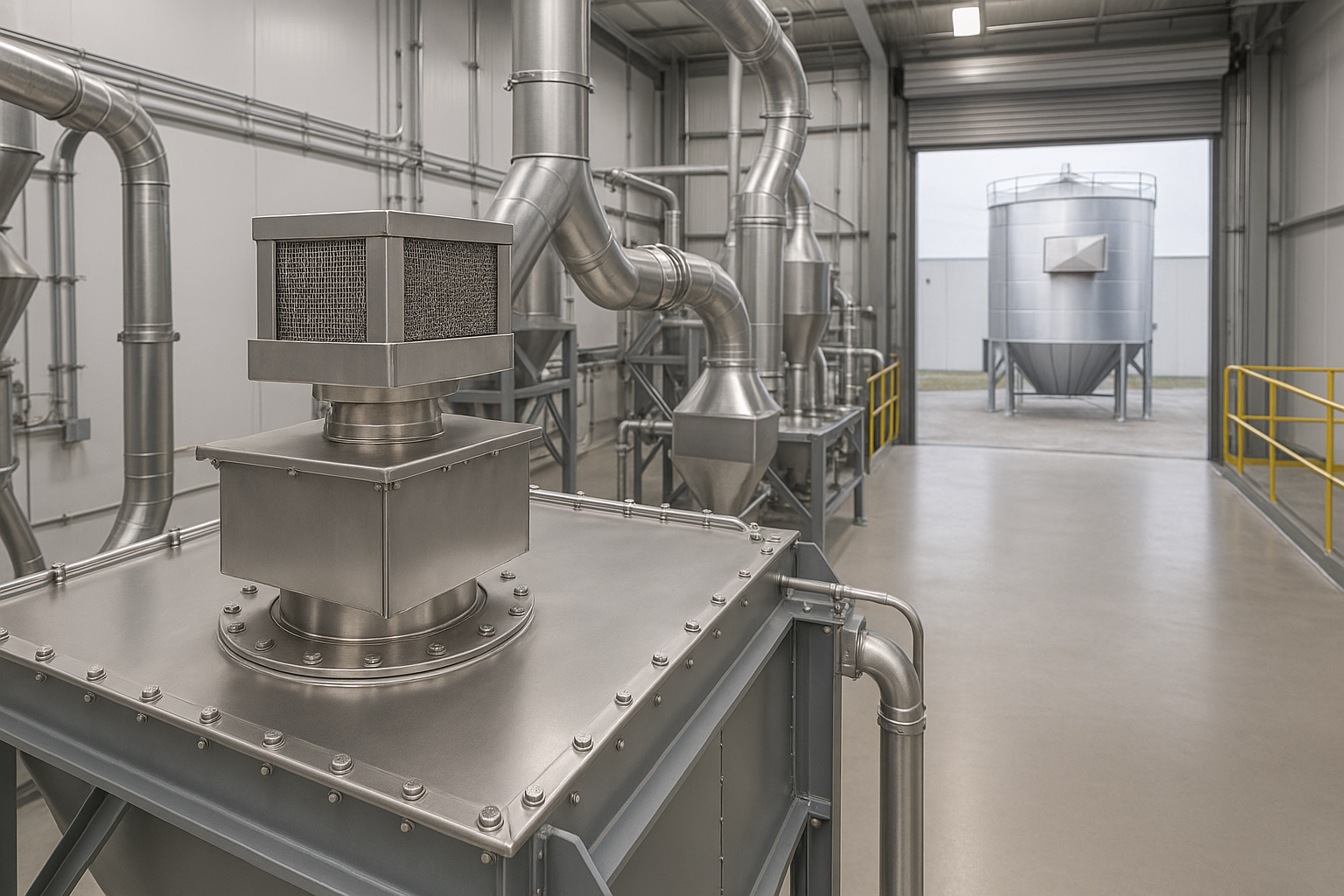
Flameless venting: the same vent opens into a mesh assembly that quenches the flame and retains most of the burning dust, so what leaves the device is hot gas rather than a fireball.
The flameless device has an efficiency factor, which means the vent area it needs is larger than the bare panel area for the same protection.
Decision criteria
| Criterion | Conventional panel | Flameless device |
|---|---|---|
| Installation | Outdoors, safe discharge area | Indoors or outdoors |
| Flame outside | Yes, several metres | Retained |
| Vent area needed | Base calculation | Larger, by the device efficiency |
| Device cost | Low | Several times higher |
| Installed cost | Can rise sharply with ducting | No ducting needed |
| Maintenance | Inspection, replace after event | Inspection, mesh condition, replace after event |
Where conventional venting is the better choice
- Outdoor silos and collectors with an unoccupied area in the discharge direction.
- Vessels where the vent can face away from traffic routes, doors and other plant.
- Projects where the cost difference matters and the location genuinely allows it.
The safe area is not a formality: it is calculated, and it has to stay clear for the life of the plant.
Partner with powderbulkvideos.com
Put your expertise beside the decisions engineers are making.
Connect a relevant company profile and technical video portfolio with clearly labelled visibility on this topic.
Where flameless venting is the better choice
- Collectors and silos inside a building, which is the usual case in food and pharmaceutical plants.
- Vessels where a vent duct to the outside would be long, bent or impractical.
- Installations where the surrounding area cannot be kept clear.
A long vent duct raises the pressure inside the vessel and often forces a larger panel or a stronger vessel, which is where the apparent cost advantage of the panel disappears.
Where neither fits
Venting of any kind is unsuitable for toxic dusts, for materials that must not reach the environment, and for vessels whose strength is too low for the reduced explosion pressure.
In those cases suppression or containment is the appropriate protection concept.
What to measure before deciding
- Explosion characteristics of the dust, measured on the real material.
- Vessel strength and the resulting reduced explosion pressure target.
- Available safe discharge area, measured rather than assumed.
- Duct length and geometry if venting to the outside is considered.
Frequently asked questions
Does a flameless device need a bigger vent opening?
Yes. The quenching element reduces venting efficiency, so the required area is larger than for a bare panel protecting the same vessel.
Can I duct a conventional vent to the outside instead?
Sometimes, but a duct increases the pressure developed inside the vessel. Length, bends and cross section all have to be included in the calculation, and a long duct often removes the cost advantage.
Is flameless venting allowed for all dusts?
No. Toxic materials and some metal dusts are excluded, and manufacturers state the dust classes their devices are tested for.
Related content
Continue exploring
Move from this page to the companies, videos and technical topics that add useful context.
Companies

Videos

REMBE® GmbH Safety+Control
REMBE®: The Original of Flameless Venting – REMBE® Q-Rohr®
This REMBE video explains the Q Rohr flameless venting device and its operating principle. The shown equipment is part of explosion mitigation, not a substitute for ignition prevention. Selection requires representative dust test data, a hazard assessment and a coordinated venting, suppression and isolation strategy.
Total reach: 29,692

VIGILEX by STIF
VIGILEX by STIF: Explosion Vent Panel and Flameless Devices Protection
The video introduces VIGILEX explosion vent panels and flameless venting devices from STIF. These are mitigation components for limiting pressure effects after a deflagration begins inside protected equipment.
Total reach: 28,391

REMBE® GmbH Safety+Control
REMBE®: Safety_Campus® –industrial – Flameless Explosion Venting
This REMBE video explains the principle and installation questions for industrial flameless venting. The shown equipment is part of explosion mitigation, not a substitute for ignition prevention. Selection requires representative dust test data, a hazard assessment and a coordinated venting, suppression and isolation strategy.
Total reach: 25,023