
Guide
Flameless Explosion Venting: Selection and Design Guide
Answer in brief
Flameless venting combines a conventional explosion vent with a flame-arresting element that quenches the fireball and retains burning dust, allowing protected equipment to vent indoors where a normal vent panel would be prohibited.
Selection follows NFPA 68 and EN 16009: establish the dust's explosibility data, size the venting area with the device's certified venting efficiency, and verify the surrounding clearance, temperature and dust-retention conditions.
By Editorial Team · Published August 14, 2026 · Updated August 14, 2026
Deflagration venting is the classic protection for dust-handling equipment: a calibrated weak panel opens, and the fireball and pressure discharge outdoors to a safe area.
Indoors, that concept collapses — the vented fireball of even a modest dust collector extends many meters and would discharge into the working area. Flameless venting exists for exactly this case: equipment that cannot be placed at an outside wall, in plants where relocation or vent ducts are impractical.
How flameless venting works
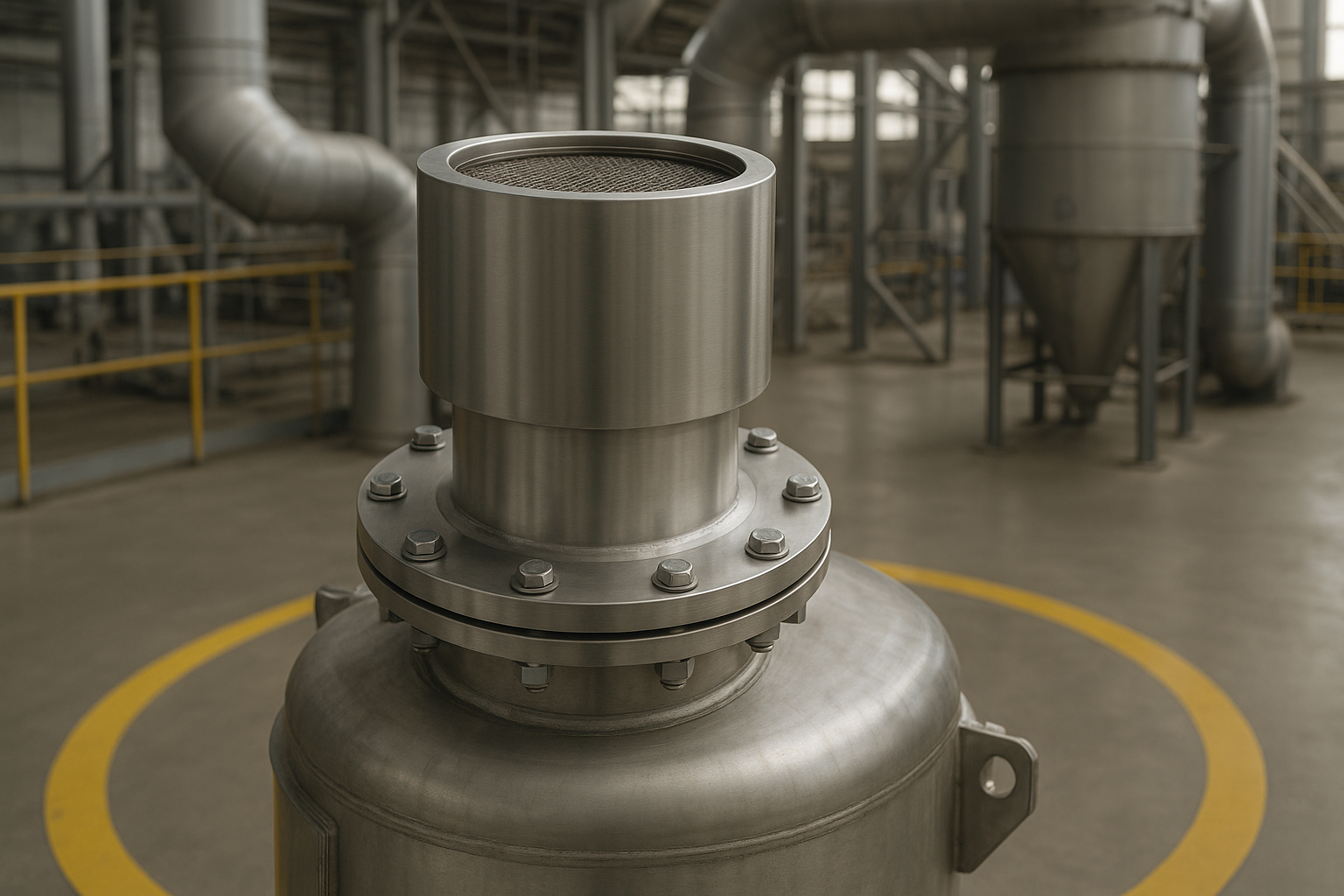
A flameless venting device mounts a flame-arresting element — typically layered stainless-steel mesh — over a conventional explosion vent. When the vent opens, combustion gases expand through the mesh, which absorbs heat fast enough to quench the flame front and retain burning and unburned dust inside the device.
What leaves the unit is pressure and hot gas, not a fireball. The vent panel itself still ruptures at its set static activation pressure; the arresting element adds flow resistance, which is why every certified device carries a venting efficiency that de-rates its effective area.
When flameless venting is the right choice
- Protected equipment stands indoors and a duct to an outside wall is impractical or would exceed workable duct lengths.
- The process handles organic or carbonaceous dusts with established explosibility data (KSt, Pmax).
- The surroundings can accept the residual effects: pressure pulse, hot gas discharge and noise.
- A defined clearance zone around the discharge face can be kept free of personnel and combustibles.
When it is not
Flameless venting has hard exclusions. Metal dusts (aluminum, magnesium and similar high-KSt, high-temperature fuels) can defeat mesh arrestors and are generally outside certification scopes. Sticky, hygroscopic or fibrous dusts blind the mesh and demand either frequent verified cleaning or a different concept.
Toxic products must not be vented into occupied space at all — retention of the fireball is not retention of the product. And equipment whose vent area demand exceeds what flameless devices can provide, after applying venting efficiency, needs suppression or containment instead.
Sizing: NFPA 68, EN 16009 and venting efficiency
Sizing starts exactly like conventional venting: the required vent area follows from the vessel volume, its strength, the dust's KSt and Pmax and the intended reduced pressure. The flameless device then enters through its certified venting efficiency — the fraction of its nominal vent area that remains effective behind the arresting element.
A device with 80 percent efficiency provides 0.8 square meters of effective venting per square meter of panel. Certification under EN 16009 (and listing practice referenced by NFPA 68) ties that efficiency, the approved dust classes and the allowed vessel conditions together; sizing outside the certificate is not engineering, it is guesswork.
Partner with powderbulkvideos.com
Put your expertise beside the decisions engineers are making.
Connect a relevant company profile and technical video portfolio with clearly labelled visibility on this topic.
Placement and clearance
The discharge face still emits a pressure pulse and hot gases. Certified devices define a clearance zone — keep it free of workstations, traffic routes and combustible storage, and respect the manufacturer's stated distances to walls and ceilings so reflected pressure does not load the structure unexpectedly.
Orientation matters: discharge should not face escape routes or areas where operators routinely stand. Recoil forces on the equipment flange are specified by the manufacturer and belong in the structural check of the protected vessel.
Integration with the rest of the protection concept
Venting — flameless or not — protects only the vessel it is mounted on. A deflagration in a dust collector still propagates through connected ducts unless explexplosion isolationemical barriers, flap valves, rotary valves acting as barriers) cuts the path to upstream and downstream equipment.
NFPA 68 sizing, isolation per the applicable isolation standards and the plant's dust hazard analysis under NFPA 652 form one concept; a flameless vent bought in isolation is a component, not a solution.
Inspection and after an event
The arresting element is a consumable safety part: inspect it on the schedule the manufacturer certifies, verify the mesh is free of product buildup and corrosion, and treat any blinding as a protection failure, not a housekeeping note.
After a deflagration, the complete device — panel and arrestor — is replaced, and the event triggers review of why ignition occurred. Inspection intervals, cleaning methods and replacement criteria all come from the device documentation and belong in the plant maintenance system, not in tribal knowledge.
Selection checklist
- Dust explosibility data (KSt, Pmax) established by test, not estimated?
- Dust type within the device certification — no metal dusts, no blinding-prone products?
- Required vent area calculated per NFPA 68 and covered after applying certified venting efficiency?
- Reduced pressure compatible with the vessel strength, including recoil forces?
- Clearance zone at the discharge face defined and kept free?
- Explosion isolation of connected ducts engineered as part of the same concept?
- Inspection and replacement schedule from the certificate embedded in maintenance?
Frequently asked questions
What is flameless explosion venting?
A protection device that combines a conventional explosion vent with a flame-arresting mesh element. When the vent opens, the mesh quenches the fireball and retains burning dust, so the deflagration is relieved as pressure and hot gas without flame ejection — which allows venting indoors where a normal vent panel would be prohibited.
Can flameless vents be used for metal dusts?
Generally no. High-KSt, high-temperature metal dusts such as aluminum or magnesium can defeat mesh flame arrestors and lie outside typical certification scopes. Metal-dust equipment usually needs suppression, containment or outdoor venting concepts instead.
What is venting efficiency?
The certified fraction of a flameless device's nominal vent area that remains effective behind the flame-arresting element. Sizing per NFPA 68 first determines the required vent area, then the device must cover it after applying its efficiency — a device with 80 percent efficiency needs proportionally more nominal area.
Does a flameless vent protect connected equipment?
No. Venting protects only the vessel it is mounted on; a deflagration still propagates through ducts. Explosion isolation — chemical barriers, flap valves or rotary valves acting as barriers — must cut the propagation paths as part of the same protection concept.
Related content
Continue exploring
Move from this page to the companies, videos and technical topics that add useful context.
Companies


Videos

REMBE® GmbH Safety+Control
REMBE®: Safety_Campus® –industrial – Flameless Explosion Venting
This REMBE video explains the principle and installation questions for industrial flameless venting. The shown equipment is part of explosion mitigation, not a substitute for ignition prevention. Selection requires representative dust test data, a hazard assessment and a coordinated venting, suppression and isolation strategy.
Total reach: 24,993

REMBE® GmbH Safety+Control
REMBE®: The Original of Flameless Venting – REMBE® Q-Rohr®
This REMBE video explains the Q Rohr flameless venting device and its operating principle. The shown equipment is part of explosion mitigation, not a substitute for ignition prevention. Selection requires representative dust test data, a hazard assessment and a coordinated venting, suppression and isolation strategy.
Total reach: 29,651

VIGILEX by STIF
VIGILEX by STIF: Explosion Vent Panel and Flameless Devices Protection
The video introduces VIGILEX explosion vent panels and flameless venting devices from STIF. These are mitigation components for limiting pressure effects after a deflagration begins inside protected equipment.
Total reach: 28,298