
Application
Valve and Airlock Selection for Food Powder Lines
Answer in brief
In a food plant the valve is judged by how fast it can be opened, cleaned and put back.
Allergen changeover and residue in a valve pocket cause more recalls than mechanical failure does, and fragile products are damaged by the same tight clearances that keep the air out.
- Specify the cleaning method first, then the valve.
- Watch the clearance: tight for air, gentle for the product.
- Treat the valve as a named item in the allergen plan.
Reviewed October 21, 2026
The problem
Food lines run several recipes through the same equipment, and a valve is full of places the previous recipe can stay in. The rotor pockets, the seat, the shaft seal and the gap behind the end plate all hold a little powder, and a little powder is enough when the next product is declared allergen free.
The second problem pulls in the opposite direction. A rotary valve earns its place by keeping conveying air out of the vessel above it, and it does that with a small clearance between the rotor tip and the housing. Small clearances shear whatever passes through them. On flour nobody notices; on a coated granule, a flake or a freeze dried piece, the same valve turns saleable product into fines that appear as dust at the packer and as a complaint from the customer.
Then there is the honest practical issue: cleaning takes time, and the time available is whatever the changeover plan allows. A valve that needs an hour to strip in a plant that allows twenty minutes is a valve that will be cleaned badly.
Desired outcome
A valve that holds the air boundary it was installed for, passes the product without degrading it, and can be opened, cleaned and reassembled inside the changeover window the plant actually has.
Cleanable to a defined standard, with a method that is written down and a result somebody checks, rather than cleanable in principle.
A grain and feed plant decides the same component on the number of devices it has to stock and on foreign body content, which makes standardisation worth more than a short changeover.
Process approach
The first decision is the duty, because food plants frequently install a rotary valve where they needed a dust tight discharge. Under a filter or a cyclone the job is to let powder out without letting air in, and a double flap valve does that with two moving parts and no pockets to clean. Under a pneumatic line the job is a pressure boundary, and only a rotary valve will do it.
Where changeover frequency is high, quick clean designs earn their cost. A rotor that withdraws on rails without breaking the line, end plates on swing bolts, and seals that come out by hand turn an hour into fifteen minutes, and fifteen minutes is the difference between a procedure that is followed and one that is signed.
For fragile products the geometry matters more than the material. Bevelled rotor tips, reduced pocket counts and a larger valve run slower pass granules that a standard rotor cuts. The trade is leakage: a gentler valve leaks more air, which the conveying design has to absorb.
The inlet vent is the detail that most often goes missing. Air carried back up through the rotor fluidises the powder above the valve and stops the pockets filling, so a vent from the inlet side back to the receiving vessel is part of the installation, not an accessory.
- Duty established first: pressure boundary, dust tight discharge or metering.
- Cleaning method and available changeover time fixed before the valve is chosen.
- Rotor geometry selected for the fragility of the product, with the leakage penalty accepted in the conveying calculation.
- Inlet vent provided so the pockets can fill.
- Surface finish, seal materials and drainage checked against the plant hygiene standard.
- Valve entered in the allergen matrix as its own item.
Selection factors
- Changeover frequency and the time allowed, which decides between a standard and a quick clean design more often than price does.
- Product fragility, measured on the actual granule, not assumed from the recipe.
- Allergen matrix: whether the valve is shared, dedicated, or shared with verified cleaning.
- Hygiene standard, which sets surface finish, seal material, drainage and whether the valve can be wet cleaned at all.
- Pressure differential across the valve, which sets the clearance and therefore the leakage.
- Explosion isolation duty, if the valve is also the isolation device, since that imposes rotor material, vane count and a maximum clearance.
Common failure modes
- Rotary valve installed under a filter where a double flap valve would have done the job with nothing to clean
- Tight clearance specified for leakage and paid for in product damage at the packer
- No inlet vent, so the pockets fill poorly and the rated capacity is never reached
- Cleaning time longer than the changeover window, so the written method is not the one used
- Valve counted as explosion isolation without the certificate that imposes clearance and vane count
- Shaft seal chosen for wear life rather than for cleanability, leaving a residue path at the bearing
Partner with powderbulkvideos.com
Put a relevant technical solution in this decision path.
Connect your company and video evidence with clearly labelled visibility where engineers evaluate this material, application, industry or product.
Frequently asked questions
Why does a rotary valve damage fragile product?
The clearance between the rotor tip and the housing is what keeps the air out, and anything caught in it is sheared. A bevelled tip, fewer pockets and a slower larger valve reduce it, at the cost of more leakage.
Do I need a rotary valve under a dust filter?
Usually not. The duty there is dust tight discharge against a small pressure difference, which a double flap valve handles with fewer surfaces to clean. A rotary valve is for a real pressure boundary.
What is the inlet vent for?
Air returning up through the rotor fluidises the powder above the valve, so the pockets never fill properly. A vent from the inlet side to the vessel gives that air somewhere to go and restores the rated capacity.
Related content
Continue exploring
Move from this page to the companies, videos and technical topics that add useful context.
Companies
Videos
ACS Valves
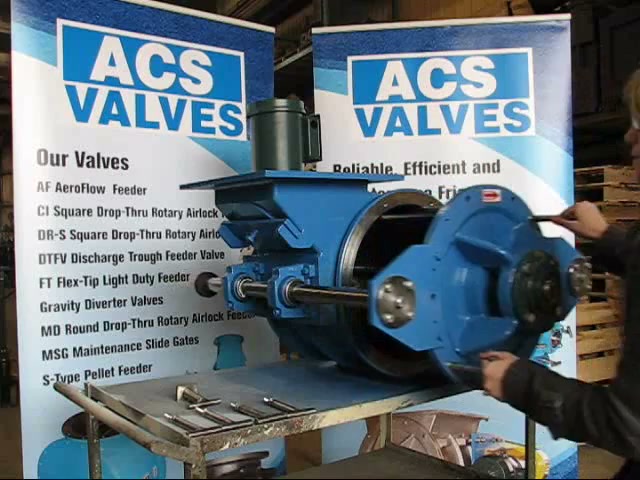
ACS Quick Clean Rotary Valve Demonstration
In this 65-second ACS Valves clip, a presenter opens a Quick-Clean rotary valve without tools: handles release, the rotor and endplate slide out on RotorRail supports, and a locating key guides reassembly. What the demo establishes is physical access to the product-contact zone — cleaning validation and sanitary certification still depend on the supplied model and the site's procedure.
Coperion
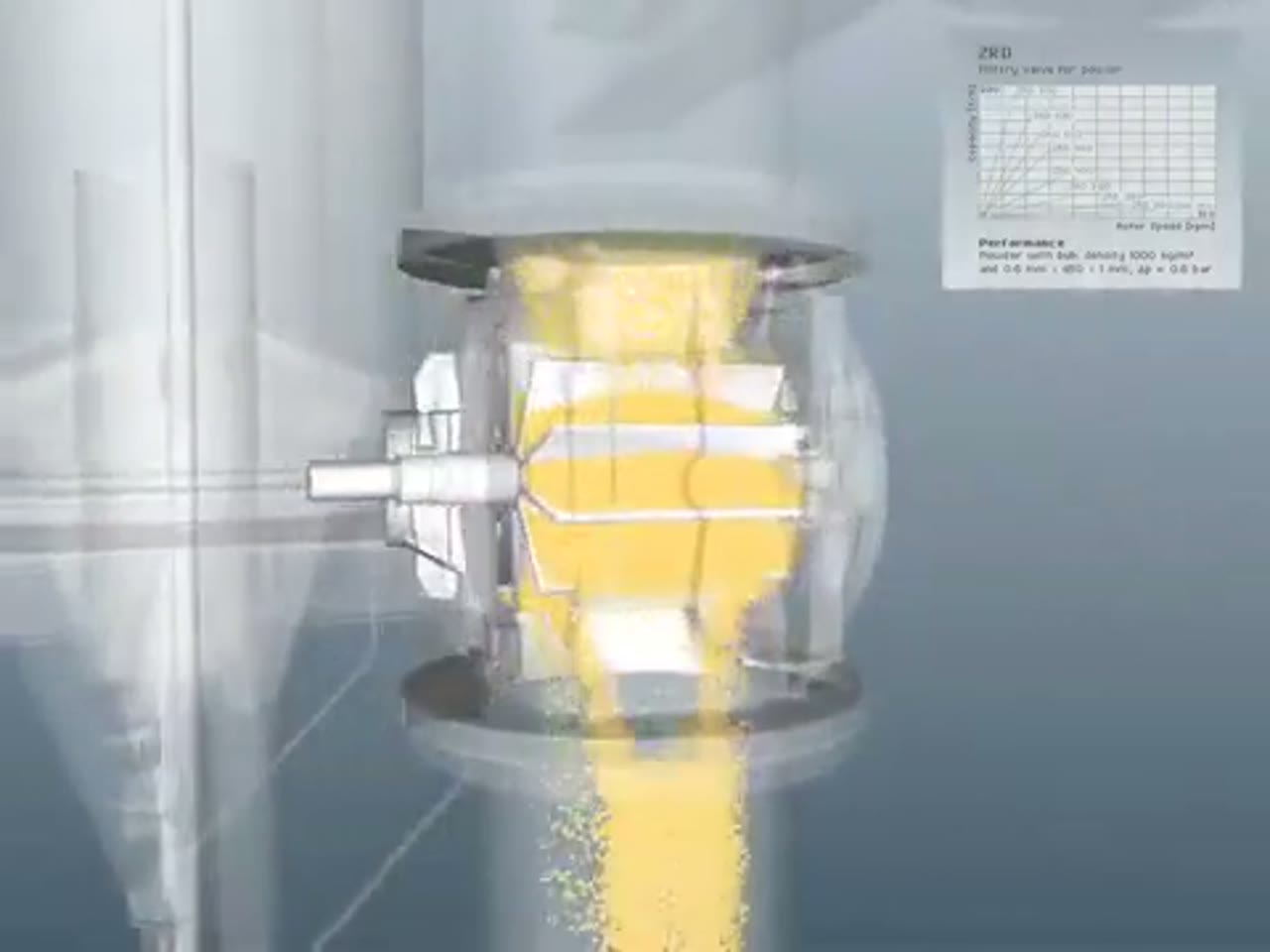
Coperion ZRD Rotary Valve for Powder Applications
Coperion presents the ZRD rotary valve and the design choices that adapt it to powder discharge, metering and pneumatic-conveying service.
Total reach: 10,524

Vortex – Solids & Bulk Handling Components
Vortex®: Orifice Slide Gate Valve
Vortex's video presents the Orifice Slide Gate Valve: a linear blade carries a machined orifice that moves into or out of alignment with the process connection to isolate or regulate dry-bulk flow.
Total reach: 68,292