
Independent industry shortlist for Rotary Valves
Top Rotary Valve Companies (2026)
Answer in brief
Gericke AG, ACS Valves, The Young Industries, DMN-WESTINGHOUSE, and Prater Industries make up this 2026 rotary valve shortlist.
Gericke covers hygienic fast-clean and extra-heavy-duty airlocks under the RotaVal brand, with housings pressure tested for 10 bar(g) explosion containment. ACS Valves offers more than 17 models with capacity tables by size and rotor speed.
Young builds valves from 1 to 36 inches, including blow-thru and side-entry designs for cohesive powders and pellets. DMN-WESTINGHOUSE supplies rail-extractable and CIP-able valves with up to 230 liters per revolution, and Prater builds ceramic-lined airlocks for abrasive minerals.
The right choice depends on whether the valve has to meter, seal a pressure difference, or feed a conveying line, and on how abrasive, cohesive, or hygiene-critical the material is.
By Editorial Team · Published July 17, 2026 · Updated October 8, 2026

How we selected these companies
ShowHide
We compared rotary valve manufacturers on five technical areas that decide whether a valve fits a duty.
- Valve range (25%) looks at which valve types and series a manufacturer offers, such as general-purpose drop-through airlocks, heavy-duty units, blow-through and side-entry designs, low-headroom models, and hygienic series, because the first question is whether a matching valve type exists at all.
- Duty-specific construction (25%) covers the differential pressure and temperature the valve is rated for, housing and rotor materials, wear linings and coatings, bearing arrangement, shaft sealing, and hygienic or explosion-isolating execution for abrasive, cohesive, and food or pharmaceutical products.
- Conveying and process integration (20%) covers blow-through valves and adapters for feeding a conveying line, matching diverter valves and blower packages, monitoring signals such as rotor-contact detection, and test centers where your material can be run.
- Sizing and capacity data (15%) covers the nominal size range, capacity per revolution for each size, and selection tools that narrow a duty to a model.
- Cleaning and maintenance access (15%) covers rotor extraction on rails or cantilevered shafts, tool-free opening, clean-in-place execution, and bearing and seal service.
Range and construction carry the most weight because they determine whether a valve can handle your material and pressure condition without excessive wear, leakage, or product buildup.
Valve range 25%
Which rotary valve types and series are offered, from general-purpose drop-through airlocks to blow-through, side-entry, low-headroom, heavy-duty, and hygienic designs.
Duty-specific construction 25%
Pressure and temperature ratings, housing and rotor materials, wear protection, shaft sealing, and hygienic or explosion-isolating execution.
Conveying and process integration 20%
Blow-through valves and adapters for conveying lines, matching diverter valves and air supply, monitoring signals, and trials with your material.
Sizing and capacity data 15%
Nominal size range, capacity per revolution for each size, and selection tools that narrow a duty to a model.
Cleaning and maintenance access 15%
Rotor extraction on rails or cantilevered shafts, tool-free opening, clean-in-place execution, and bearing and seal service.
Last reviewed October 7, 2026
Disclosure: Up to 40 percent of the places on this list can be booked. Booked and Featured entries are commercially supported, clearly labeled and carry no bought rank. Payment does not determine the editorial assessment or the ranked positions.
What this rotary valve ranking covers
Gericke AG, ACS Valves, The Young Industries, DMN-WESTINGHOUSE, and Prater Industries cover rotary valves from general-purpose airlocks to abrasion-resistant, blow-through, side-entry, and CIP-able designs. The order reflects valve range, duty-specific construction, conveying integration, sizing data, and maintenance access.
Rank alone doesn't select a rotary valve. The same device may meter material, isolate two pressure zones, feed a pneumatic line, discharge a collector, or handle several of these duties with compromises. Material, pressure, temperature, leakage tolerance, rate, cleaning, and maintenance drive the design. Treat the ranking as a candidate list for technical qualification, not a substitute for that work; the best fit for your duty can differ from the order shown here.
Define the required function
Start by stating what the valve must accomplish. A feeder under a hopper may prioritize stable discharge and a controllable rate. An airlock on a pressure or vacuum system must also limit gas leakage. A collector discharge may need reliable removal, dust containment, and protection of the pressure boundary. Each duty can lead to different rotor, housing, seal, drive, and clearance choices.
Describe upstream and downstream conditions for normal operation, startup, shutdown, and faults: pressure on both sides, temperature, gas composition, rate range, fill condition, and expected cycling. If the valve interfaces with a pneumatic conveying line, define the air flow and how leakage affects system capacity. If it feeds a process, define the required control behavior and how pulsation will be assessed.
Connect material properties with valve design
Material data: provide particle size, bulk density, cohesion, abrasiveness, hardness, friability, moisture sensitivity, temperature, and hazard data. Fibrous, sticky, fragile, abrasive, or easily compacted materials create different risks. Rotor pocket shape, tip speed, inlet geometry, clearance, venting, and surface treatment should be justified against those properties rather than picked from a generic schedule.
The proposal should explain how product enters and leaves the pockets. Poor inlet conditions can cut capacity, increase shearing, or create bridging above the valve. High speed can increase product damage or wear. Tight clearances reduce leakage but may raise contact risk when temperature changes or hard particles enter the gap. A useful design is a reasoned balance for the actual duty.
Pressure, leakage, and conveying integration
For airlock service, ask for the leakage basis and the conditions behind it. Differential pressure, rotor clearance, temperature, wear, product presence, and gas properties can all change leakage. The conveying system designer should include the expected value in the air balance and state how performance shifts over time. A low initial figure means little without operating conditions and an inspection plan.
Integration extends to venting, equalization, adapters, upstream feeding, downstream line geometry, instrumentation, and controls. Clarify who supplies each interface and who owns the system guarantee. When the valve sits below a filter, silo, or process vessel, structural loads and maintenance withdrawal space matter too. Drawings should show how the rotor, drive, and seals can be serviced in the installed layout.
Engineering infographic
Geometric displacement is not installed capacity
Usable throughput depends on pocket volume, speed, bulk density and effective filling; poor inlet flow, gas blowback and incomplete discharge reduce the delivered solids rate.
Wear, reliability, and maintenance
Abrasive service calls for a lifecycle discussion. Ask where wear is expected, which components are replaceable, how clearances are measured, and what happens to leakage and capacity as surfaces change. Materials, coatings, rotor design, speed, and upstream tramp protection may all contribute. Claims of heavy-duty construction should come with model details and a maintenance recommendation.
When comparing maintenance, cover access, isolation, rotor removal, bearing and seal work, cleaning, lubrication, alignment, and spare parts. Quick-access features only reduce downtime when the plant has safe space and suitable lifting arrangements. Request a parts list and inspection schedule with the proposal, and confirm service availability for the region rather than inferring it from a general company statement.
Safety, hygiene, and compliance
Explosion protection, flame isolation, pressure shock resistance, hazardous area certification, food contact, and pharmaceutical suitability are model- and configuration-specific. The project must define the applicable requirements and obtain current documents for the exact offered valve. The connected process and protection concept determine whether a certification is relevant and sufficient.
Hygienic selection takes more than stainless steel. Review contact surfaces, gaps, seals, access, disassembly, cleaning method, cross-contamination risk, drainability where applicable, and verification. For combustible materials, review ignition sources, grounding, surface temperature, mechanical contact, isolation strategy, and maintenance controls. Supplier certificates must be read within the complete risk assessment.
Compare proposals and total cost
Use one data sheet and require every bidder to return values, assumptions, and deviations. Ask which claims are calculated, which are tested, and which depend on site conditions. That makes for a fairer decision than comparing model names or nominal inlet size. Compare at least:
- guaranteed rate and the leakage basis;
- motor, controls, materials, and clearances;
- temperature allowance and wear features;
- maintenance access, documentation, and test method.
Total cost: include adapters, controls, structures, installation, spares, planned rebuilds, air loss, production downtime, cleaning labor, and the consequences of wear. A lower purchase price can be poor value when maintenance access is difficult or leakage increases system energy. The preferred supplier should make lifecycle assumptions visible and accept an agreed commissioning check.
Use the list as a qualification sequence
Begin with the candidates whose configurations resemble your duty, then request model-specific data. A lower-ranked company may still provide the best solution when it offers stronger material testing, a clearer guarantee, better local support, or a design that matches the plant constraints more closely.
Record the final selection logic in a comparison matrix so that rate, leakage, materials, safety basis, maintenance, testing, exclusions, and lifecycle cost stay visible. That protects the decision from being reduced to rank or purchase price.
Engineering infographic
Pressure differential creates several leakage paths
Gas can pass through rotor-tip and end clearances and return through empty pockets, affecting hopper conditions, pocket filling and the conveying-system gas balance.
Partner with powderbulkvideos.com
Show your equipment where buyers compare suppliers.
Booked places and Featured Listings are limited to 40 percent of a Top List, clearly labelled and separate from the editorial ranking.
Selected companies
-
Best for: Hygienic fast-clean and abrasive heavy-duty valves, with 10 bar(g) explosion-containing housings
Gericke builds its rotary valves under the RotaVal brand as a modular range in drop-through (HDM) and blowing-seal (BSM) form.
- Sizes run from 150 to 400 mm with throughput up to 50 m³/h, and special valves reach 750 by 1200 mm.
- Rotor clearances stay below 0.2 mm, and housings are individually pressure tested for 10 bar(g) explosion and flame containment.
- The fast-clean HDMF/BSMF valves carry USDA Dairy and EHEDG qualification and extract the rotor on rails with a self-centering RotaLign bearing assembly.
- The EHD line handles cement and silica sand with replaceable liners, blades, and end discs, and the Hypergienic valve adds clean-in-place for pharmaceutical duty.
- Pipe-selector diverter valves rated to 4 barg and test centers in six countries tie the valves into complete conveying systems.
View related CompanyTechnical score breakdown
- Valve range
- 5/5 · HDM/BSM general-purpose, HDMC/BSMC cleanable, HDMF/BSMF fast-clean, EHD and EBS/EBSM extra-heavy-duty, BSV vehicle blowing seal, and Hypergienic HGMC/HGMF valves, plus specials up to 750 by 1200 mm.
- Duty-specific construction
- 5/5 · Clearances below 0.2 mm, housings pressure tested for 10 bar(g) explosion and flame containment, cast iron, stainless steel, or nickel alloys, tungsten carbide and hard chrome coatings, and USDA Dairy and EHEDG qualified fast-clean valves.
- Conveying and process integration
- 5/5 · BSM blowing seals with a flow path optimized by computational fluid dynamics, pipe-selector diverter valves for lean and dense phase up to 4 barg, and test centers in six countries running conveying trials over more than 200 m.
- Sizing and capacity data
- 4.5/5 · HDM/BSM and fast-clean valves in sizes 150 to 400 mm with 0.14 to 2.85 m³/h per rpm and throughput up to 50 or 60 m³/h; Hypergienic valves in six inlet sizes from 100 to 300 mm.
- Cleaning and maintenance access
- 5/5 · Rail-guided rotor extraction with tapered bore and self-centering RotaLign assembly, bearings replaceable with the valve in place, tool-free HDMC end cover, clean-in-place Hypergienic valve, and IPx9K external washdown option.
-
Best for: Configurable metering and airlock valves with capacity tables, tool-less RotorRail access, and blow-through options
ACS Valves offers more than 17 rotary valve models in 82 configurations.
- The square-flange CI Series comes in 11 sizes from 6 to 26 inches, handles 15 psig differential (22 psig as a super-duty build) and up to 750°F, and can be cast in 304, 316, or 2205 stainless steel.
- The round-flange MD Series covers 4 to 16 inches.
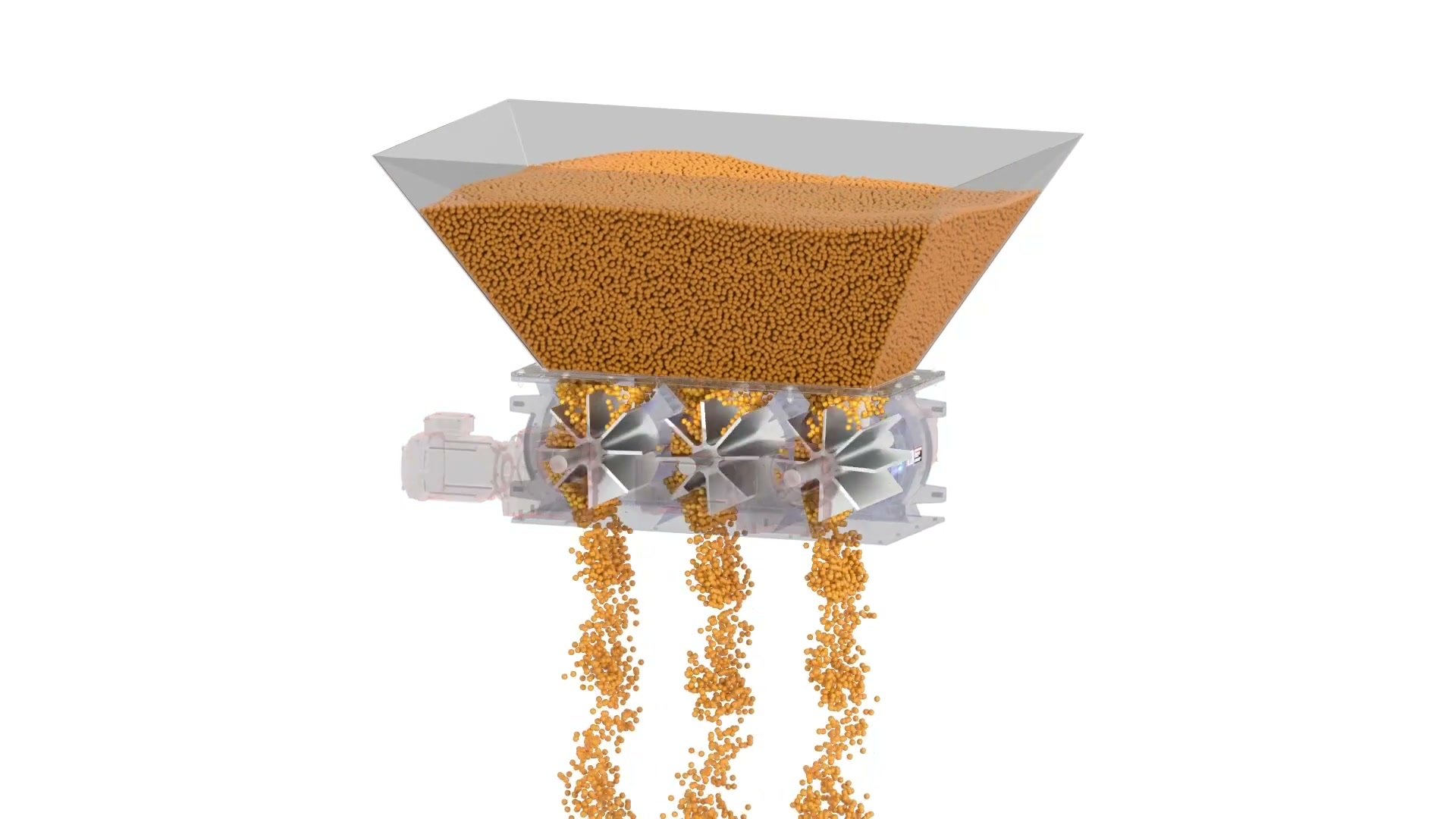
- For conveying lines, the 12-vane BT Series vents leakage air on the return side, and the Multi-Port valve runs two to four independent rotors at 1.42 to 2.84 cubic feet per revolution for split-line feeds.
- Capacity is tabulated by valve size and rotor speed, and a three-input web tool sizes the valve.
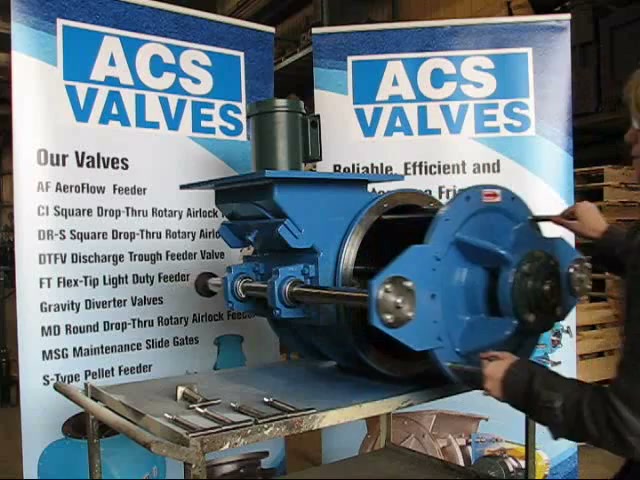
- RotorRail versions open without tools and re-align rotor and endplate on closing.
View related CompanyTechnical score breakdown
- Valve range
- 5/5 · More than 17 models in 82 configurations: CI and MD metering and airlock valves, BT blow-through, Aero-Flow air-assisted, S-Pellet side-inlet, Multi-Port, and RotorRail quick-clean and sanitary versions.
- Duty-specific construction
- 5/5 · CI Series rated 15 psig (22 psig super-duty) and 750°F with outboard bearings, cast iron or 304, 316, and 2205 stainless housings, hard chrome, tungsten, nickel, or epoxy coatings, and a glandless ACST-4 shaft seal.
- Conveying and process integration
- 4.5/5 · BT Series with 12-vane rotor and return-side vent for 8 and 10 inch lines up to 20 psig, blow-through adapters, Multi-Port valve for split-line feeds, and skid-mounted positive displacement blower packages.
- Sizing and capacity data
- 5/5 · Capacity tables by size and rotor speed, from 6 cubic feet per hour at 1 rpm on the 6 inch CI valve to 11,880 at 22 rpm on the 26 inch, Multi-Port at 1.42 to 2.84 cubic feet per revolution, and a three-input web sizing tool.
- Cleaning and maintenance access
- 4.5/5 · RotorRail gives tool-less access to rotor and internal surfaces and re-aligns rotor and endplate on reassembly; the ACST-4 shaft seal comes out with basic hand tools in minutes.
-
Best for: Cohesive powders, pellets, and low-headroom or high-temperature installations in sizes from 1 to 36 inches
The Young Industries builds a separate valve for each duty.
- The Model HC is a high-capacity drop-thru valve, the Model LH fits low headroom, and the side-entry Model SE fills pockets to about 40 percent to stop pellets from jamming.
- The Model BT routes the convey line through the end plates for lines from 1 to 6 inches and suits cohesive materials, and the End Seal option cuts leakage by roughly 50 percent.
- Standard housings are rated 15 psig internal and differential at 250°F, with designs to 1,000°F.
- HC sizes run from 4 to 24 inches at 0.0528 to 10.833 cubic feet per revolution.
- Quick Clean and cantilevered CA versions pull the rotor without disturbing the shaft seal, and the HC-CA and LH-CA hold 3-A Dairy approval as clean-in-place valves.
View related CompanyTechnical score breakdown
- Valve range
- 5/5 · Model HC high-capacity, LH low-headroom, SE side-entry, BT blow-thru, ES end-seal, EV fluidizing, QC quick-clean, CA cantilevered, RNHC pellet-metering, and double-length versions.
- Duty-specific construction
- 5/5 · Housings rated 15 psig internal and differential at 250°F, designs to 1,000°F and up to 150 psig internal pressure, carbon steel, stainless, Hastelloy, or titanium, and close-clearance versions with 0.0079 inch maximum clearance for St 1 and St 2 dusts.
- Conveying and process integration
- 4/5 · Model BT with the convey line integrated in the end plates for 1 to 6 inch lines, swing-gate and rotary-plug diverter valves for pneumatic conveying, and a product pump conveying up to 6,000 lb/h over 300 feet.
- Sizing and capacity data
- 5/5 · Model HC in standard sizes 4 to 24 inches with 0.0528 to 10.833 cubic feet per revolution, special sizes from 1 to 36 inches, and a web calculator that sizes the valve from capacity and bulk density.
- Cleaning and maintenance access
- 4.5/5 · Quick Clean and CA valves with cantilevered rotor removable without disturbing the shaft seal, tool-free disassembly of product contact parts on the CA, and 3-A Dairy clean-in-place approval for the HC-CA and LH-CA.
-
Best for: Hygienic dairy and food lines needing rail-extractable or CIP-able valves with USDA and EHEDG options
DMN-WESTINGHOUSE builds a modular range around the AL drop-through and BL blow-through valves.
- The AL comes in ten sizes from 100 to 500 mm, with 0.8 to 230 liters per revolution, and the AXL and BXL add an enlarged inlet for poorly flowing products.
- Standard valves run to 150°C and 2 bar pressure difference, special versions cover -200 to +600°C, and ATEX protective-system versions reach 10 barg.
- Rotors have nine blades, and the outboard bearings are sealed for life.
- Dairy versions are USDA accepted, with rotor pockets polished to Ra 0.8 µm.
- MZC valves slide end cover and rotor out on rails within minutes, and the MZC-I cleans in place with the rotor in position.
- Diverter valves and rotor-contact detection with EtherNet/IP output complete the conveying line.
View related CompanyTechnical score breakdown
- Valve range
- 5/5 · AL/AXL and AML drop-through, BL/BXL/BXXL blow-through, MZC-I and MZC-II hygienic, DL dust-lock, GL granular, SAL sanitary, USAL, and MALD/MLD medium-duty valves, with Dairy versions.
- Duty-specific construction
- 5/5 · Standard valves to 150°C and 2 bar, special versions from -200 to +600°C, ATEX protective-system versions to 10 barg, cast iron, stainless steel, or aluminum housings, USDA Dairy accepted versions polished to Ra 0.8 µm, and EHEDG Type ED Class II.
- Conveying and process integration
- 4/5 · BL/BXL/BXXL blow-through valves, two-way, three-way, and multiport diverter valves for pneumatic conveying, RID 3.0 rotor-contact detection with EtherNet/IP or 4-20 mA output, and shaft-seal air flow control.
- Sizing and capacity data
- 4.5/5 · AL in ten sizes from 100 to 500 mm with 0.8 to 230 liters per revolution, and BL in six sizes from 150 to 350 mm with 2.5 to 58 liters per revolution, each at 100 percent filling.
- Cleaning and maintenance access
- 5/5 · MZC rails remove end cover and rotor within minutes, the MZC-I cleans in place with the rotor in position, the MZC-II opens on both sides, and bearings are lubricated and sealed for life.
-
Best for: Ceramic-lined airlocks for abrasive minerals, alumina, sand, and pigments, and hot duties to 500°F
Prater builds rotary airlocks in heavy-duty PAV, quick-take-apart, blow-thru, abrasion-resistant, and dust-collector versions.
- The castings are designed for up to 15 psi differential pressure, standard models run to 500°F, and custom models to 1,000°F.
- Every valve uses an eight-blade rotor, outboard bearings, and self-adjusting packing glands that can be repacked with the valve assembled.
- The abrasion-resistant valve has a ceramic-lined cast-iron housing with alumina wear surfaces in sizes from 6 to 16 inches square, rated ±12 psi and 300°F.
- PAV capacity runs from 0.15 cubic feet per revolution at 6 inches to 2.3 at 16 inches.
- The quick-take-apart valve removes rotor and end plate as one assembly, and a rail version slides them out and re-centers the rotor on closing.
View related CompanyTechnical score breakdown
- Valve range
- 4/5 · Heavy-duty PAV, quick-take-apart QTA and rail-mounted versions, blow-thru, ceramic-lined abrasion-resistant, and dust-collector airlocks.
- Duty-specific construction
- 4.5/5 · Up to 15 psi differential and 500°F standard, custom models to 1,000°F, ceramic-lined cast-iron housing with alumina wear surfaces, eight-blade rotors, outboard bearings, self-adjusting packing glands, and NFPA 69 compliant builds.
- Conveying and process integration
- 3.5/5 · Blow-thru airlock that passes conveying air through the housing and fits low headroom, with system engineering for air movers, filter receivers, piping, and controls, and a testing and tolling facility.
- Sizing and capacity data
- 4/5 · PAV from 0.15 cubic feet per revolution at 6 inches to 2.3 at 16 inches, abrasion-resistant valve in 6 to 16 inches square, dust-collector valve in 6 to 12 inches, and a web tool that recommends the airlock size.
- Cleaning and maintenance access
- 4.5/5 · Quick-take-apart valve removes rotor and end plate as one assembly without tools, the rail version re-centers the rotor on closing, and packing can be changed with the valve fully assembled.
-
Work with usAvailable
3 places on this Top List are open
Bookable places are limited, clearly labelled and separate from the editorial ranking above.

Frequently asked questions
Can a company buy a higher rank on this list?
No. The ranked positions follow the five technical criteria above. Booked and Featured places are labeled as such and carry no rank.
What does the rotary valve score measure?
It rates valve range, duty-specific construction, conveying and process integration, sizing and capacity data, and cleaning and maintenance access, weighted 25, 25, 20, 15, and 15 percent.
Is a rotary valve feeder the same as a rotary airlock?
Not necessarily. A feeder under a hopper is chosen for stable discharge and a controllable rate, while an airlock on a pressure or vacuum system must also limit gas leakage. Each duty can lead to different rotor, housing, seal, drive, and clearance choices.
What changes rotary valve leakage in airlock service?
Differential pressure, rotor clearance, temperature, wear, product presence, and gas properties all change leakage. Tight clearances reduce it but raise contact risk when temperature changes or hard particles enter the gap, so the expected value belongs in the conveying air balance.
When is a blow-through rotary valve the better choice than a drop-through valve?
A blow-through valve passes the conveying air through the rotor pockets, which helps clear cohesive or sticky powders and saves height because no separate pickup adapter sits below the valve. A drop-through valve discharges by gravity and suits free-flowing material, metering under a hopper, and collector discharge.
What clearance does a rotary valve need to act as an explosion isolation device?
Close-clearance valves built for deflagration isolation hold the gap between rotor and housing at or below 0.0079 inch, about 0.2 mm, use metal rotor tips, and keep at least two blades sealing on each side. Whether a given valve is sufficient depends on the dust, its Kst and Pmax values, and the protection concept of the connected equipment.
Sources and further reading
- 3-A Sanitary Standards, 3-A Sanitary Standards, Inc.
- A Practical Guide to Rotary Valves, SHAPA
- Air leakage through rotary valves, Proceedings of the Institution of Mechanical Engineers
- Combustible Dust Hazard Communication Guidance, Occupational Safety and Health Administration
- Combustible Dust Safety and Health Topics, OSHA
- Directive CPL 03-00-008: Revised Combustible Dust National Emphasis Program, Occupational Safety and Health Administration (OSHA)
- Effect of Rotary Valve Leakage on Pneumatic Conveying Performance, Particulate Science and Technology
- GL 38 Hygienic Engineering of Rotary Valves in Process Lines for Dry Particulate Materials, EHEDG
- Hazard Communication Guidance for Combustible Dusts (OSHA 3371-08), Occupational Safety and Health Administration, U.S. Department of Labor
- HSE rotary valves used as explosion chokes, UK Health and Safety Executive
- NFPA 654: Standard for the Prevention of Fire and Dust Explosions from the Manufacturing, Processing, and Handling of Combustible Particulate Solids, National Fire Protection Association
- NFPA 69: Standard on Explosion Prevention Systems, National Fire Protection Association (NFPA)
- NFPA 69: Standard on Explosion Prevention Systems, National Fire Protection Association (NFPA)
- Rotary Valve Selection for Pneumatic Conveying Systems (F. J. Gerchow, bulk solids handling, Vol. 1, No. 1, 1981), bulk solids handling / bulk-online
- Safe handling of combustible dusts, Health and Safety Executive
- The interaction between rotary valves and pneumatic conveying pipelines (S. R. Kessel, PhD thesis, 1985), University of Greenwich (Thames Polytechnic)
Related content
Continue exploring
Move from this page to the companies, videos and technical topics that add useful context.
Companies
Videos
ACS Valves
ACS Multi-Port Rotary Valve in 3D
ACS Valves uses a 3D animation to explain a multi-compartment rotary-airlock arrangement for high-volume discharge duties with independent rotors and drives.
ACS Valves
ACS Quick Clean Rotary Valve Demonstration
In this 65-second ACS Valves clip, a presenter opens a Quick-Clean rotary valve without tools: handles release, the rotor and endplate slide out on RotorRail supports, and a locating key guides reassembly. What the demo establishes is physical access to the product-contact zone — cleaning validation and sanitary certification still depend on the supplied model and the site's procedure.

Airlock
Airlock: Dairy Standard Rotary Valves
Airlock video on the DCSR Version 2.0 rotary valve range (2T and 2TE): drop-through and blow-through configurations for feeding, metering, and pneumatic conveying, with a detachable rotor and end cover for cleaning access in dairy service.
Total reach: 20,547

Coperion
Coperion ZRD Rotary Valve for Powder Applications
Coperion presents the ZRD rotary valve and the design choices that adapt it to powder discharge, metering and pneumatic-conveying service.
Total reach: 10,318
DMN-WESTINGHOUSE
DMN-WESTINGHOUSE MZC-II Basic Inspection and Cleaning
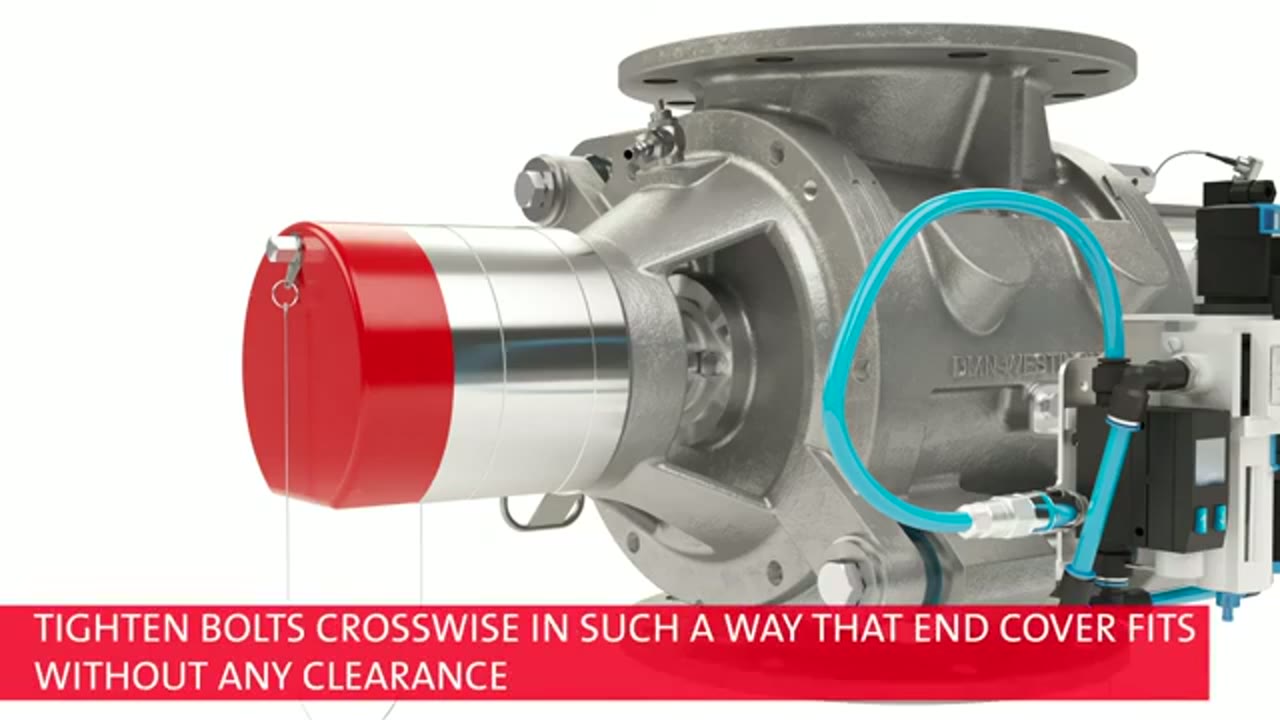
DMN-WESTINGHOUSE demonstrates the basic inspection and cleaning context for an MZC-II rotary valve and states the safety boundary for maintenance work.
Total reach: 2,148

Prater Industries
How To Select The Proper Rotary Airlock Valve
Prater Industries explains the process information engineers need before choosing and sizing a rotary airlock valve.
Total reach: 3,597

Kice Industries
Kice VJX Airlock Installation
Kice Industries demonstrates installation considerations for its VJX airlock at a dry-bulk process interface.

KREISEL Industries GmbH
Kreisel: Screw Pump vs. Rotary Valve
This video presents KREISEL rotary valves and the process duties that distinguish a rotary valve from alternative feeding equipment.
Total reach: 6,222