
Independent industry shortlist for Rotary Valves
Best Rotary Valves for Food Processing
Answer in brief
A food-duty rotary valve earns its place through cleanable product-contact geometry, defined contact materials and finishes, practical rotor access, and seals that suit the sanitation regime, not through the word "food" in a model name.
On those terms this shortlist ranks Gericke, DMN-WESTINGHOUSE, ACS Valves, The Young Industries, and Prater Industries. Gericke's Fast Clean valves from 150 to 400 mm slide the rotor out on rails without tools, and the HDMF series is USDA Dairy accepted.
DMN-WESTINGHOUSE cleans its MZC valves in place with the rotor in position.
ACS casts its sanitary housings in stainless steel with a No. 4 finish, Young removes a cantilevered rotor through the free end of the housing, and Prater pulls rotor and end plate as one assembly.
By Editorial Team · Published July 27, 2026 · Updated October 15, 2026

How we selected these companies
ShowHide
We compared rotary valve suppliers on five technical areas that decide whether a valve suits food duty.
- Cleanable design and rotor access (30%) looks at how the product-contact surfaces are exposed: tool-free rotor withdrawal, rails, single or double-sided opening, cast housings without internal bolted joints, and whether the valve can be cleaned in place with the rotor in position.
- Contact materials, finish, seals, and approvals (25%) covers the alloy and surface finish of the contact parts, the shaft seal arrangement and its materials, and approvals such as USDA Dairy acceptance, EHEDG certification, 3-A approval, and FDA-compliant materials.
- Rate, pressure, and leakage fit (20%) covers valve sizes, volume per revolution, pressure differential, temperature limit, and drop-through or blow-through geometry.
- Inspection and reassembly (15%) covers how rotor alignment and clearances are restored after cleaning, where the bearings sit, and how seals are serviced.
- Model range and application engineering (10%) covers the spread of hygienic models, sizes, and rotor types.
Cleanable design and contact construction carry the most weight because food safety depends on the exact surfaces, seals, and cleaning procedure, not on the size of a catalog. A supplier can place well with one specialist hygienic model. Use the list to form a shortlist, then qualify the exact valve with your own product, allergen, sanitation, pressure, and acceptance data.
Cleanable design and rotor access 30%
How product-contact surfaces are exposed for cleaning: tool-free rotor withdrawal, rails, single or double-sided opening, crevice control, and clean-in-place capability.
Contact materials, finish, seals, and approvals 25%
Alloy and surface finish of the product-contact parts, the shaft seal arrangement, and food approvals such as USDA Dairy, EHEDG, 3-A, and FDA-compliant materials.
Rate, pressure, and leakage fit 20%
Valve sizes, volume per revolution, pressure differential, temperature limit, and drop-through or blow-through geometry.
Inspection and reassembly 15%
How rotor alignment and clearances are restored after cleaning, plus bearing position, seal service, and rotor contact monitoring.
Model range and application engineering 10%
Spread of hygienic valve models, sizes, rotor types, and explosion-protection options.
Last reviewed October 7, 2026
Disclosure: Up to 40 percent of the places on this list can be booked. Booked and Featured entries are commercially supported, clearly labeled and carry no bought rank. Payment does not determine the editorial assessment or the ranked positions.
Food-duty rotary valves sit at an awkward intersection: they must move dry solids, restrict gas leakage and still be opened, cleaned and inspected without creating new contamination risks. Stainless steel helps, but hygienic design is a system of geometry, materials, seals, access and procedure. The rotary valves technology guide covers the underlying mechanics; this list focuses on hygienic selection.
How to use this shortlist
Product first: record allergens, microbiological sensitivity, moisture behavior, allowable residues, cleaning chemicals and whether the valve is cleaned dry, wet, in place or out of place.
Then the duty: feeding from a hopper, discharging a dust collector and introducing flour into a pressurized line impose different requirements on pocket fill, leakage and rotor clearances.
If abrasive wear dominates your selection instead of hygiene, the list for abrasive powders weights wear protection and clearance control instead.
What cleanable design means
Product-contact surfaces should be reachable and inspectable. Internal corners, fasteners, shaft seals and endplate joints deserve close attention, because that's where residue tends to remain.
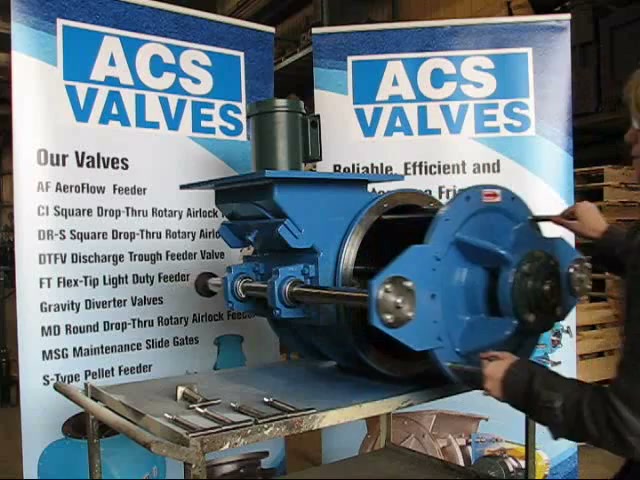
Quick-release rails can cut changeover time and alignment risk; the ACS Quick-Clean demonstration shows one such access concept. Rails do not remove the need to support the rotor safely, isolate energy and verify correct reassembly.
Materials, finishes and seals
Request the exact alloy and finish for every product-contact part. A general statement such as “stainless construction” may hide a coated rotor, dissimilar tips or seals with limited chemical and temperature compatibility.
Surface roughness is useful only when its scope and measurement method are clear. A polished rotor does not compensate for an inaccessible housing joint.
Capacity and leakage
Geometric pocket volume is not guaranteed capacity. Fill factor changes with bulk density, aeration, cohesion, rotor speed and inlet geometry. Pressure leakage can oppose filling and disturb the upstream hopper.
Ask suppliers to show the assumptions behind rate and leakage calculations. Test with representative product when blend integrity, particle damage or feeding stability matters.
Rotor geometry and product behavior
Open-end, closed-end, shallow-pocket and flexible-tip rotors do not handle every ingredient in the same way. Pocket depth affects fill and residual product. Tip geometry affects leakage, shear and the chance of trapping larger particles at the inlet.
Fragile cereals, inclusions and agglomerates need a different discussion from free-flowing flour. Slow speed and generous pockets may reduce breakage, while a sticky premix may need geometry that empties reliably. The correct answer comes from representative product tests, not from the word “food” in a model name.
Seals, bearings and lubricants
Shaft seals sit close to the product boundary and deserve explicit review. Confirm the seal type, elastomer or packing material, purge arrangement, allowable leakage and replacement method. Bearings placed outboard of the endplate are easier to separate from product and cleaning fluid, but the actual arrangement still matters.
Lubricant selection and the route by which a failed seal could reach product belong in the hazard analysis. The same applies to wear debris from rotor tips, coatings and housing contact.
Dry cleaning, wet cleaning and validation
Dry-cleaned lines may avoid water because moisture can promote microbial growth or turn powder residue into a stubborn paste. Wet cleaning removes more but introduces drainage, drying and corrosion questions. The valve design has to support the chosen regime.
Validation defines what “clean” means for the process. That may include visual inspection, allergen swabs, ATP testing or microbiological methods. Sampling points should cover the hardest-to-clean surfaces, not only the easiest to reach.
Installation details that affect hygiene
A cleanable valve can be undermined by poor installation. Nearby steelwork may block rotor withdrawal. A dead pocket in the inlet transition may retain product. Flexible connectors can wrinkle or abrade, and an unsupported outlet can distort the housing.
Review the installed assembly in three dimensions before release. Include removal envelopes, lifting points, drain paths, access to seals and the position of extraction or containment connections.
Factory acceptance and documentation
Factory acceptance should verify the quoted materials, finish, rotor, clearances, seals, guards and drive. A dry mechanical run checks rotation and interlocks, but product trials are needed when feed repeatability, product damage or cleanout is critical.
The handover package should include drawings, certificates, manuals, spare-parts data and the configuration record. A certificate without a clear link to the serialized equipment is difficult to use during an audit.
Food-safety boundary
FDA current good manufacturing practice requires equipment to be adequately cleanable and maintained to protect against contamination and allergen cross-contact. EHEDG guidance likewise treats hygienic selection as risk-based and tied to intended use.
A catalog label is therefore the beginning of qualification, not the end. The plant still owns its hazard analysis, sanitation procedure and verification limits.
Questions for the shortlist
- Which exact surfaces contact product, and how are they exposed for cleaning?
- Which finish, seals and declarations apply to the quoted configuration?
- How are rotor alignment and clearances checked after reassembly?
- What rate and leakage assumptions were used?
- Which cleaning and acceptance records will be supplied?
Partner with powderbulkvideos.com
Show your equipment where buyers compare suppliers.
Booked places and Featured Listings are limited to 40 percent of a Top List, clearly labelled and separate from the editorial ranking.
Selected companies
-
Best for: Extractable valves from 150 to 400 mm with USDA Dairy and EHEDG approval
Gericke builds its RotaVal Fast Clean valves in two forms: the HDMF drop-through valve and the BSMF blowing seal for feeding a conveying line.
- Both come in six sizes from 150 to 400 mm, move 0.14 to 2.85 m3/h per rpm, and reach up to 60 m3/h.
- The rotor slides out without tools on horizontal rails with a support tray, and can be rotated there for cleaning.
- A tapered bore with a matching rotor prevents scratching during extraction, and the RotaLign system puts the rotor back without a clearance check.
- Housings come in cast iron, stainless steel, or nickel alloys, with polished, hard chrome, tungsten carbide, or PTFE finishes.
- The HDMF series is USDA Dairy accepted, and the Fast Clean range is EHEDG qualified.
View related CompanyTechnical score breakdown
- Cleanable design and rotor access
- 4.5/5 · Tool-free rotor extraction on horizontal rails with a support tray, single or double-ended opening, tapered bore, and an external washdown option rated IPx9K; the Hypergienic HGMC adds full clean-in-place with self-draining surfaces.
- Contact materials, finish, seals, and approvals
- 4.5/5 · Cast iron, stainless steel, or nickel alloy housings with polished, hard chrome, tungsten carbide, or PTFE finishes; HDMF series USDA Dairy accepted, Fast Clean range EHEDG qualified, FDA double lip shaft seal with air purge on the Hypergienic valve.
- Rate, pressure, and leakage fit
- 4/5 · Six sizes from 150 to 400 mm, 0.14 to 2.85 m3/h per rpm, up to 60 m3/h, as HDMF drop-through or BSMF blowing seal; housings pressure tested to 10 bar(g) for explosion and flame containment.
- Inspection and reassembly
- 4.5/5 · RotaLign locking restores rotor position without checking clearances or orientation, bearings can be replaced with the valve in place, and RotaSafe stops the drive on rotor-to-housing contact.
- Model range and application engineering
- 4/5 · HDMF and BSMF in six sizes each with single or double-ended opening, the Hypergienic HGMC and HGMF, heavy-duty valves, and ATEX versions for dust and gas zones.
-
Best for: Dairy and food powders that need clean-in-place with the rotor left in position
DMN-WESTINGHOUSE builds its hygienic valves around the MZC design.
- The MZC-I opens on one side; the MZC-II opens on both sides on rails and comes with direct drive only, which keeps the drive end clear.
- Both are cleaned in place with the rotor in position and carry an integrated emergency safety switch.
- The housing styles AL, AXL, AML, BL, BXL, and BXXL in Dairy execution are USDA Dairy accepted, and the Dairy-WD versions are suited to CIP.
- Shaft sealing uses the SAS or SAS-II air purge seal with PTFE and FKM gaskets.
- The AL range runs from 4 to 20 in. with 0.03 to 8.12 ft3 per revolution, up to 150 °C and 2 barg.
- The small SAL metering valve is polished inside and outside and comes apart within minutes.
View related CompanyTechnical score breakdown
- Cleanable design and rotor access
- 4.5/5 · MZC-I opens on one side and MZC-II on both sides, with rotor and end cover drawn out on rails; clean-in-place with the rotor in position, and Dairy-WD versions suited to CIP.
- Contact materials, finish, seals, and approvals
- 4.5/5 · Stainless steel valves with SAS or SAS-II air purge shaft seals and PTFE and FKM gaskets; USDA Dairy accepted, EHEDG Type ED Class II available, and the SAL is high-gloss polished inside and outside with FDA and EC 1935/2004 compliant product surfaces.
- Rate, pressure, and leakage fit
- 4.5/5 · AL from 4 to 20 in. with 0.03 to 8.12 ft3 per revolution, up to 150 °C and 2 barg; BL, BXL, and BXXL blow-through housings; SAL from 2 to 6 in. with 0.0025 to 0.09 liters per revolution, up to 100 °C and 1 barg.
- Inspection and reassembly
- 3.5/5 · Integrated emergency safety switch on the MZC valves, rail-guided end cover and rotor, direct drive on the MZC-II for unobstructed opening, and model-specific installation manuals.
- Model range and application engineering
- 4.5/5 · Drop-through AL, AXL, and AML, blow-through BL, BXL, and BXXL, the SAL sanitary valve, MZC-I and MZC-II executions with 8, 9, or 10-blade rotors, and ATEX certification for dust and gas.
-
Best for: Cast stainless valves with a No. 4 finish and rail-mounted rotor up to 500 °F
ACS Valves offers two sanitary series with its Quick-Clean RotorRail: the round-flange Sanitary MD in seven sizes from 4 to 15 in. and the square-flange Sanitary CI in nine sizes from 6 to 22 in. Quick-release handles slide the rotor and endplate out in a single step without tools, and the rails hold the alignment for reassembly.
- The housing is cast stainless steel in 304, 304L, 316, 316L, or 2205, so there are no bolted joints inside, and the housing contact surfaces and all rotor surfaces have a No. 4 finish.
- Both series handle pressure differentials up to 15 psig and temperatures up to 500 °F.
- Shaft sealing is a glandless ACST-4 seal or a packing gland, with optional air purge of the shaft seal and rotor pockets.
View related CompanyTechnical score breakdown
- Cleanable design and rotor access
- 4/5 · RotorRail slides rotor and endplate out in a single step without tools; one-piece cast housing without internal bolted joints, and Run-Clean angled surfaces and rounded edges on the Sanitary CI.
- Contact materials, finish, seals, and approvals
- 4/5 · Cast 304, 304L, 316, 316L, or 2205 stainless housing, No. 4 finish on housing contact surfaces and all rotor surfaces, glandless ACST-4 shaft seal or packing gland with optional air purge.
- Rate, pressure, and leakage fit
- 4.5/5 · Sanitary MD in seven sizes from 4 to 15 in. and Sanitary CI in nine sizes from 6 to 22 in., up to 15 psig and 500 °F; the 15 in. MD moves 84 ft3/h per rpm at full pocket fill.
- Inspection and reassembly
- 4/5 · RotorRail keeps rotor and endplate aligned during disassembly and reassembly; outboard bearings sit away from product, and CNC-machined parts prevent axial shaft movement.
- Model range and application engineering
- 4/5 · Sanitary MD and Sanitary CI series with closed-end, metering, shallow-pocket, and coated rotors in 6, 8, or 10 vanes, plus blow-through adapters and housing vent ports.
-
Best for: Cantilevered rotor with 3-A dairy clean-in-place approval
The Young Industries builds its cleanable valves on a cantilevered rotor: both bearings sit on one end of the shaft, and the rotor comes out completely through the opposite end of the housing.
- The Cantilevered models CA-HC and CA-SE come in sizes from 4 to 14 in. and disassemble without tools; four PTFE chevron seal rings on the drive hub come out with the rotor.
- The HC-CA and LH-CA models hold 3-A dairy approval as clean-in-place valves.
- The Quick Clean models QC-HC, QC-LH, and QC-SE use a bolt-in access door and a single shaft seal with packing gland.
- Housings are cast or fabricated in carbon steel or 300 series stainless steel, designed for 15 psig and 250 °F.
- The End Seal valve cuts air leakage by about 50%.
View related CompanyTechnical score breakdown
- Cleanable design and rotor access
- 4/5 · Cantilevered rotor removed completely through the non-drive end, tool-free on the CA models and through a bolt-in access door on the QC models; HC-CA and LH-CA approved as clean-in-place valves.
- Contact materials, finish, seals, and approvals
- 3.5/5 · Carbon steel or 300 series stainless steel, cast or fabricated; four PTFE chevron seal rings on the CA drive hub, packing gland on the QC; 3-A dairy approval for HC-CA and LH-CA.
- Rate, pressure, and leakage fit
- 4/5 · CA models from 4 to 14 in. with 15 psig design and 5 psi differential; QC models at 15 psi differential and up to 250 °F; standard HC range from 4 to 24 in., with high-pressure designs to 150 psig.
- Inspection and reassembly
- 3/5 · Both bearings sit on the drive end, away from the opening; the rotor pulls off the shaft and the chevron seal rings come out with it for inspection.
- Model range and application engineering
- 4/5 · Quick Clean in three inlet styles, two Cantilevered models, plus high-capacity, low-headroom, side-entry, End Seal, and blow-through valves in stainless steel, Hastelloy, or titanium.
-
Best for: Compact 6 and 8 in. airlocks opened several times per shift
Prater Industries offers two quick-clean airlocks in 6 and 8 in. sizes.
- On the Quick-Take-Apart (QTA) series, the rotor and end plate come out together as one assembly without tools, so the rotor is not re-gapped at reassembly.
- The BAV series carries the same assembly on rails with a self-centering rotor, which keeps the rotor from being dropped in an awkward location.
- The QTA is built in cast iron or stainless steel with an eight-blade rotor, runs at 9, 15, or 23 rpm on a direct-drive gearmotor, and handles up to 500 °F and 12 psi differential.
- Prater's sanitary airlock is stainless steel with a No. 4 finish on the rotor and internal contact surfaces, a split packing gland, and a design for high-pressure washdown.
View related CompanyTechnical score breakdown
- Cleanable design and rotor access
- 4/5 · QTA rotor and end plate come out as one assembly without tools; the BAV adds rails and a self-centering rotor; the sanitary airlock has swept surfaces and a dual cleaning zone for the drive side.
- Contact materials, finish, seals, and approvals
- 3.5/5 · Stainless steel sanitary airlock with a No. 4 finish on the rotor and internal contact surfaces, FDA-compliant materials, and a split packing gland changed without removing the rotor.
- Rate, pressure, and leakage fit
- 3.5/5 · QTA and BAV in 6 and 8 in. sizes, up to 500 °F and 12 psi differential, eight-blade rotor at 9, 15, or 23 rpm; the heavy-duty PAV covers nine sizes up to 15 psi differential.
- Inspection and reassembly
- 3.5/5 · Single-assembly removal avoids re-gapping the rotor; self-adjusting packing glands, outboard sealed-for-life bearings, and a shaft seal indicator on the sanitary airlock.
- Model range and application engineering
- 3.5/5 · Heavy-duty PAV, Quick-Take-Apart, BAV on rails, dust collector, blow-through, and abrasion-resistant series; the quick-clean models cover 6 and 8 in.
-
Work with usAvailable
3 places on this Top List are open
Bookable places are limited, clearly labelled and separate from the editorial ranking above.

Frequently asked questions
What makes a rotary valve suitable for food processing?
Suitability depends on cleanable geometry, defined product-contact materials and finish, compatible seals, practical rotor access, the actual process duty, and a cleaning procedure validated for the real product. US food regulation requires equipment to be adequately cleanable, with food-contact surfaces that are corrosion-resistant and made of nontoxic materials.
Does stainless steel make a rotary valve hygienic?
No. Stainless steel addresses material compatibility, but crevices, seals, surface finish, access, and cleaning validation remain decisive. A polished rotor does not compensate for a housing joint that cannot be reached. A cast one-piece housing, for example, removes the internal bolted joints where residue collects.
What is the difference between USDA Dairy, EHEDG, and 3-A approval on a rotary valve?
All three are design reviews of a specific model, not of a supplier. USDA Dairy acceptance follows the USDA Guidelines for the Sanitary Design and Fabrication of Dairy Processing Equipment together with 3-A criteria, and states whether the model is cleaned manually or by partial CIP. EHEDG Type ED Class II covers equipment that is dry cleaned manually after dismantling. 3-A Sanitary Standards are US hygienic design standards for food and dairy equipment. Check that the approval names the exact model, size, and shaft seal you are buying.
Should a food-duty rotary valve be cleaned dry or wet?
It depends on the product. Dry cleaning avoids water, which can promote microbial growth or turn powder residue into a stubborn paste. Wet cleaning removes more but raises drainage, drying, and corrosion questions, so the valve design has to support the regime you choose: an extractable rotor for dry cleaning, or a clean-in-place design with self-draining surfaces for wet cleaning.
Can a supplier buy a higher rank on this list?
No. The ranked positions follow the five technical criteria described above, led by cleanable design and contact construction. Booked and Featured places are labeled as such and carry no rank.
Sources and further reading
- 21 CFR 117.40 Equipment and utensils, Legal Information Institute, Cornell Law School
- 3-A Sanitary Standards catalogue, 3-A Sanitary Standards, Inc.
- Boost Your Processes and Their Reliability, BulkInside
- DMN-Westinghouse Unveils Rotary Valve for Food Processing, Powder & Bulk Solids
- EHEDG Certificate C2300081, ED Class II, rotary valve types MZC-I and MZC-II, EHEDG
- EHEDG Guideline Catalogue, EHEDG
- EHEDG hygienic engineering of rotary valves, EHEDG
- EHEDG risk-based hygienic design principles, EHEDG
- FDA guide citing 21 CFR 117.40 equipment cleanability, FDA
- FDA review of difficult-to-clean food equipment, FDA
- Gericke RotaVal expands Fast Clean rotary valve range to 400 millimeters, Processing Magazine
- GL 38 Hygienic Engineering of Rotary Valves in Process Lines for Dry Particulate Materials, EHEDG
- Hygienic and Easy to Clean Rotary Valves, BulkInside
- Hygienic Gericke RotaVal Valves Earn USDA Certification, Powder & Bulk Solids
- Quick-Take-Apart Rotary Airlock, Powder & Bulk Solids
- Sanitary Airlock, Powder & Bulk Solids
- Sanitary Quick-Clean Valve Reduces Contamination, Powder & Bulk Solids
- Tool-less, CIP Rotary Airlock Valve for Sanitary Applications, Powder & Bulk Solids
- USDA Dairy Accepted Equipment List, December 2025, USDA Agricultural Marketing Service
Related content
Continue exploring
Move from this page to the companies, videos and technical topics that add useful context.
Companies
Videos
ACS Valves
ACS Multi-Port Rotary Valve in 3D
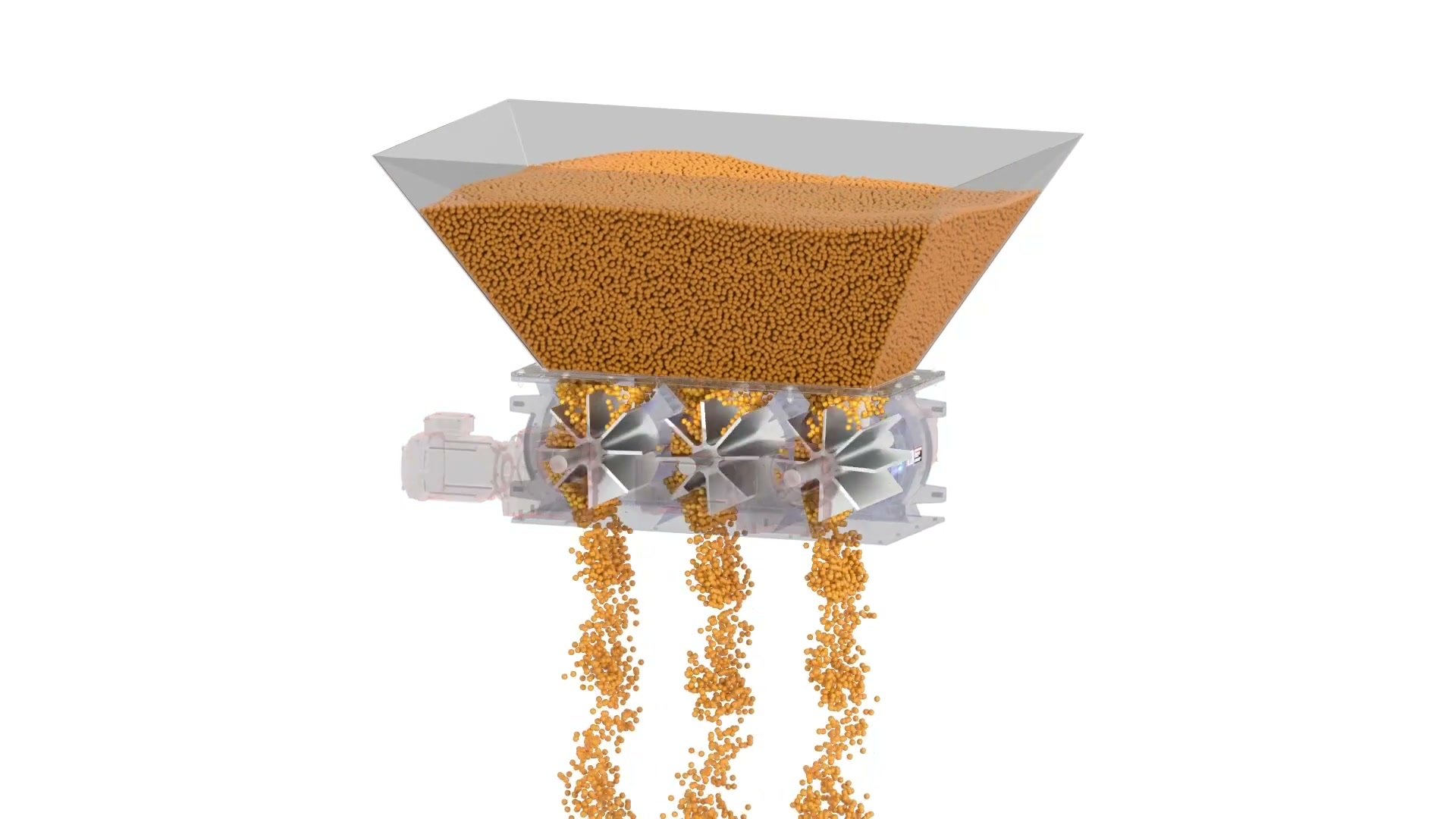
ACS Valves uses a 3D animation to explain a multi-compartment rotary-airlock arrangement for high-volume discharge duties with independent rotors and drives.
ACS Valves
ACS Quick Clean Rotary Valve Demonstration
In this 65-second ACS Valves clip, a presenter opens a Quick-Clean rotary valve without tools: handles release, the rotor and endplate slide out on RotorRail supports, and a locating key guides reassembly. What the demo establishes is physical access to the product-contact zone — cleaning validation and sanitary certification still depend on the supplied model and the site's procedure.

Airlock
Airlock: Dairy Standard Rotary Valves
Airlock video on the DCSR Version 2.0 rotary valve range (2T and 2TE): drop-through and blow-through configurations for feeding, metering, and pneumatic conveying, with a detachable rotor and end cover for cleaning access in dairy service.
Total reach: 20,553

Coperion
Coperion ZRD Rotary Valve for Powder Applications
Coperion presents the ZRD rotary valve and the design choices that adapt it to powder discharge, metering and pneumatic-conveying service.
Total reach: 10,376
DMN-WESTINGHOUSE
DMN-WESTINGHOUSE MZC-II Basic Inspection and Cleaning
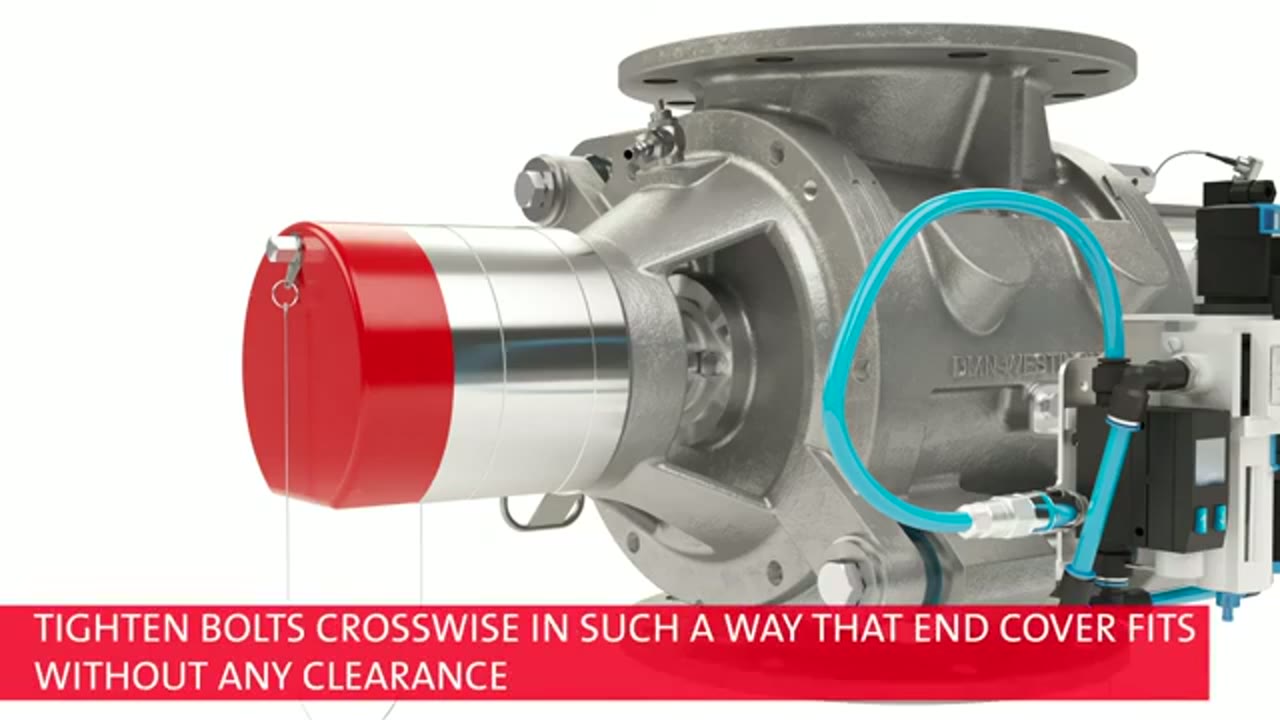
DMN-WESTINGHOUSE demonstrates the basic inspection and cleaning context for an MZC-II rotary valve and states the safety boundary for maintenance work.
Total reach: 2,204

Prater Industries
How To Select The Proper Rotary Airlock Valve
Prater Industries explains the process information engineers need before choosing and sizing a rotary airlock valve.
Total reach: 3,611

Kice Industries
Kice VJX Airlock Installation
Kice Industries demonstrates installation considerations for its VJX airlock at a dry-bulk process interface.

KREISEL Industries GmbH
Kreisel: Screw Pump vs. Rotary Valve
This video presents KREISEL rotary valves and the process duties that distinguish a rotary valve from alternative feeding equipment.
Total reach: 6,228