
Application
Valve and Airlock Selection for Plastics Processing
Answer in brief
In plastics processing the valve is where pellets get damaged and where static builds.
A rotary valve shearing a pellet produces streamers that block the line downstream, and a line full of charged pellets grounds itself through whatever is nearest.
- Avoid shear surfaces in pellet service wherever a gate will do.
- Ground and bond every metal part of the valve assembly.
- Treat regrind as a different material from virgin pellets.
Reviewed October 21, 2026
The problem
Pellets are tough and the equipment that handles them is not the problem. What is a problem is the gap. A pellet caught between a rotor tip and the housing is sheared, melted by friction and drawn out into a thread, and those threads build into the mats that plastics plants call streamers or angel hair. They collect at bends, at screens and at the throat of the extruder, and they block a line that was conveying perfectly a week earlier.
Static is the second issue and it is intrinsic. Pellets moving through a conveying line charge heavily, the charge accumulates on anything isolated, and a valve assembly with an ungrounded actuator bracket or a plastic sight glass becomes the discharge point.
Regrind changes the picture again. It is angular, inconsistent in size, often carries film, dust and the occasional metal fragment, and it jams clearances that virgin pellets pass without touching.
Desired outcome
A valve arrangement that moves the material without generating streamers, with shear surfaces avoided where the duty allows and minimised where it does not.
A fully bonded and grounded assembly, with the grounding treated as a tested item rather than as a wire that was once attached.
Clearances and openings sized for the worst material in the plan, which for most plants means the regrind rather than the virgin pellet.
A power or energy plant sets the same clearance differently, because a valve adjusted cold binds once the line reaches operating temperature.
Process approach
The first question is whether an airlock is needed at all. Under a silo or a bin discharging to atmosphere, a slide gate does the job with no rotating clearance and no shear surface. A rotary valve belongs where there is a real pressure difference to hold, typically feeding a dilute phase line or sitting under a filter.
Where a rotary valve is unavoidable in pellet service, the geometry is what reduces damage. A larger valve turning slowly, bevelled or adjustable tips and a reduced pocket count all lower the number of pellets that meet the clearance. Some plants accept a leakier valve for exactly this reason and make the conveying system carry the difference.
Grounding is then designed as a system. Every flange, the actuator, the drive and the frame are bonded, the continuity is measured at commissioning, and it is measured again, because a bonding strap that corrodes is indistinguishable from one that works until something ignites.
Regrind service is specified separately. Larger openings, more clearance, a magnet or metal detector ahead of the valve, and the acceptance that the valve will be inspected more often than the virgin line.
- Slide gate preferred wherever no pressure boundary is required.
- Rotary valve geometry chosen to reduce shear: larger, slower, bevelled tips, fewer pockets.
- Leakage penalty of a gentle rotor absorbed in the conveying design.
- Full bonding and grounding of the assembly, measured at commissioning and periodically after.
- Metal separation ahead of valves in regrind service.
- Clearances and openings sized for regrind, not for virgin pellets.
Selection factors
- Material form: pellets, powder, flake or regrind, each with a different failure mode at the same clearance.
- Need for a pressure boundary, which is the only reason to accept a rotating clearance in pellet service.
- Streamer sensitivity of the downstream process, since the cost of a blockage sets how much shear is tolerable.
- Static behaviour of the polymer and the grounding concept for the whole assembly.
- Explosibility of the fines and dust, which for many polymers is real even when the pellets are not a hazard.
- Contamination tolerance, which decides whether a wear part may shed into the product.
Common failure modes
- Rotary valve installed where a slide gate would have done, generating streamers for no gain
- Tight tip clearance chosen for leakage, with the blockages that follow treated as a conveying fault
- Actuator bracket or sight glass left unbonded, giving static a discharge point
- Grounding measured at commissioning and never again
- Regrind run through a valve sized for virgin pellets, so jams and wear arrive early
- Polymer dust explosibility ignored because the pellets themselves are not a hazard
Partner with powderbulkvideos.com
Put a relevant technical solution in this decision path.
Connect your company and video evidence with clearly labelled visibility where engineers evaluate this material, application, industry or product.
Frequently asked questions
What causes angel hair at a rotary valve?
Pellets caught in the clearance between the rotor tip and the housing. Friction melts the surface and draws it into a thread, and the threads collect at bends and screens until the line blocks.
Can a slide gate replace an airlock?
Where there is no pressure difference to hold, yes, and it is the better choice because there is no rotating clearance to shear pellets. An airlock is only needed when air has to be kept out of the vessel above.
Is static really a safety issue with pellets?
Yes, through the dust rather than the pellets. The fines generated in conveying are explosible for many polymers, and a charged, isolated metal part next to that dust is an ignition source.
Related content
Continue exploring
Move from this page to the companies, videos and technical topics that add useful context.
Companies
Videos
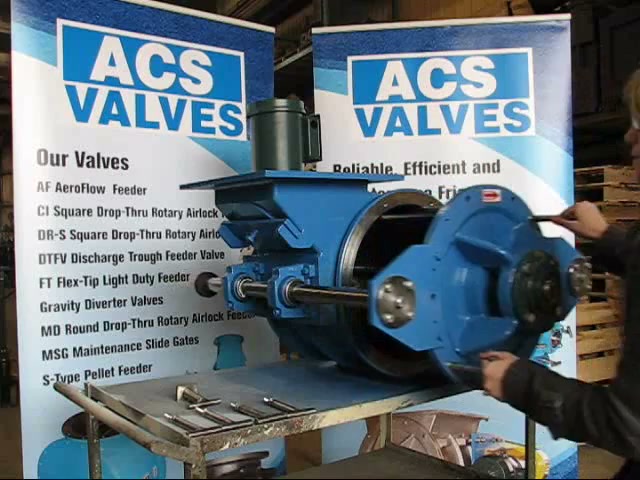
ACS Valves
ACS Quick Clean Rotary Valve Demonstration
In this 65-second ACS Valves clip, a presenter opens a Quick-Clean rotary valve without tools: handles release, the rotor and endplate slide out on RotorRail supports, and a locating key guides reassembly. What the demo establishes is physical access to the product-contact zone — cleaning validation and sanitary certification still depend on the supplied model and the site's procedure.
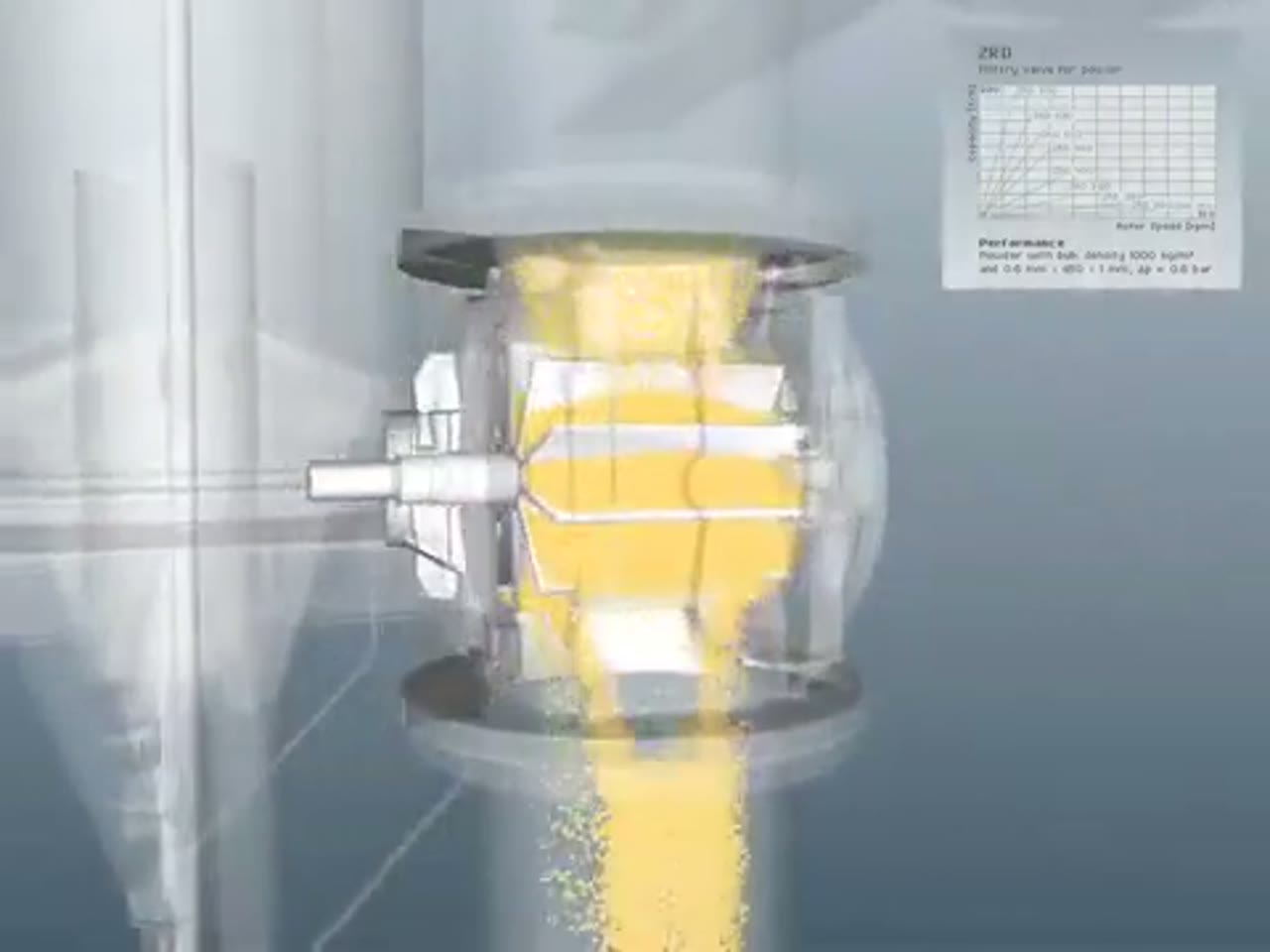
Coperion
Coperion ZRD Rotary Valve for Powder Applications
Coperion presents the ZRD rotary valve and the design choices that adapt it to powder discharge, metering and pneumatic-conveying service.
Total reach: 10,524

Vortex – Solids & Bulk Handling Components
Vortex®: Orifice Slide Gate Valve
Vortex's video presents the Orifice Slide Gate Valve: a linear blade carries a machined orifice that moves into or out of alignment with the process connection to isolate or regulate dry-bulk flow.
Total reach: 68,292