
Industry
Plastics
Answer in brief
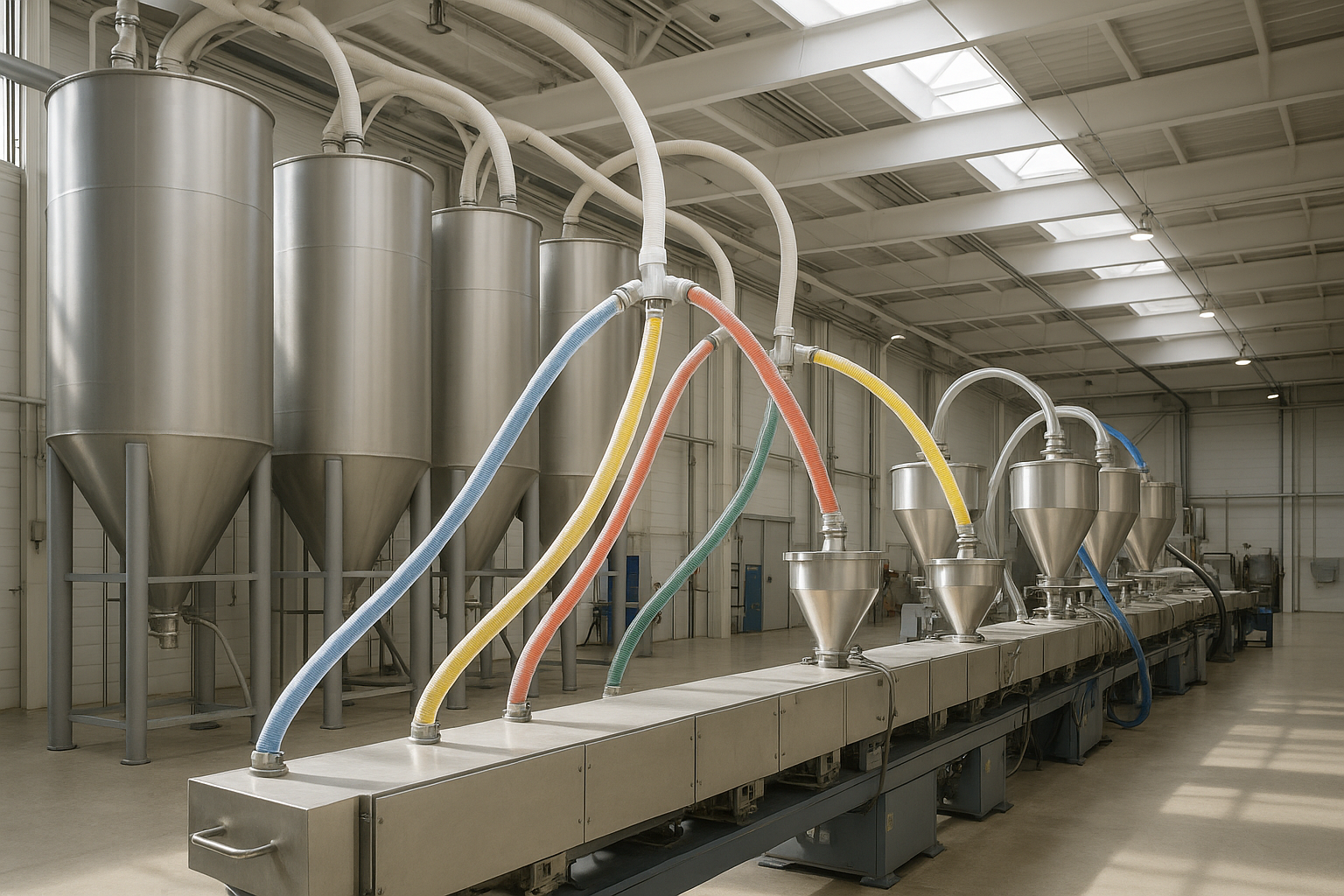
Plastics processing moves polymer pellets, regrind, powders and additives from silos and bulk bags to dryers, blenders and processing machines. System selection balances gentle conveying that limits dust and streamers, moisture control for hygroscopic resins, accurate additive dosing and contamination-free material changes.
Reviewed August 13, 2026 · Updated October 11, 2026
Sponsored visibility
Featured Plastics videos
Paid placements are clearly marked and remain separate from the editorial related-video selection.
Process challenges
Material challenges
Hygiene requirements
Safety requirements
Regulatory context
Partner with powderbulkvideos.com
Put a relevant technical solution in this decision path.
Connect your company and video evidence with clearly labelled visibility where engineers evaluate this material, application, industry or product.
Related content
Continue exploring
Move from this page to the companies, videos and technical topics that add useful context.
Companies


Videos

Gericke AG
Gericke: GUC-F Feeding and Dosing Controller
This video presents the Gericke GUC-F Feeding and Dosing Controller, a multi-channel control system designed for precise feeding, dosing, and weighing tasks in powder and bulk solids processing. The controller supports demanding process requirements across a wide range of industries where accuracy, reproducibility, and process transparency matter.
Total reach: 3,530

Hosokawa Solids Solutions GmbH
Hosokawa Solids: Turnkey solutions for bulk solids handling processes
Hosokawa Solids presents integrated bulk-solids handling systems in a turnkey project context.
Total reach: 36,944

HS Umformtechnik GmbH
HS Umformtechnik Company Video
HS Umformtechnik presents large-radius pipe bends, pipe couplings and branch pipes for pneumatic conveying systems.
Total reach: 6,271

Gericke AG
Nibbler and Deagglomerator Gericke GNB
Gericke's video explains the operating and cleaning concept of the GNB coarse grinder and deagglomerator: a low-speed paddle-and-screen arrangement works lumps down to size, and the unit opens for inspection. Particle size, capacity, heat input and wear still require representative material testing.
Total reach: 3,145

KREISEL Industries GmbH
Kreisel: Screw Pump vs. Rotary Valve
This video presents KREISEL rotary valves and the process duties that distinguish a rotary valve from alternative feeding equipment.
Total reach: 6,225

Netter Vibration
Netter Vibration: Efficient packaging – cost reduction and quality improvement with vibrating tables
NetterVibration presents low-profile vibrating tables for package settling and compaction where installation height is constrained.
Total reach: 102,937

RETTAR
RETTAR: 3D Radar Scanner
RETTAR presents its 3DPro2300 3D radar scanner in this video.
Total reach: 19,802

F.lli Sacchi S.n.c.
Smart Pick – Fully Automated Bag Emptying and Processing of Complex Recipes
The video shows the F.lli Sacchi SmartPick robotic bag emptying system. A robot selects bags from pallet stations, presents them to a cutting and emptying station, and supports recipe controlled ingredient handling.
Total reach: 23,040