
Material
Coffee Beans & Ground Coffee
Answer in brief
Roasted coffee is two materials in one plant, and they fail in opposite ways.
Whole beans are brittle and break into fines that block screens and change extraction; ground coffee is cohesive, oily and gives off carbon dioxide for days after grinding.
- Convey beans slowly and in dense phase, because velocity is what breaks them.
- Treat degassing as a design input for silos, valves and packaging.
- Keep oxygen and moisture away from both forms, since aroma loss is irreversible.
Reviewed October 21, 2026 · Updated November 10, 2026
Handling challenges
A roasting plant conveys the same product twice in two completely different states, and most handling problems come from treating them alike.
Beans break, and broken beans cost twice
Roasted beans are porous and brittle, and the damage is done by velocity rather than by the machine type.
In a dilute phase line at 25 metres per second, beans arrive chipped and accompanied by fines that were saleable product a moment earlier.
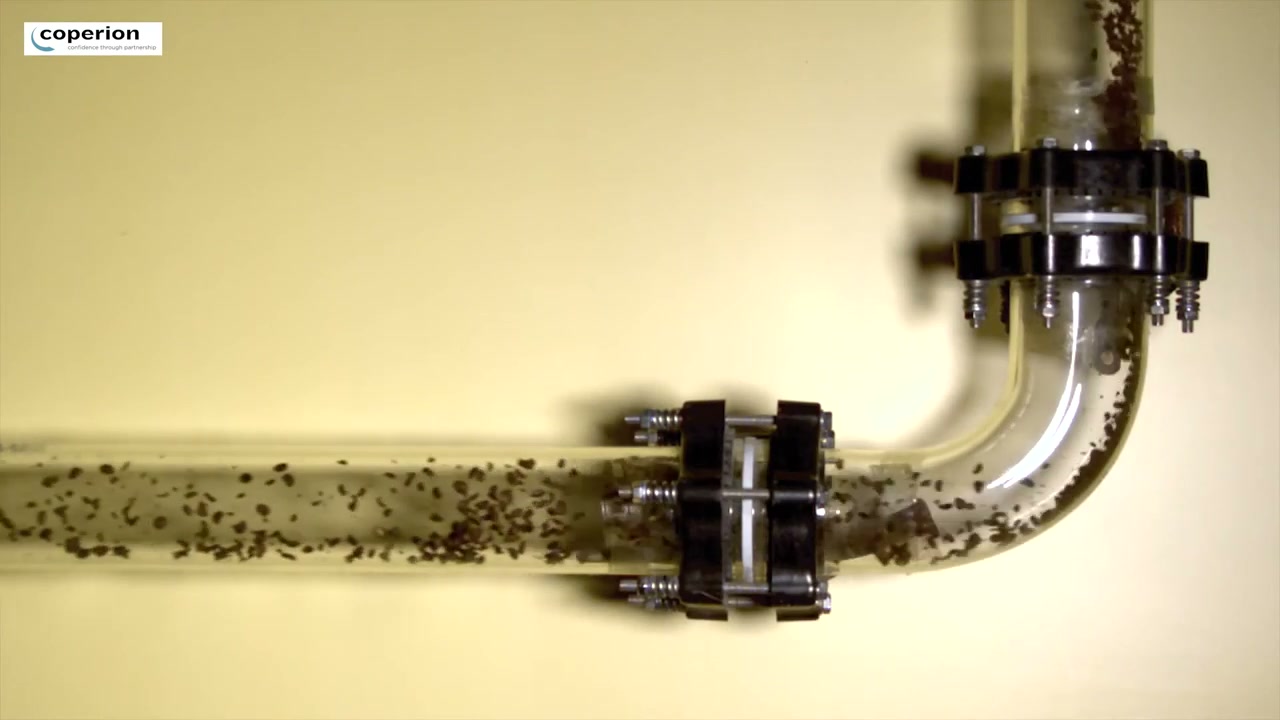
Dense phase conveying at low velocity, gentle bends with generous radius and soft let-down into silos keep the bean population intact.
- Check the fines fraction before and after the conveying line, not only at the end of the process.
- Avoid sharp deflector plates in bends, which concentrate impact at one point.
- Limit free fall into silos, where the first beans hit steel and later beans hit each other.
Degassing is a process condition, not a nuisance
Roasted coffee releases carbon dioxide for days, and the gas has to go somewhere.
In a closed silo the gas accumulates and can displace oxygen, which makes confined space entry a serious hazard, and in packaging it causes bag swelling if the product is sealed too early.
Degassing time, silo venting and the sequencing between grinding and packing belong in the plant design rather than in operating practice alone.
Ground coffee behaves like a fat-bearing powder
Grinding exposes coffee oil, and oil makes the powder cohesive, sticky on walls and prone to bridging in small hoppers.
Fine grinds for espresso are markedly more cohesive than filter grinds, so one hopper geometry rarely suits the whole product range.
Keep the residence time in ground form short, because the same oil that causes sticking also oxidizes.
Dust, fines and explosion risk
Coffee dust from grinders, silos and dust collectors is combustible, and roasting plants also deal with hot material and chaff.
Smouldering chaff from the roaster is a documented ignition route into downstream equipment, which makes separation, spark detection and collector protection worth reviewing together.
What to establish before buying equipment
- Acceptable fines percentage after conveying, measured by sieve and agreed with the supplier.
- Bulk density for whole bean and each grind, which differ by a factor of roughly two.
- Degassing rate and the venting route for every closed vessel.
- Explosion characteristics of the grinder and collector dust, not of the bean.
Storage and conditioning
Roasted coffee degasses, and that single fact shapes the storage.
Freshly roasted beans release carbon dioxide for days. In a closed silo that builds pressure and displaces oxygen; in a sealed package it bursts the bag. The aroma that is the product also leaves, which is why storage time is a quality variable.
- Vent degassing silos deliberately and treat them as a confined space with a depleted atmosphere.
- Keep ground coffee cold and sealed; it loses aroma far faster than whole beans.
- Protect beans from moisture and from fat migration in blends containing oily beans.
What this means for equipment
Beans and ground coffee are two different handling problems in one plant.
Beans flow freely and chip at impacts. Ground coffee is fine, cohesive, oily and aerates, so it floods when fresh and bridges when settled.
- Gentle transfer for beans: low drops, cascade chutes, no high-velocity pneumatic line.
- For ground coffee, a deaeration volume, a generous outlet and gravimetric dosing.
- Closed transfer throughout, because aroma loss is a product loss.
Safety and regulatory
Coffee dust is explosible and the degassing creates an atmosphere hazard.
- Explosion protection on grinders, filters and silos, from measured values.
- Atmosphere testing before entry to any degassing vessel; carbon dioxide displaces oxygen silently.
- Dust capture at grinding and packing, where the fines concentrate.
Material behavior
- Flowability
- Beans free flowing, ground coffee cohesive
- Abrasiveness
- Low
- Cohesiveness
- Low for beans, moderate to high when ground
- Moisture behavior
- Hygroscopic; pickup causes staling and clumping
- Contamination risk
- Flavor carryover between varieties and decaf lines
Partner with powderbulkvideos.com
Put a relevant technical solution in this decision path.
Connect your company and video evidence with clearly labelled visibility where engineers evaluate this material, application, industry or product.
Frequently asked questions
Why is a coffee silo a confined space risk?
Because roasted beans release carbon dioxide for days. It displaces oxygen in the headspace without any warning sign, so the atmosphere has to be tested before entry.
Why does ground coffee flood and bridge?
It is fine, oily and aerates during filling, so it runs like a liquid at first and consolidates afterwards. A design for one state fails in the other.
Does handling affect quality?
Yes. Aroma is the product, and every open transfer loses some. Closed handling is a quality measure as much as a dust measure.
Related content
Continue exploring
Move from this page to the companies, videos and technical topics that add useful context.
Companies
Videos
Coperion
Dense Phase Conveying of Coffee Beans
Coperion shows dense phase conveying applied to coffee beans, where the point of the method is to move a fragile product without damaging it.
Total reach: 7,963

Coperion
E-finity Continuous Dense Phase Conveying
Coperion presents E-finity, a continuous dense phase conveying system for fragile granular and pelleted materials that monitors pressure and corrects the airflow during the run.
Total reach: 1,904