Application
Gentle Dense Phase Conveying for Fragile Products
Answer in brief
Dense phase conveying often reduces impact damage to fragile particles because it runs at lower gas and particle velocities than dilute phase transport. It is not automatically gentle: material behavior, flow mode, feed control, pipeline geometry and the number of transfers decide whether the finished system actually protects the product.
Reviewed July 26, 2026 · Updated October 9, 2026
The problem
Conveying performance, product condition and equipment life depend on the interaction between the material, gas, pipeline and operating sequence. A generic technology label is not enough to approve the duty.
Desired outcome
A stable transfer that reaches the required capacity while keeping breakage, surface abrasion and fines generation within a measured product acceptance limit.
Process approach
Fragile granules, pellets and agglomerates can lose value when conveying creates chips, fines or a changed particle size distribution. The damage can affect appearance, dissolution, flow, dust generation and the performance of the next process step.
Why lower velocity can help
Particle damage in pneumatic conveying is strongly connected to collision energy. Published experimental and modeling work shows that particle impacts, especially at bends, are important degradation mechanisms. Dense phase operation often lowers gas and particle velocity, which can reduce severe impacts.
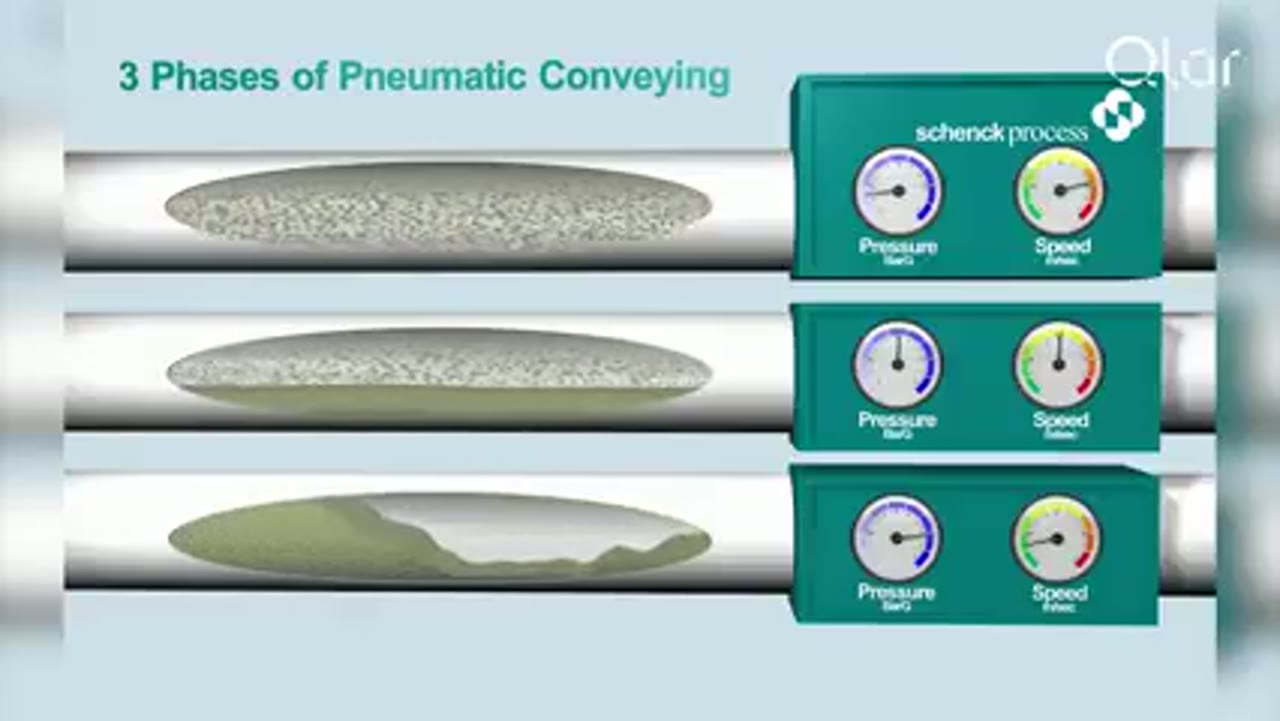
That advantage has limits. Dense phase material may move as plugs, slugs or a moving bed. Sliding contact can create surface attrition, while an unstable plug can produce pressure fluctuations, sudden acceleration or blockage. The engineering question is therefore not whether dense phase is gentle in general. It is whether the selected flow mode is gentle for the actual product and route.
Characterize the product before selecting equipment
Record the initial particle size distribution, shape, bulk density, moisture and mechanical strength. State which property must be protected and how it will be measured. A verbal requirement such as minimal damage cannot serve as an acceptance criterion.
Material state matters. Storage time, temperature, moisture and prior handling can change strength or flow behavior. Test samples should represent normal production variation rather than an ideal laboratory sample.
Evaluate whether dense phase flow is feasible
Research on pneumatic conveying behavior shows that particle size distribution, permeability and air retention influence the flow modes a material can support. Some free flowing materials can form plugs or slugs. Fine materials with suitable air retention may move as a fluidized dense bed. Other materials may not support stable dense phase transport.
A conveying trial should identify the stable operating region. Record mass flow, pressure behavior, gas use, restart performance and material condition. A single successful transfer does not define a complete operating envelope.
Design the route around product protection
Minimize unnecessary bends and sudden changes in direction. Review feed points, boosters, valves and the final approach to the receiver because local acceleration can defeat the benefit of a low average velocity. Bend radius and geometry should be part of the product protection review.
The receiving stage also matters. A gentle pipeline can still damage product through a high speed entry, a hard target surface or an unsuitable discharge device. Follow the particles from source to final destination.
Write a measurable acceptance test
Take controlled inlet and outlet samples across repeated cycles. Compare the agreed quality measures and record the system settings. Include normal startup, steady operation, a controlled stop and restart. If segregation matters, sample at more than one point in the receiving batch.
The accepted configuration should identify material condition, route, pipe size, pressure, air settings, feed rate and bend arrangement. Future changes can then be reviewed against a known baseline.
Engineering visual guide
How the system behaves
These conceptual diagrams connect the operating principle, equipment internals and engineering review points. They are explanatory and not fabrication drawings or a substitute for project-specific calculations.
Engineering infographic
Source-to-destination process flow
Conceptual source-to-destination process flow for Gentle Dense Phase Conveying for Fragile Products; use it to structure an engineering review, not as a fabrication drawing or project-specific design.
Selection factors
Particle size distribution, particle strength, shape, bulk density, permeability, air retention, moisture, required rate, route, lift, bend geometry, feed arrangement, receiving vessel and the permitted change in product quality.
Engineering infographic
Engineering input and decision path
Conceptual engineering input and decision path for Gentle Dense Phase Conveying for Fragile Products; use it to structure an engineering review, not as a fabrication drawing or project-specific design.
Common failure modes
- Selecting dense phase from a label rather than a material test
- Unstable plugs or a blocked pipeline
- High local velocity at feed points and bends
- Excessive sliding attrition
- Segregation or fines generation
- Applying test results to a different material condition
Engineering infographic
Fault recovery and acceptance workflow
Conceptual fault recovery and acceptance workflow for Gentle Dense Phase Conveying for Fragile Products; use it to structure an engineering review, not as a fabrication drawing or project-specific design.
Partner with powderbulkvideos.com
Put a relevant technical solution in this decision path.
Connect your company and video evidence with clearly labelled visibility where engineers evaluate this material, application, industry or product.
Frequently asked questions
Is dense phase conveying always gentler than dilute phase conveying?
No. Lower velocity can reduce high energy impacts, but sliding contact, unstable plugs, bends and unsuitable material behavior can still damage a fragile product.
How should particle damage be measured?
Compare representative inlet and outlet samples using agreed measures such as particle size distribution, fines fraction, visual breakage, bulk density or another product quality test.
When is a conveying trial necessary?
A representative trial is prudent when breakage limits matter, the material has not been conveyed before, or published correlations do not cover the actual powder and route.
Related content
Continue exploring
Move from this page to the companies, videos and technical topics that add useful context.
Companies