
Material
Polysilicon
Answer in brief
Polysilicon is priced on purity measured in parts per billion, so the handling system is judged by what it adds, not by what it moves.
Every steel surface the material touches is a contamination source, and every drop creates fines that carry the largest surface area per gram.
- Use non-metallic or lined contact surfaces throughout.
- Minimise impacts, because fines concentrate contamination.
- Treat the reclaimed powder as a product, not as waste.
Reviewed October 21, 2026 · Updated November 10, 2026
Handling challenges
In polysilicon the usual priorities invert: throughput is easy, purity is everything.
Contact material decides the value
Iron, chromium and nickel picked up from a chute wall travel into the ingot and reduce cell efficiency.
- Polymer, quartz or ceramic liners on every contact surface.
- No bare steel fasteners, edges or inspection covers in the product path.
- Documented liner wear checks, since a worn liner exposes the steel beneath.
Breakage and fines
Silicon is hard and brittle, so impacts produce sharp fines with a very high surface area.
Those fines both carry contamination and are combustible, which makes the reclamation system a safety item as well as a yield item.
Powder reclamation
Fines generated in crushing and handling have real value if they are collected cleanly.
Closed vacuum conveying into dedicated containers keeps the reclaimed powder within specification rather than mixing it with plant dust.
Cleanroom discipline
Packing is usually done in a controlled environment with gloves, liners and sealed bags, and the handling equipment has to fit that regime rather than fight it.
What to establish before buying equipment
- Purity specification and the acceptable metallic pickup per transfer.
- Liner material and its wear and particle shedding behavior.
- Fines target and the reclamation route.
- Explosion protection for the fines collection system.
Storage and conditioning
Polysilicon is handled for purity above everything else.
Any contact with ordinary metal adds contamination that the downstream process cannot remove, so the storage containers, the gloves and the tools are part of the specification.
- Dedicated, non-metallic or lined contact surfaces throughout.
- Controlled environment: particles from the room become contamination in the product.
- Segregate grades rigorously; mixing them downgrades the better one.
What this means for equipment
Everything is chosen to avoid adding anything to the material.
Chunks are hard and sharp enough to abrade ordinary equipment, and whatever they abrade ends up in the product. That makes lined or non-metallic surfaces normal and makes gentle handling a purity measure.
- Lined or non-metallic contact surfaces, verified rather than assumed.
- Low drop heights to limit both breakage and abrasion of the equipment.
- Closed transfer to keep room particles out.
Safety and regulatory
Fine silicon powder is combustible and the chunks are a mechanical hazard.
- Explosion protection where fines are generated, such as crushing and sizing.
- Cut protection for anyone handling chunks.
- Respiratory protection where fines are produced; the respirable fraction matters.
Material behavior
- Flowability
- Chunks free flowing, powder cohesive
- Abrasiveness
- High; silicon is harder than most liner materials
- Cohesiveness
- Low for chunks, high for fine powder
- Moisture behavior
- Surface moisture promotes oxidation and particle adhesion
- Contamination risk
- Metallic contamination from any bare steel contact
Partner with powderbulkvideos.com
Put a relevant technical solution in this decision path.
Connect your company and video evidence with clearly labelled visibility where engineers evaluate this material, application, industry or product.
Frequently asked questions
Why are contact surfaces so important?
Because any metal the material abrades becomes contamination that the downstream process cannot remove. The lining is part of the product specification.
Does handling damage polysilicon?
It generates fines and it abrades the equipment. Both matter: the fines are a hazard and the abrasion is a purity problem.
Is silicon dust explosible?
Fine silicon powder is, yes. Protection belongs wherever fines are generated, particularly at crushing and sizing.
Related content
Continue exploring
Move from this page to the companies, videos and technical topics that add useful context.
Companies

Videos

VAC-U-MAX
VAC-U-MAX: Signature Series Packaged Vacuum Conveying Systems
With over 65 years of experience in pneumatic conveying and more than 10,000 powders and granular materials handled, VAC-U-MAX packages its Signature Series vacuum conveying systems as complete units: receiver, UL-listed controls, convey hose, filters, and vacuum producer.
Total reach: 10,827
Volkmann GmbH
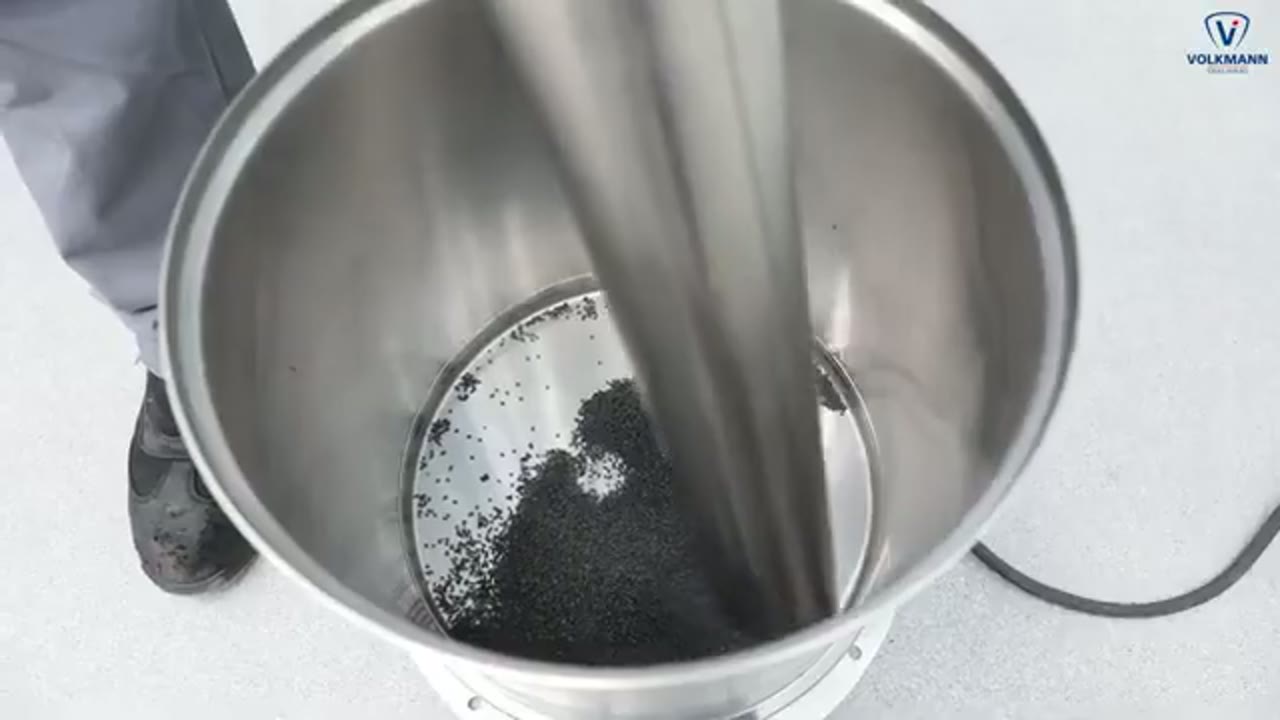
Suction lance for powder feeding
The Volkmann video shows powder being introduced from a drum or container through a suction lance into a vacuum conveying line. It shows the pickup boundary and the need to admit material and conveying air in a controlled way. Capacity and suitability depend on the powder and need a conveying trial with the actual material.
Total reach: 1,929